Archive for the 'Progress Notes' Category


A New Diagnosis or a Re-Diagnosis?

From my Substack last summer

Walter Williams is a thin man with a mild demeanor. I met him in his home for a Medicare Wellness Visit. He was considering becoming a patient for primary care with us. He had a dramatic history of a couple of strokes with right sided paralysis lasting up to 24 hours without any remaining weakness. He also told me he had had several TIAs, transient ischemic attacks, between his strokes.

He lives in an area with minimal cell phone service and he has no internet in his home. He told me he’d had lots of CT scans that didn’t show anything. He didn’t think he’d had an MRI, but he was now scheduled for one because he had hearing loss in only one ear, which always makes you worry about an acoustic neuroma.

I asked him and his son to describe the spells to me. They always involved the right side of his body. The strokes involved the right side of his face as well as his right arm and leg and had lasted a day or more. The shorter spells usually involved only weakness of the right side of his face.

His neurological exam was normal except for numbness in his left 4th and 5th finger, which suggested that the ulnar release at the elbow he had several years ago had failed. He also had mild weakness in all the fingers of his left hand suggesting carpal tunnel syndrome.

“I’d like to get into the Maine Health InfoNet and look at all your hospitalizations, emergency room visits and x-rays you’ve had done. Then I’ll need to think about all this and come back to make a recommendation on what we should do next. Would that be all right with you”, I asked.

He agreed, and back home I pored over his big online dossier.

He had undergone two CT angiograms of the blood vessels in his neck and brain which were both normal. And two brain CTs were also normal. When his brain MRI then came in, it showed no acoustic neuroma and also no sign of a prior stroke.

It made no sense to me that someone could have several strokes with full recovery and TIAs with negative angiograms and brain MRI imaging. This had to be purely neurological and not vascular.

In my mind, this left only two options that could explain his symptoms, complicated migraine or some sort of seizures. I googled my question whether you could see paralysis during a seizure. The answer i found listed in my search was Todd paresis, something I had not heard of, but certainly matched his symptoms, multiple episodes of one-sided full or partial weakness lasting up to a few days and resolving completely on its own.

In follow-up I zeroed in on whether he’d experienced any kind of headache with his neurological episodes. He had , but not severe and only some of the time. As far as seizures went, most TIA and stroke-like episodes had occurred when he was alone, but his son had once or twice seen his father act a little spacey before the right sided facial weakness developed. He had certainly never had anything like a grand mal seizure. In my reading I saw that the seizure that precedes the paresis can sometimes be very subtle.

I explained my differential diagnosis to the two of them.

“The first time, when I was in the hospital in Boston, they put me on a seizure medicine, but I’m not sure why”, Walter said. “I took it for a few years but when my wife died and I moved up here, I stopped all my medications”.

“Why was that”, I asked.

“I went through a severe depression”, he answered.

“Did they do an EEG, where they put stickies and wires on your head, while you were in Massachusetts General”, I asked.

“No, I never had that done”, he answered.

I told him I’d like to order such a test and he agreed. It may be normal, and if so, I would probably still offer him a trial of seizure medications while we wait for a neurology consultation, which can take many months to get here in Maine.

I will also try to get the records from MGH to see if they made the diagnosis of Todd paresis on just the clinical history the way I am now considering, years later. A diagnosis made, lost and rediscovered?

(Why does this country have such fragmented medical records?)

This case was one of the first times I used my practice’s subscription to RubiconMD, a text based curbside consultation service with every imaginable specialty and subspecilty. Within less than an hour, I had my diagnosis confirmed and a solid treatment suggestion, the anti-seizure medicine Keppra (levetiracetam).

Curbside Consults by Subscription

Beyond Good and Evil: Nietzsche Foresaw the Übermenschen of Today

I was in a science track on my way to medical school so my philosophy education was not in-depth. But I am rereading Nietzsche and thinking OMG…

I have been with Blinkist for many months now and really enjoy listening to their book summaries when I’m resting or driving. Sometimes, after listening to a summary there, I will buy the book on audible or in print. This is what happened after I listened to Nietzsche’s Beyond Good and Evil. I just opened the package that came last week. It’s a small, hard cover volume that looks old, even though it is brand new. 

Here’s Google’s AI summary (I just realized it is more than a little different every time I come back to it…) of the central ideas in Nietzsche’s Beyond Good and Evil. I have to say it sounds a lot like some of what is going on today with the widening gaps in resources and influence between the elite and the masses, whose opposite moralities he calls “master morality” and “slave morality”. 

I really do think our culture has moved exactly where Nietzsche predicted and wanted it to go.

“The central idea in Nietzsche’s “Beyond Good and Evil” is that traditional morality, with its rigid classifications of “good” and “evil,” is flawed and should be rejected, as there are no universal truths and individuals should instead strive to create their own values based on their unique perspective and will to power, essentially going “beyond good and evil.”. 

Key points about this central idea:

Critique of established morality:

Nietzsche criticizes philosophers for blindly accepting traditional moral systems, arguing that they are often based on the perspective of the weak and resentful, rather than the strong and creative. 

Will to Power:

A core concept where individuals are driven by an inherent desire to dominate and express their own power, which can be seen as a force beyond conventional morality. 

Perspectivism:

Nietzsche argues that all truths are subjective and depend on the individual’s perspective, meaning there is no single “correct” morality. 

The “Noble Soul”:

Nietzsche envisions a higher type of person who embraces their own will to power and creates their own values, rising above the herd mentality.”

https://open.substack.com/pub/hansduvefeltmd/p/beyond-good-and-evil-nietzsche-foresaw?r=254ice&utm_campaign=post&utm_medium=web&showWelcomeOnShare=false

Boy, Have I Seen Measles

The news about measles in Texas brought back memories from when I worked at the Student Health Center at the University of Maine in Orono back in the early 90s. We had a significant outbreak then. Just about all the students who got sick had been vaccinated as young children and had mild symptoms. The rashes were fairly subtle in some of them. Our nurses and my physician colleagues often called on me to help confirm the diagnosis, since I was the only one who had ever seen a case, in fact several, during medical school and residency in Sweden 1974-1981

Sweden got its first measles vaccine in 1971, but it wasn’t widely adopted. In 1982, a two dose regimen was introduced, combined with the mumps and rubella vaccines (MMR).

In the US, the first measles vaccine was introduced in 1963, followed by an improved version in 1968.

After a big measles outbreak among vaccinated school children here in 1989, two doses were recommended and the MMR was introduced.

Since I was born before 1957, I am presumed immune to all the common childhood viruses we are now vaccinating against. The philosophy then was, get it over and done with, so children were purposely exposed to sick children, especially chicken pox. These occasions were called “pox parties”. I remember being told, both before and during medical school that it would be good to get mumps before puberty and especially before adulthood, because mumps sometimes doesn’t just affect our large parotid salivary glands but also a man’s testicles (ouch).

Here’s a piece I wrote in 2014 about illnesses with rashes:

A Rash of Rashes

THE BACK STORY: Invisible Ties

Invisible Ties

Read the back story here:

https://acdw.substack.com/p/the-back-story-invisible-ties

Hyposkillia, a Widespread Clinician Affliction

I think it was Adam Cifu who made me curious to read more of Dr. Herbert L. Fred’s writings. It was one word that started me on this journey, a brand new word, minted in 2005: “Hyposkillia, Deficiency of Clinical Skills”.

Many forces have created this modern epidemic. The availability and reliance on advanced imaging and more or less affordable laboratory panels have replaced old fashioned history taking and physical exam skills. The corporate demands on physicians’ time have de-prioritized our cognitive skills. It is faster to order a bunch of tests than to take a thorough history and physical exam, and the tests we order instead are fueling the big business of the healthcare industry.

I remember during my Swedish internship I was called down to see the Chief of Radiology. “Duvefelt, you’re ordering too many x-rays”, he said. Our hospital didn’t have a CT scanner yet, so this was not about very expensive tests. His concern was mostly my orders for simple chest x-rays. I also remember learning physical exam skills at Uppsala University, taught by older pulmonologists, who could predict what a chest x-ray would look like after their thorough physical exam with inspection, palpation, percussion and auscultation.

Dr. Fred didn’t really think in 2005 that it would be possible to turn the clock back to when doctors practiced Oslerian bedside medicine. He thought that the skill set, particularly among generalists, had already been lost. And now we are twenty years further down this path.

The only place where that skill set may be called for is perhaps the kind of practice I am in, housecalls and telemedicine for patients who have great difficulty leaving their homes for CT scans, MRIs, echocardiograms and EEGs.

Telemedicine in general may also be an area where a physician’s history taking skill is getting better recognition. I wrote about this on KevinMD five years ago in the early months of the COVID pandemic.


I just realized none of the posts show on an iPad or a computer, but they do show on an iPhone. WordPress is working on this. In the meantime, please visit my Substack.


Osler said “Listen to your patient, he is telling you the diagnosis”. Duvefelt says “Listen to your patient, he is telling you what kind of doctor he needs you to be”.


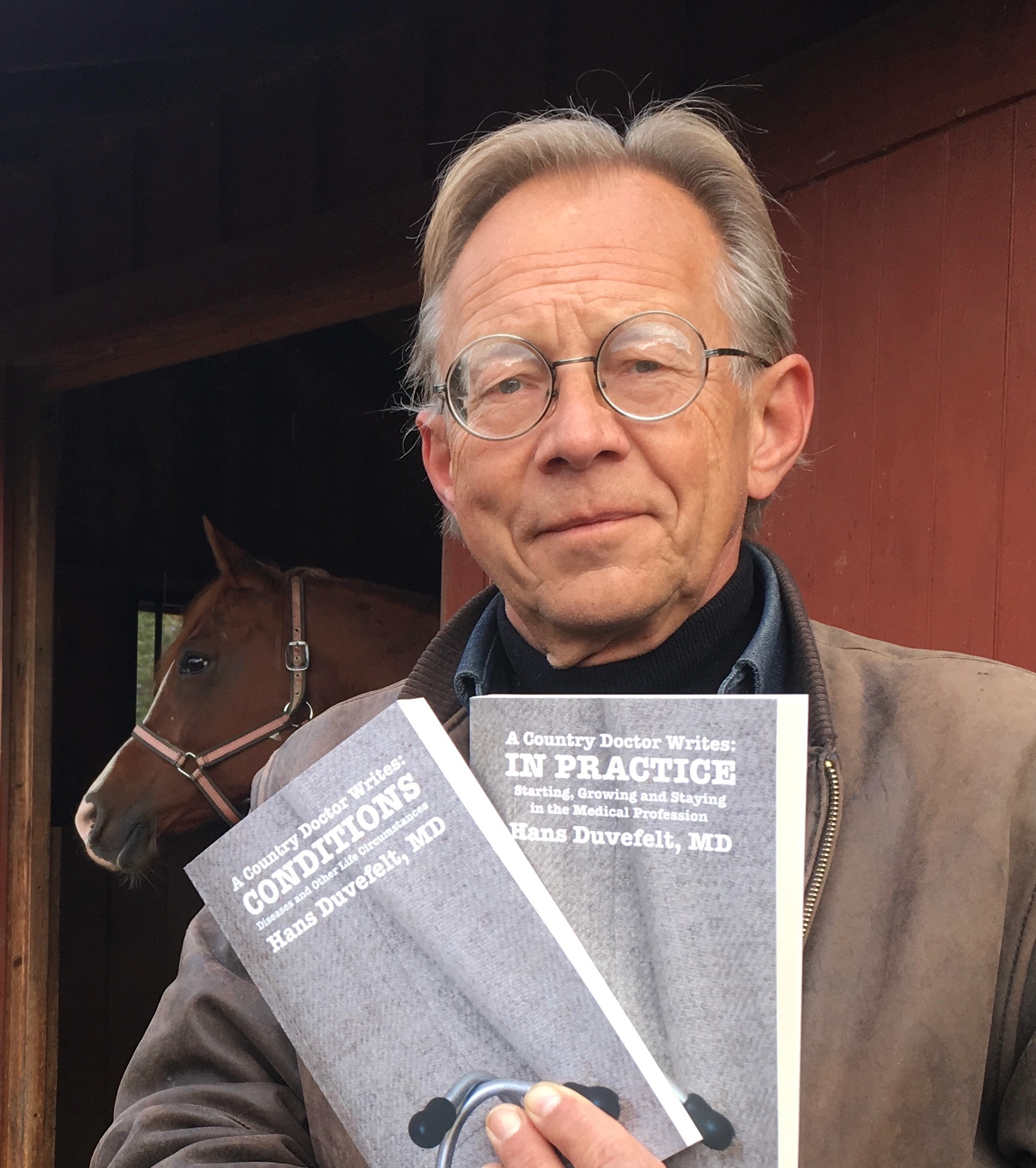
BOOKS BY HANS DUVEFELT, MD

CONDITIONS, Chapter 1: An Old, New Diagnosis

Top 25 Doctor Blogs Award

Doctor Blogs

Enter your email address to subscribe to this blog and receive notifications of new posts by email.

Mailbox

contact @ acountrydoctorwrites.com
Bookmark and Share
© A Country Doctor Writes, LLC 2008-2022 Unauthorized use and/or duplication of this material without express and written permission is strictly prohibited. Excerpts and links may be used, provided that full and clear credit is given.