Archive for the 'Progress Notes' Category


American Telemedicine Has Gone Viral

It took a 125 nanometer virus only a few weeks to move American healthcare from the twentieth to the twenty-first century.

This had nothing to do with science or technology and only to a small degree was it due to public interest or demand, which had both been present for decades. It happened this month for one simple reason: Medicare and Medicaid started paying for managing patient care without a face to face encounter.

Surprise! In the regular service industries, businesses either charge for their services or give certain services away for free to build customer loyalty. In healthcare, up until this month, any unreimbursed care or free advice was provided on top of the doctors’ already productivity driven work schedules.

None of the healthcare systems that employ physicians, if they were in their right mind, saw any great value in paying their doctors for giving away free advice virtually when they instead could haul patients into the office and make them spend hours as we delivered more “comprehensive” care with higher complexity at greater cost than our “customers” generally expected.

It took a worldwide health emergency to shift our view of the best use of physicians’ time, to rock an antiquated, bureaucratic, patient-unfriendly colossus out of its rut into reimagining what our patients really need from us.

I got an email from my bank this week, saying the lobby is closed but the drive-through, ATM, online and telephone services are still available and in the rare event that you really need to speak with a banker in person, you can request an appointment. Imagine that general principle at work in healthcare. A quarterly diabetic followup visit is mostly talking about the numbers, the diet, the exercise regime and the medications. The eye doctor does the eye exam and we do a foot exam once a year when there are no problems. Now that we can charge for doing that visit via telemedicine, it seems strange that it took so long to get there.

My lawyer charges for professional services regardless of venue. Why American healthcare insisted for a hundred years that a physician’s advice wasn’t worth anything unless delivered in person will go down as a quaint footnote in the history of medicine.

Depression in Modern Times: We Have Many Friends and Followers, But Low Perceived Social Support Scores Can Make Us Sick

Why is depression now the leading cause of disability worldwide? I have been thinking and reading about this more and more, and the theories are many, from genetics to what we ingest to general stress to smartphones.

It has all seemed a bit vague – until I came across the concept of Perceived Social Support (PSS) score. It is a way to consolidate and quantify all the effects our modern life seems to have on our mental health by looking inside ourselves before considering the nature of the external forces, which may differ from one person to another.

The Oslo Social Support Scale, perhaps the most concise rating scale, is a simple scoring system based on three questions. It was first used in research to make comparisons between recent immigrants and people born in Norway. Not surprisingly, a poor OSSS score was a predictor of poor mental health.

► Oslo 1: How many people are you so close to that you can count on them if you have great personal problems? (none (1), 1–2 (2), 3–5 (3), 5+ (4))

► Oslo 2: How much interest and concern do people show in what you do? (a lot (5), some (4), uncertain (3), little (2), none (1))

► Oslo 3: How easy is it to get practical help from neighbours if you should need it? (very easy (5), easy (4), possible (3), difficult (2), very difficult (1))

More recently, this simple scoring system has been used to quantify the risk that Adverse Childhood Events (ACE) will cause adult depression. A favorable Perceived Social Support score, PSS, (factual or not, our perception is what matters) can act as a buffer, or a resilience factor if you will.

Exposure to ACE was assessed using the ACE questionaire, which addresses 10 individual ACEs under three categories:

► abuse: emotional, physical and sexual abuse

► neglect: emotional and physical neglect

► household dysfunction: parental separation/divorce, violence against mother, household substance abuse, household mental illness and incarceration of household member.

A low PSS score may increase the risk of depression five-fold for people with a history of three or more Adverse Childhood Events according to a 2017 paper in the British Medical Journal:

(https://bmjopen.bmj.com/content/bmjopen/7/9/e013228.full.pdf)

Perceived Social Support is like a prism through which we interpret external factors, or like sets of filters for photographic effects – sepia, cold, warm or black and white.

The obvious conclusion to be drawn from the link between Perceived Social Support and mental health, drawn by many but perhaps not always so neatly explained and quantified, is to look at all the circles we belong to or may be able to join and see how we can contribute to those micro communities.

Because, and this is the magic of understanding PSS, when you offer yourself as a support or resource to others, you usually get multiples of your input in return from those you help.

As I finish writing this reflection, which I started outlining last month, the inevitable and obvious context becomes “Who will have the most severe mental health symptoms develop as a consequence of natural disasters and pandemics?” I think the PSS score is a good predictor here, too.

And, as I am right now in self quarantine while waiting for the results of my COVID-19 test, the obvious question isn’t how much Social Support I objectively have, but whether I feel I have enough.

Black Box Warnings: Time to Reconsider Our Disease=Drug Reflex?

The recent news of a black box warning for psychiatric side effects from the allergy drug Singulair (montelukast) reminded me of a patient I saw ten years ago. She wanted help getting off the hook from a shoplifting charge. The judge didn’t buy it.

It is a frightening thought that medications we prescribe to help people feel better emotionally can do the opposite: Antidepressants, for example, can bring on mania, suicidal or homicidal thoughts or actions and are now known to at least some of the time cause irreversible changes in “brain chemistry”.

It is even worse, in fact horrifying, to consider that psychiatric side effects can occur with medications we think of as allergy treatments (Singulair), antibiotics (Levaquin) or antivirals (Tamiflu), immunosuppressants (methotrexate or steroids), acne treatments (Accutane), Parkinson or restless leg treatments (Requip), blood pressure medications (beta blockers), drugs for smoking cessation (Chantix) and so many others. Not that these types of side effects are all terribly common, but they are common enough to have to be a concern.

It does make you pause. Medical providers have flash card style knowledge memorized: Disease = Drug to prescribe. This knowledge is ingrained, learned reflexes that bypass commonsensical, non-pharmaceutical approaches.

The longer I’m in this business, the more I think we need to consider the options in the space between symptom/diagnosis and prescription. It isn’t as uncharted or infertile as we may think and it is often safer and less loaded with inadvertent liability.

First, do no harm.

Hope is a Contagious Force of Healing

In our last Friends and Family group meeting, which we hold every two weeks to support our Medication Assisted Treatment (Suboxone) program, the word HOPE came up several times.

The first person to use the word apologized, saying it sounded so passive, but another person said it is a very powerful action word.

As the meeting progressed, other people chimed in about the importance of never giving up hope, even though they all had seen and dreaded relapses, any one of which could be fatal.

Wrapping up, we went around the room and everyone said what their takeaway was from the night and what their “homework” would be before the next meeting.

I said I was going to think more about hope and write something about it.

Theologically, the three virtues of Faith, Hope and Charity (Love) are viewed as having God both as their source, infusing them into us, and as their object. In this context, the opposite of Hope, Despair, is viewed as a sin.

Hope has been described as our intellect’s desire for something and our expectation that it will come about. It is a future oriented attitude and frame of mind, an optimistic outlook.

Faith is trust in what is here and now, perhaps something you attain further along your life’s journey than Hope.

With everything we now know of neurobiochemistry, psychoneuroimmunology, placebo effects and natural healing, most of us believe in the power of optimism. We also know that people with addictions struggle with self loathing in all its forms and that any expression of negative expectations from people around them can push them deeper into despair and further into chemical escape. They often have little hope for themselves and no faith in their here and now.

I believe Hope is a powerful emotion that can be contagious, transmitted, shared and multiplied when we claim it for ourselves and publicize it openly. It can be like a blood transfusion or a catalyst in a chemical reaction when we share it with those who have less of it or none at all.

For people who have a hard time believing in themselves and their own future, tangible expressions of hope from people who matter in their lives can change them, just like we all tend to smile when someone else looks happy, if we think of a trivial example. The same contagiousness exists for despair, as history has demonstrated many times from stock market crashes to pandemics to Jonestown.

Our patients’ or loved ones’ lives are on the line. We can’t be neutral; do we choose to carry Hope or Despair? It’s one or the other. The ones we care about can sense it in us and their success or failure may hinge on our innermost expectations.

As Physicians Today, We Must Both Represent the “System” and Disregard it

Healthcare today, in the broadest sense, is not a benevolent giant that wraps its powerful arms around the sick and vulnerable. It is a world of opposing forces such as Government public health ambitions and more or less unfettered market ambitions by hospitals and downright profiteering by some of the middlemen who stand between doctors and patients, such as insurers, Pharmacy Benefits Managers, EMR vendors and other technology companies.

Within healthcare there is also a growing, more or less money-focused sector of paramedicine, promoting “alternative” belief systems, some of which may be right on and showing the future direction for us all and some of which are pure quackery.

I stand by my conviction that physicians must embrace the role of guide for their patients. If we see ourselves only as instruments or tools in the service of the Government, the insurance companies or our healthcare organizations, patients are likely to mistrust our motives when we make diagnoses or recommend treatments.

On the other hand, if we work within the traditional healthcare system, we must strive to understand it well and present fairly the merits of the establishment’s usual approach to our patient’s problem. When our own educated opinion differs from mainstream medicine, it is our professional and ethical duty to tell our patients what we understand about their options and make it clear that this is not at this point in time the typical approach. I have done this for decades, warning patients that low fat diets promote heart disease by often inadvertently increasing intake of refined carbohydrates and telling patients that a Mediterranean diet has been shown to reduce heart attack risk at least as much as statin drug therapy. Medicine has always been an evolving science and to think it won’t continue to change is naive.

But if we disagree with everything conventional medicine does, we need to follow our conviction and move outside the system. If we do, we could be throwing the baby out with the bath water. And we could confuse and jeopardize patients by not informing them plainly enough that we aim to withhold accepted therapy because of our own dogmatism.

Our duty as guides is to walk with our patients in the direction they wish to go and to know more than one way of getting there; some people want the scenic route, others the fastest – some patients want better health with fewer medications and some want every intervention they can get.

It isn’t professional to only offer one approach if you know several. Let the patient choose.


I just realized none of the posts show on an iPad or a computer, but they do show on an iPhone. WordPress is working on this. In the meantime, please visit my Substack.


Osler said “Listen to your patient, he is telling you the diagnosis”. Duvefelt says “Listen to your patient, he is telling you what kind of doctor he needs you to be”.


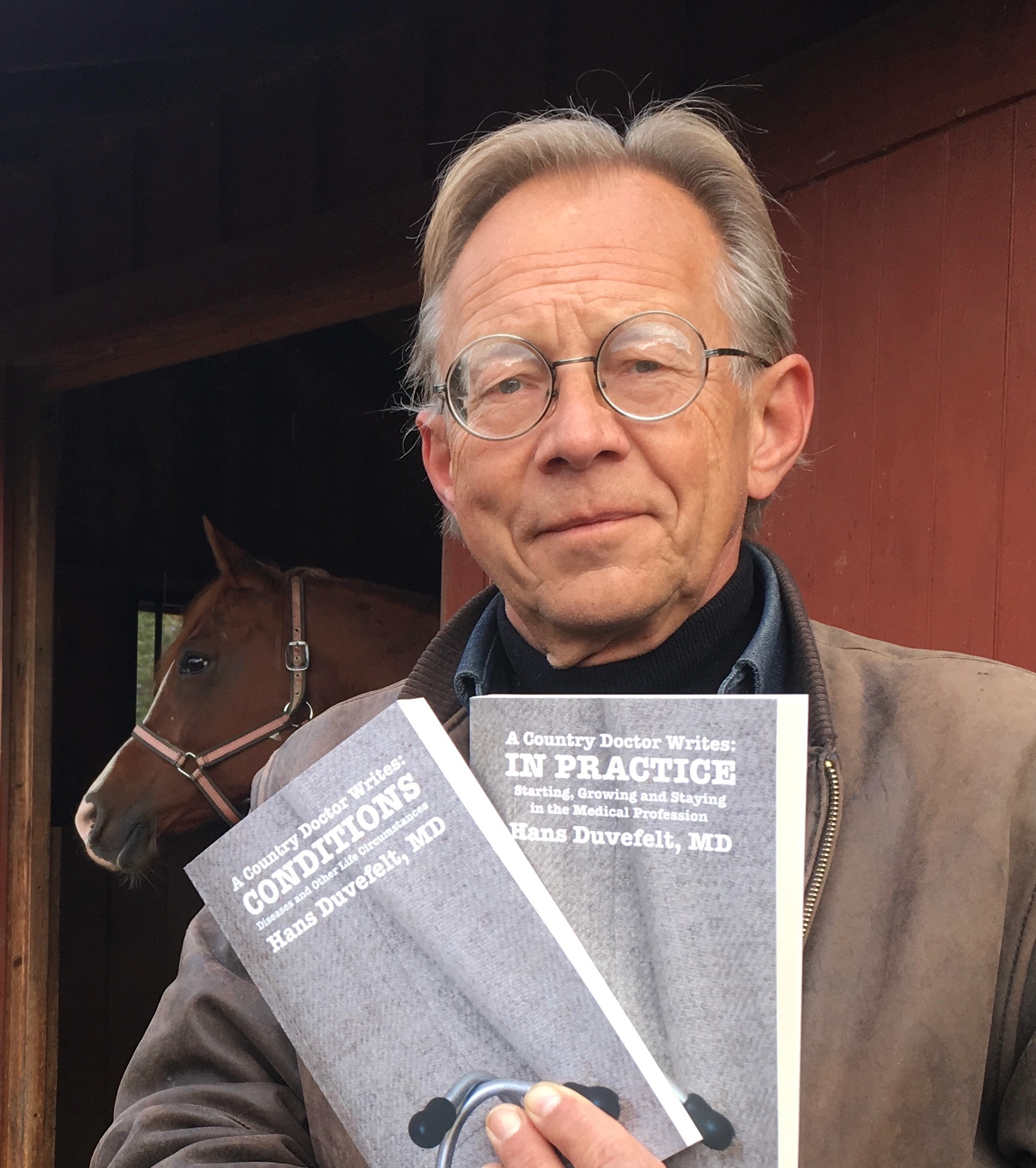
BOOKS BY HANS DUVEFELT, MD

CONDITIONS, Chapter 1: An Old, New Diagnosis

Top 25 Doctor Blogs Award

Doctor Blogs

Enter your email address to subscribe to this blog and receive notifications of new posts by email.

Mailbox

contact @ acountrydoctorwrites.com
Bookmark and Share
© A Country Doctor Writes, LLC 2008-2022 Unauthorized use and/or duplication of this material without express and written permission is strictly prohibited. Excerpts and links may be used, provided that full and clear credit is given.