Archive for the 'Progress Notes' Category


Covid-19 is Bringing Out the Worst Dishonesty in Some Patients

Most healthcare organizations try very hard to control the flow of patients through their facilities to minimize risk to staff and fellow patients and many are moving more or less completely to telemedicine.

Triage protocols like ours generally say something like this:

A) If you have what feels like a bad cold or bronchitis, stay home and take care of yourself, because most cases really don’t require antibiotics or professional medical care.

B) If you think you have been exposed to coronavirus but don’t feel all that bad, stay home and take care of yourself, because there is no treatment and there aren’t enough test kits right now to test you just for your own curiosity.

C) If you have severe symptoms but are not in distress or think you ONLY MIGHT need to be hospitalized, please call and we will direct you there our to designated clinic area at a specific time so you can be evaluated and tested.

D) If you have serious trouble breathing and feel like you absolutely will need help breathing and need an ambulance, ONLY then call 911.

Still, we have people in category C who call and deny their high fever plus recent travel to a high risk area plus severe symptoms until they are all the way inside the clinic, having exposed staff and fellow patients because there isn’t enough personal protective equipment to use for every staff member for every patient encounter in a state with one million people and only 250 cases so far.

At our stage in the pandemic, we need patients to be honest with us, so we can direct clinic flow and allocate our resources in a responsible manner.

Why Do Patients Trust their Doctor? Because He or She is a Competent Mensch

Trust is equal parts character and competence. — Stephen M R Covey

Because of the well documented science behind nocebo and placebo effects, we now know that patients’ trust in their clinicians can affect outcomes as much as their prescribed medications can. We also, obviously, know that physicians don’t get paid by their patients, but directly by their employers and indirectly by the Government or by the insurance companies. Treatment outcomes are inherently affected by the demands such non-patient entities place on physicians’ decision making.

So, what does it take to be trusted by our patients? And, truthfully, is that always something we strive for above anything else?

Trust in the realm of medicine involves not only the belief that a medical provider has the necessary technical skill to help a patient. More and more, it also must mean that the clinician doesn’t have conflicts of interest that could keep them from delivering care that is truly in the patient’s best interest.

From productivity demands that serve corporate financial interests to physician compensation algorithms, patients rightfully sometimes wonder if they get enough time with their provider to get the care they expect. Examples of this include not listening well to patients but instead ordering expensive or unnecessary testing or enforcing “rules” like only addressing one problem per visit.

When patients have medical conditions with quantifiable “quality” indicators that are helpful for a majority of patients, do medical providers always consider that individual patients with unique situations don’t always fit the mold and could be harmed if “guidelines” are followed too blindly? An example of this is increasing blood pressure medications for people with “white coat hypertension” who actually have symptoms at home from low blood pressure.

When resources are scarce, do physicians unfairly ration care? Are there situations when the doctor is thinking more of “the common good” than what the patient in front of him or her is asking for? Who gets the last intensive care unit bed or respirator, as the debate about Covid-19 now goes?

The Covey quote at the beginning of this reflection is both succinct and broad. Competence is fairly straightforward, but character is a difficult quality to define and quantify.

What is the character of a physician? How do we develop, hone and maintain it? And, perhaps more important than we had thought it to be, how do we show it?

In my mind, all kinds of other words cluster around the word character: Humility, Kindness, Empathy, Honesty and Righteousness.

I think you need to cultivate relationship in order to demonstrate your character. You can’t bee distant or aloof and show your true character at the same time. You have to reveal the inner workings of your mind, show that you are constantly assessing, weighing and processing information.

It isn’t enough to imply that you will always do the right thing, because every situation is unique and just like we were told in medical school that what we learned was how to learn and not a fixed encyclopedia of medical knowledge, we need to embody the wisdom that our life and our work involve the capacity and willingness to process problems in an ethical and patient centered way not once and for all, but continually as life and medicine are ever-changing.

Click image for more information

My high school German allowed me to understand some of the Yiddish I encountered in my Jewish host family when I first visited this country (Hi, Bob!), and I really liked the use of the word Mensch. In German, it just means human being and says nothing about individual character, just like a dog can be big or small, cuddly or vicious. But Mensch in Yiddish is a beautiful characterization of a kind of human being that all of us, and especially doctors in these complicated times, need to always strive to become.

American Telemedicine Has Gone Viral

It took a 125 nanometer virus only a few weeks to move American healthcare from the twentieth to the twenty-first century.

This had nothing to do with science or technology and only to a small degree was it due to public interest or demand, which had both been present for decades. It happened this month for one simple reason: Medicare and Medicaid started paying for managing patient care without a face to face encounter.

Surprise! In the regular service industries, businesses either charge for their services or give certain services away for free to build customer loyalty. In healthcare, up until this month, any unreimbursed care or free advice was provided on top of the doctors’ already productivity driven work schedules.

None of the healthcare systems that employ physicians, if they were in their right mind, saw any great value in paying their doctors for giving away free advice virtually when they instead could haul patients into the office and make them spend hours as we delivered more “comprehensive” care with higher complexity at greater cost than our “customers” generally expected.

It took a worldwide health emergency to shift our view of the best use of physicians’ time, to rock an antiquated, bureaucratic, patient-unfriendly colossus out of its rut into reimagining what our patients really need from us.

I got an email from my bank this week, saying the lobby is closed but the drive-through, ATM, online and telephone services are still available and in the rare event that you really need to speak with a banker in person, you can request an appointment. Imagine that general principle at work in healthcare. A quarterly diabetic followup visit is mostly talking about the numbers, the diet, the exercise regime and the medications. The eye doctor does the eye exam and we do a foot exam once a year when there are no problems. Now that we can charge for doing that visit via telemedicine, it seems strange that it took so long to get there.

My lawyer charges for professional services regardless of venue. Why American healthcare insisted for a hundred years that a physician’s advice wasn’t worth anything unless delivered in person will go down as a quaint footnote in the history of medicine.

Depression in Modern Times: We Have Many Friends and Followers, But Low Perceived Social Support Scores Can Make Us Sick

Why is depression now the leading cause of disability worldwide? I have been thinking and reading about this more and more, and the theories are many, from genetics to what we ingest to general stress to smartphones.

It has all seemed a bit vague – until I came across the concept of Perceived Social Support (PSS) score. It is a way to consolidate and quantify all the effects our modern life seems to have on our mental health by looking inside ourselves before considering the nature of the external forces, which may differ from one person to another.

The Oslo Social Support Scale, perhaps the most concise rating scale, is a simple scoring system based on three questions. It was first used in research to make comparisons between recent immigrants and people born in Norway. Not surprisingly, a poor OSSS score was a predictor of poor mental health.

► Oslo 1: How many people are you so close to that you can count on them if you have great personal problems? (none (1), 1–2 (2), 3–5 (3), 5+ (4))

► Oslo 2: How much interest and concern do people show in what you do? (a lot (5), some (4), uncertain (3), little (2), none (1))

► Oslo 3: How easy is it to get practical help from neighbours if you should need it? (very easy (5), easy (4), possible (3), difficult (2), very difficult (1))

More recently, this simple scoring system has been used to quantify the risk that Adverse Childhood Events (ACE) will cause adult depression. A favorable Perceived Social Support score, PSS, (factual or not, our perception is what matters) can act as a buffer, or a resilience factor if you will.

Exposure to ACE was assessed using the ACE questionaire, which addresses 10 individual ACEs under three categories:

► abuse: emotional, physical and sexual abuse

► neglect: emotional and physical neglect

► household dysfunction: parental separation/divorce, violence against mother, household substance abuse, household mental illness and incarceration of household member.

A low PSS score may increase the risk of depression five-fold for people with a history of three or more Adverse Childhood Events according to a 2017 paper in the British Medical Journal:
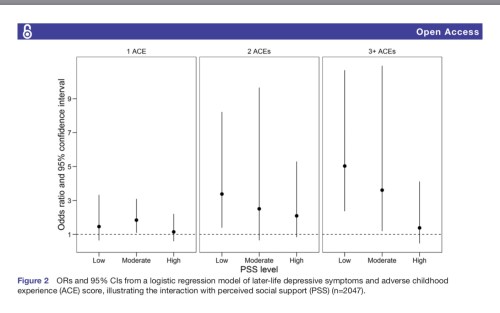
(https://bmjopen.bmj.com/content/bmjopen/7/9/e013228.full.pdf)

Perceived Social Support is like a prism through which we interpret external factors, or like sets of filters for photographic effects – sepia, cold, warm or black and white.

The obvious conclusion to be drawn from the link between Perceived Social Support and mental health, drawn by many but perhaps not always so neatly explained and quantified, is to look at all the circles we belong to or may be able to join and see how we can contribute to those micro communities.

Because, and this is the magic of understanding PSS, when you offer yourself as a support or resource to others, you usually get multiples of your input in return from those you help.

As I finish writing this reflection, which I started outlining last month, the inevitable and obvious context becomes “Who will have the most severe mental health symptoms develop as a consequence of natural disasters and pandemics?” I think the PSS score is a good predictor here, too.

And, as I am right now in self quarantine while waiting for the results of my COVID-19 test, the obvious question isn’t how much Social Support I objectively have, but whether I feel I have enough.
Black Box Warnings: Time to Reconsider Our Disease=Drug Reflex?

The recent news of a black box warning for psychiatric side effects from the allergy drug Singulair (montelukast) reminded me of a patient I saw ten years ago. She wanted help getting off the hook from a shoplifting charge. The judge didn’t buy it.

It is a frightening thought that medications we prescribe to help people feel better emotionally can do the opposite: Antidepressants, for example, can bring on mania, suicidal or homicidal thoughts or actions and are now known to at least some of the time cause irreversible changes in “brain chemistry”.

It is even worse, in fact horrifying, to consider that psychiatric side effects can occur with medications we think of as allergy treatments (Singulair), antibiotics (Levaquin) or antivirals (Tamiflu), immunosuppressants (methotrexate or steroids), acne treatments (Accutane), Parkinson or restless leg treatments (Requip), blood pressure medications (beta blockers), drugs for smoking cessation (Chantix) and so many others. Not that these types of side effects are all terribly common, but they are common enough to have to be a concern.

It does make you pause. Medical providers have flash card style knowledge memorized: Disease = Drug to prescribe. This knowledge is ingrained, learned reflexes that bypass commonsensical, non-pharmaceutical approaches.

The longer I’m in this business, the more I think we need to consider the options in the space between symptom/diagnosis and prescription. It isn’t as uncharted or infertile as we may think and it is often safer and less loaded with inadvertent liability.

First, do no harm.


I just realized none of the posts show on an iPad or a computer, but they do show on an iPhone. WordPress is working on this. In the meantime, please visit my Substack.


Osler said “Listen to your patient, he is telling you the diagnosis”. Duvefelt says “Listen to your patient, he is telling you what kind of doctor he needs you to be”.


BOOKS BY HANS DUVEFELT, MD

CONDITIONS, Chapter 1: An Old, New Diagnosis

Top 25 Doctor Blogs Award

Doctor Blogs

Enter your email address to subscribe to this blog and receive notifications of new posts by email.

Mailbox

contact @ acountrydoctorwrites.com
Bookmark and Share
© A Country Doctor Writes, LLC 2008-2022 Unauthorized use and/or duplication of this material without express and written permission is strictly prohibited. Excerpts and links may be used, provided that full and clear credit is given.


