Archive for the 'Progress Notes' Category


Stewardship: We Worry More About the Environment than Our Own Bodies

Sooner, rather than later, we will be driving electric cars because of the environment. We use energy efficient light bulbs and recyclable packaging for the same reason. And there is a growing debate about the environmental impact of what kind of food we produce and consume. But I still don’t hear enough about the internal impact on our own bodies when we consider stewardship of natural resources.

Our bodies and our health are the most important resources we have, and yet the focus in our culture seems to be on our external environment.

Just like the consumption culture has ignored its effect on our planet in favor of customer convenience and business profits, it has ignored the effect it has had on the health of the human beings it set out to serve. And just as we now are fearing for the future of our planet, we ought to be more than a little bit concerned about the future of the human race.

But, just as we really can’t expect the corporate world to lead the environmental effort, unless we can engineer a way for them to see profit in doing that, we cannot expect it to lead any kind of effort to make the population healthier. That is something that has to start with the individual.

We all need to take responsibility for our actions, large and small, external and internal. Idling your car to warm it up before your morning commute is bad for the environment and eating corn flakes, instant oatmeal or pop tarts for breakfast is bad for your body. And, for lunch, I see cars lined up, idling, at takeout restaurants that don’t have fruit, vegetables or unprocessed grains on their menu. And just think of the soft drinks that come with those meals.

Driving to make a short, nearby errand is bad for the environment. Choosing not to walk that distance on foot is bad for your body.

The one good thing that may have come with the Covid pandemic is that people are cooking and eating more at home and I hear there is a renewed interest in growing your own vegetables. Someone wrote recently that in some way our physical world has gotten smaller and more important to us while the nation and the world have come to feel almost virtual.

Maybe that offers some hope that we will pay more attention to our own health and our own habits.

If we don’t, the chronic diseases plaguing the industrial world will dominate our lives in ways that one day will make the environmental disasters seem irrelevant to the growing majority who will suffer from the failures and breakdowns of their own bodies.
CRAZY AMERICA: Health Insurance Covers Testing When You Are Well But Not When You Are Sick

Insurance is the wrong word for what we have here. Our private health insurance system’s prioritization of sometimes frivolous screenings but non-coverage for common illnesses and emergencies is a travesty and an insult to typical American middle class families.

State Medicaid insurance for the underemployed has minimal copays of just a few dollars for doctor visits and medications. From my vantage point as a physician, it is the best insurance a patient can have. They cover almost everything and it is clear to me how to apply for exceptions or follow their step care requirements. I cannot say that about most other insurers.

Most employed people have the kind of commercial health “insurance” that covers an annual physical and certain screening tests at no cost, but requires people to pay the first several thousand dollars of actual sick care expenses out of pocket. This is, in my opinion, insane. It causes delays and omissions in diagnosis and treatment.

A shining example of this bizarre arrangement is the screening colonoscopy. It is free as long as it is normal. If a patient has a polyp removed, which if unchecked could turn cancerous, future health care costs for treating colon cancer are eliminated. But the patient gets billed for the early cure.

The pandemic we live under has demonstrated the thin financial margins many Americans live with. A couple of months of missed paychecks and suburban families are lining up at food pantries.

The high deductibles and the high and often undisclosed cost of health care tests and procedures can be more than enough to destabilize an average American family’s economy. Under such circumstances people hesitate seeking care for new symptoms, even if they seem serious.

Historically, the word insurance is derived from the Old French ensurer, meaning “make safe”. The word assure is an even older word, long used specifically for providing a guarantee against loss in exchange for money. American health insurance has drifted into higher and higher deductibles and people now feel less and less safe for having health insurance.

I have many patients who, because of the cost, hesitate getting the lab work to monitor their chronic conditions and to ensure that their medications aren’t causing adverse effects. At the same time, I have patients who are perfectly healthy and take advantage of the “free” physical and random blood tests year after year. But if you feel fine and your weight and lifestyle never change, chances are your blood count, chemistries or lipid profile won’t change much from year to year either.

In fact, annual screening blood tests and even routine “complete physicals” have little or no proven value, depending on exactly who you listen to, including the US Public Health Service Taskforce on Prevention. However, an annual review and conversation around specific health screenings, immunizations and disease prevention, such as the no-touch Medicare “Wellness Visit” has been shown to improve compliance with preventive care guidelines (often called quality).

The whole concept of health insurance is confusing because it is so different from other types of insurance.

My car insurance only pays for accidents. They don’t pay for my state inspection, scheduled maintenance or normal wear and tear, and certainly not for mechanical failures. A brand new or certified used car, on the other hand, may be covered by a “bumper-to-bumper” warranty for a few years, but never for its entire useful life.

There is complete disagreement about how health care should be paid for. Socialized medicine and insurance medicine are two very different models. Americans seem to intuitively, emotionally, want to think of commercial health insurance as something a lot closer to free health care or a car warranty than it actually is. Commercial health insurance is a for profit enterprise that happens to be in the health care field. Their ultimate reason for existing is to make money. They do that by paying out as little as possible and keeping as much as possible of our premiums without looking unacceptably greedy.

I left Sweden with the insight that its socialized healthcare system had many inefficiencies and much bureaucracy. I live in America with the insight that a government bureaucracy, like our Medicaid, is easier to understand and navigate than a hodgepodge of federal, state and commercial payers. And it saddens me to see the insecurity of my fellow Americans who risk getting bankrupted by health care expenses and inadequate sick time benefits or disability income protections – many of them, just like health care, provided by for profit insurance companies.

PATIENTS: Sufferers, Consumers or Something In Between?

The word we use to describe those who come to see us in person, or seek our advice through other means of communication, is ancient and – according to some – outdated.

Patient, both as a noun and an adjective, is derived from the Latin pati, which is a word for suffering.

Not long ago, people only sought a doctor’s advice when they were feeling ill. Now, more and more, we are involved in health promotion and disease prevention. In this new role, we need to think of our relationship with those we work for as something very different and more equal. We now speak of active patient involvement and patient participation and some people call that an oxymoron. I don’t agree.

No existing or new word has replaced patient. Consumer, client, participant, partner and many others have failed to get traction.

As much as I love words and enjoy learning or contemplating their historical origins, my own thought is this:

We don’t need a new word to replace patients. Words are just words, approximations. Changing our nomenclature for ethnic minorities did not eliminate the injustices of our society, as today’s news reports have illustrated, for example.

We need to work on our view of and relationship with our patients. Retailers have consumers, lawyers have clients, teachers have students. All those relationships are continually evolving to some degree, just like the doctor-patient relationship. Keeping the word patient and staying focused on understanding what they need from us helps us avoid the trap of commercializing or trivializing our relationship the way consumers would, for example.

Old and antiquated words can still make sense when describing something new and very different: You may be driving a combustion engine automobile in the US or motor car in Great Britain, or an electric car on the European continent, measuring its efficiency in miles per gallon, liters per kilometer or Watt hours per kilometer. But we all still like to think of our vehicle’s horse power, even though we know there are no horses under the hood and who knows what hundreds of horses could really accomplish if you tried to get them to pull a vehicle. They certainly could not match the speed or acceleration we associate with horse power numbers.

Patients of today are both looking to be fixed and seeking guidance on avoiding becoming ill. Some are even coming to us seeking health. Health is more than the absence of illness, but that is not part of the everyday thinking of most doctors.

This brings me to the question of how we want to define our own role in our chosen field: If a patient today is different from a patient a hundred years ago, how well has health care adapted to that evolution? I know drug companies are very much stuck in the old model of fixing suffering by external means. They promote the notion of artificial interventions creating active, smiling but still overweight diabetics with better blood sugar control, for example. That is not quite health or even the absence of disease, only the mitigation of some of the worst effects of illness.

Health care has largely failed to meet the needs of those patients who look for real health, beyond the absence of overt disease. That arena is now dominated by what we call alternative medicine practitioners. The Functional Medicine movement promises to bridge this gap, and maybe the medical school curriculum of the future will prepare doctors differently. But knowing how long it takes for even basic medical knowledge to change physician behavior, we will continue to muddle along the way we are for a while.

My only hope for the immediate future is that doctors, on an individual level, listen more to each patient we meet. If we acknowledge or awaken the desire for more than mitigating symptoms in some of them, it will rejuvenate us professionally and inspire us to consider the basics of health we have perhaps viewed as too trivial to bother with: nutrition, sleep, physical activity, relationships, spirituality in any of its forms, connection with the natural world. That includes respecting and listening to our own bodies.

Sure, diagnosing that insulinoma I think I saw the other day makes me a good traditional doctor for a traditional, helpless patient. But what about the handful of people who realized that the dietary changes they started to make made them feel better very quickly? They weren’t really suffering from anything serious and I didn’t really treat them in the traditional sense. But our engagement, or partnership, was just as satisfying as chasing down a rare diagnosis.

I Still Love Being a Doctor – KevinMD

On today’s KevinMD, Kevin Pho is featuring a post I wrote this January on the occasion of the 46th anniversary of my first day of medical school (described in detail here). This post touches on E&M coding and the silliness of some EMR templates, but it still ends with my honest conclusion “I love my job.”

It became clear to me that my desire for a career in medicine was because it would allow me to teach, coach, explain, motivate and guide fellow humans in medical matters. I never fantasized about heroic procedures or brilliant diagnostic victories – I have since understood they are usually a little too infrequent to sustain a doctor week after month after year.

“Helping people” is often cited as a motivator for becoming a physician, but I don’t think that is precise enough. “Repairing their body parts”, “comforting them and relieving their suffering” or “helping them understand their options” are more likely to translate into professional satisfaction.

In today’s medical practice environment, there are plenty of opportunities to do what I enjoy the most, and I receive plenty of positive feedback for doing it. My favorite compliment is probably “Nobody has ever explained it like that before”.

Read on KevinMD: https://www.kevinmd.com/blog/2020/10/meet-the-physician-who-loves-his-job.html

Swedish Analysis: Dark Triad Personality and Denying the Dangers of Covid-19

My Swedish morning paper has an interesting article that ties in with recent pieces in the New York Times and other US media.

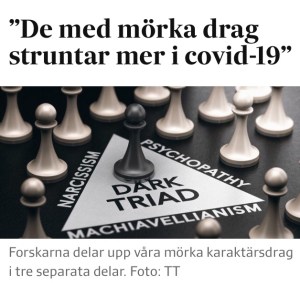
The so-called “Dark Triad” of personality traits was described by Paulhus and Williams in 2002 – narcissism, psychopathy and machiavellianism. They are strongly linked to lack of empathy. This triad, according to Svenska Dagbladet, helps explain the animosity and violence expressed and perpetrated by Covid-deniers in the United States, who value their freedom not to wear masks more than the health of their fellow human beings.

The Swedish article writes about this 18 year old concept:

“But since the world was paralyzed by covid-19 this spring, the dark triad has become relevant again. A number of researchers have studied how our dark features are linked to how we acted during the pandemic. A few, albeit relatively small, studies indicate that people with strong dark features to a greater extent ignore obeying instructions during the pandemic.”

Media here are full of accounts of the violence the non-believers are capable of inflicting on those who are trying to protect their own health and others, too. This is perpetrated under the guise of protecting their own individual freedom, denying everyone else the freedom to avoid exposure to illness and death. I personally find this divisiveness in our society frightening and disheartening.

In just two examples from today’s news, an 80-year-old man was killed at a bar for asking another patron to wear a mask and the president is urging his supporters to ignore the risk of dying from Covid-19.

NYT has a piece about cognitive dissonance and the virtual bubbles Americans live in when it comes to where we get our news (Fox versus the older TV networks, for example), describing how our brains “will go to baroque lengths — do magic tricks, even — to preserve the integrity of our worldview, even when the facts inconveniently club us over the head with a two-by-four”.

We live in a divided country regarding race, climate, and so many other things. Not that I actually imagined living in a time of a worldwide pandemic of this magnitude, but I would have thought if anything could have united us, that would have been it.

I was wrong.


I just realized none of the posts show on an iPad or a computer, but they do show on an iPhone. WordPress is working on this. In the meantime, please visit my Substack.


Osler said “Listen to your patient, he is telling you the diagnosis”. Duvefelt says “Listen to your patient, he is telling you what kind of doctor he needs you to be”.


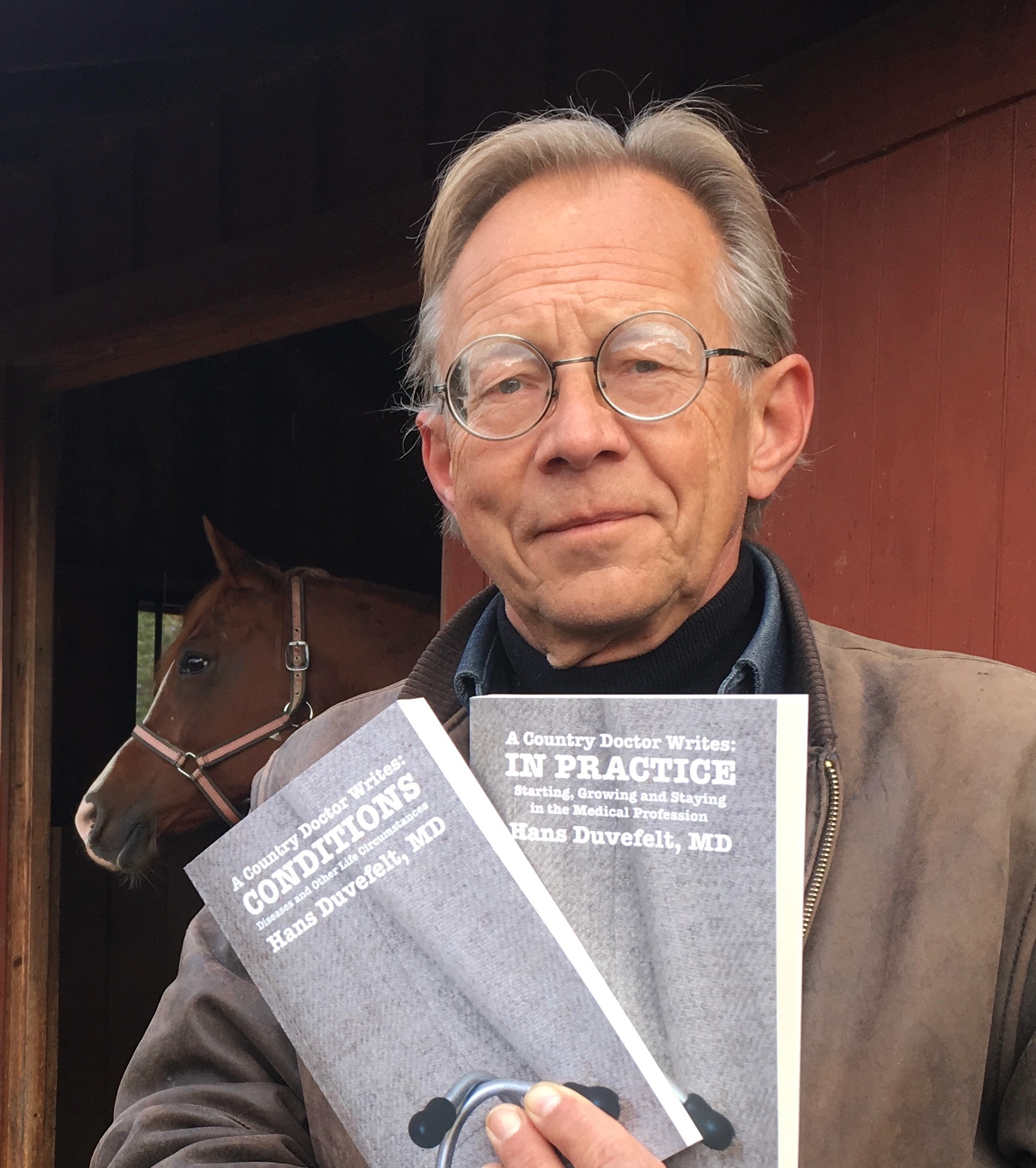
BOOKS BY HANS DUVEFELT, MD

CONDITIONS, Chapter 1: An Old, New Diagnosis

Top 25 Doctor Blogs Award

Doctor Blogs

Enter your email address to subscribe to this blog and receive notifications of new posts by email.

Mailbox

contact @ acountrydoctorwrites.com
Bookmark and Share
© A Country Doctor Writes, LLC 2008-2022 Unauthorized use and/or duplication of this material without express and written permission is strictly prohibited. Excerpts and links may be used, provided that full and clear credit is given.