Archive for the 'Progress Notes' Category


The Science of Clinical Intuition

In 2002, Dr. Trisha Greenhalgh published a piece in the British Journal of General Practice titled Intuition and Evidence – Uneasy Bedfellows? In it she writes eloquently about the things Christer Petersson and I have written articles on and emailed each other about. He mentioned her name and also Italian philosopher Lisa Bortolotti, and I got down to some serious reading. These two remarkable thinkers have described very eloquently how clinical intuition actually works and describe it as an advanced, instantaneous form of pattern recognition.

Clinical Intuition (should we start calling this CI, as opposed to the other, electronic form of pattern recognition, AI – Artificial Intelligence?) begins with clinical patient experience but is cultivated through reflection, writing and dialogue with other physicians. And as Petersson and I have both written, there isn’t enough of the latter in medicine today. Both of us do as much reflecting and writing as we can, but we both know that more collegial interchange can make all of us better clinicians. Greenhalgh writes:

The educational research literature suggests that we can improve our intuitive powers through systematic critical reflection about intuitive judgements–for example, through creative writing and dialogue with professional colleagues. It is time to revive and celebrate clinical storytelling as a method for professional education and development. The stage is surely set for a new, improved–and, indeed, evidence-based–‘Balint’group.
— Read on www.ncbi.nlm.nih.gov/pmc/articles/PMC1314297/

Bortolotti, the philosopher, makes the case that experts are more intuitive than novices, a skill that only comes with experience, and have developed advanced pattern recognition abilities that allow them to make decisions faster than possible when only using analysis and reasoning. Her article is quote-heavy. She writes:

Dreyfus and Dreyfus develop a different model of the acquisition of expertise in five stages: (1) the novice who relies on surface features of the situation and context-free rules; (2) the advanced beginner who starts perceiving patterns but cannot discriminate between relevant and irrelevant features; (3) the competent decision-maker who can cope with a variety of situations via deliberate planning; (4) the proficient decision-maker who sees situations holistically and arrives at her judgement by exercising her perceptual skills; (5) the expert who has an intuitive understanding of the situation and uses analysis only when problems occur or when the situation is unfamiliar.

She goes on:

Here are some examples of the reaction against the perceived over-conceptualisation of expert decision-making:

The view of expert decision making presented here is perceptual rather than conceptual. It is more a matter of how people see the world than the knowledge that they have accumulated. The reason is that knowledge, to be useful, must be translated into action. From a pragmatic perspective, decision making and problem solving are based on situation awareness, on the recognition of situations as typical or anomalous, and, with that, on the actions that are associated with that recognition. (Hutton and Klein 1999, 32–3)

[W]ith enough experience in a variety of situations, all seen from the same perspective but requiring different tactical decisions, the brain of the expert performer gradually decomposes this class of situations into subclasses, each of which shares the same action. This allows the immediate intuitive situational response that is characteristic of expertise. (Dreyfus 2002, 372).

Expert decision making seems removed from explicit deliberation, unlike novices who rely on explicit instruction when learning a new task. Linked to this, speed of performance increases notably with expertise, whereas novices are slow and deliberate. Experts can multi-task and engage in other activities while making expert decisions, whereas novices can be easily distracted from tasks with which they are unfamiliar. Recognition of visual stimuli and its categorization shifts up a level in speed once one has become expert through repeated experience, allowing experts to respond to and categorize subordinate-level stimuli almost instantaneously. (Nee and Meenaghan 2006, 938)

What is expert decision-making? Hutton and Klein (1999) list the main characteristics: (1) expertise is domain-specific; (2) in comparison with novices, experts do not necessarily have a wider knowledge base, but are better able to perceive patterns; (3) expert performance is faster than that of novices and virtually error-free; (4) experts have superior memory in their domain of expertise, and this is not necessarily all “in their heads” but recalled when needed by means of external cues; (5) experts have a deeper understanding of the problem to solve (e.g. they catch on the causal mechanisms), whereas novices are distracted by superficial features of the problem; (6) experts have a better understanding of their own limitations and an ability to catch themselves when they commit errors; (7) through years of experience, experts acquire the ability to perceive relevant features of the situation (distinguish typical features from exceptions, make fine discriminations, antecedents, and consequences).

In her conclusion, Bortolotti writes that reflection and intuition are both valuable and, when used together (in the right proportions in the right circumstances), make for better decisions.

There seem to be different conceptions of the relationship between reflection and intuition, and they cut across the philosophical and the cognitive science literature:

(1) Pro reflection. Reflection is slower but more accurate, so using intuition instead requires a trade-off: faster and more computationally economic processes in exchange for less accurate decisions. Stop and think!

(2) Pro intuition. Intuition is more accurate than reflection in delivering good decisions, and it is also less vulnerable to evidence manipulation and confabulation. Go with the flow!

(3) Against the dichotomy. Reflection and intuition should not be characterised as dichotomous. Conscious and unconscious, fast and slow, perceptual and analytic reasoning processes interact in the making of good decisions.

Both Art and Science, Medicine encompasses many apparent opposites. The skillful clinician is comfortably considering all of them. Once again I am reminded of how I once thought Dr. Pete, my Residency Director, had a tendency for (as I called it) “shooting from the hip“. What he actually did was practice advanced pattern recognition.

To Understand What You Already Know

I read an article last weekend in Allmän Medicin by my Swedish colleague, Christer Petersson, who once wrote a piece titled “I worked as a doctor for 20 years. Then I became one”.

He again writes about the difference between academic knowledge and experience-based intuition and how each is necessary to acquire and cultivate in order to be a good physician. He draws from Russian author Mikhail Bulgakov and American Nobel Prize winner Daniel Kahneman (I now have both books).

In A Young Doctor’s Notebook, Bulgakov describes how his obstetrics textbook made no sense to him until he, with the help of a seasoned midwife, performed a version of a transverse fetus in the middle of the night. After that, he returned to his textbook and wrote:

It was just after one o’clock when I got home. In a patch of lamplight on the desk in the study Döderlein lay peacefully open at the page ‘The Dangers of Version’. I sat with it for another hour or so, gulping tea that had grown cold, leafing through its pages. And now something interesting happened: all of the formerly obscure bits became completely comprehensible, as though they had filled with light, and there, in the light of the lamp, at night, in the back of beyond, I realized what real knowledge means. “There’s great experience to be gained in the countryside,” I thought, falling asleep, “only I have to read, read a lot… read…”

Kahneman, an economist, writes in Thinking, Fast and Slow about the value of clinical intuition, and explains it as a result of learning:

We have all heard such stories of expert intuition: the chess master who walks past a street game and announces “White mates in three” without stopping, or the physician who makes a complex diagnosis after a single glance at a patient. Expert intuition strikes us as magical, but it is not. Indeed, each of us performs feats of intuitive expertise many times each day. Most of us are pitch-perfect in detecting anger in the first word of a telephone call, recognize as we enter a room that we were the subject of the conversation, and quickly react to subtle signs that the driver of the car in the next lane is dangerous.

The psychology of accurate intuition involves no magic. Perhaps the best short statement of it is by the great Herbert Simon, who studied chess masters and showed that after thousands of hours of practice they come to see the pieces on the board differently from the rest of us. You can feel Simon’s impatience with the mythologizing of expert intuition when he writes: “The situation has provided a cue; this cue has given the expert access to information stored in memory, and the information provides the answer. Intuition is nothing more and nothing less than recognition.”

Petersson Writes:

As family physicians we are next-door neighbors to uncertainty. Not infrequently do we have to make decisions without suspenders or a belt (Swedish expression for leaving your comfort zone). Our judgment is constantly being tested. Without intuitive sensitivity we become paralyzed and without analysis we become reckless. Only in our encounters with individual patients’ concrete problems and by connecting those to our profession’s collective knowledge, textbooks and databases can our judgment evolve.

For the general practitioner it is primarily the patient encounter that creates experience. Communication between colleagues, one on one or in a group setting, is in my opinion a necessary ingredient for growing that knowledge.

He writes that there is much to be done with that in Sweden. Here, too, is what I think. Professional isolation in American primary care is possibly worse. And primary care providers are often thought of as interchangeable. Experience and intuition are not valued the way they might be in other fields or in other practice settings, like academic medicine.

Editor’s (that’s me) note:

I sent Christer my draft for this post and he gave me some names, and synopses of writings by people who have written eloquently about intuition. I will be doing some more reading and thinking. Stay tuned for another post about the science behind clinical intuition.

There is a Word for People Like Me: AMBIVERT (A Personal Reflection)

A while ago I recognized myself in one of the five newspapers/sites I check during my morning coffee in bed. I don’t remember where I read about what I thought was something unique I had not been able to put into words before: You can be introvert and extrovert at the same time. So-called ambiverts actually often make better leaders than either of the two opposites.

A quiet only child, I could sit for hours with pen and paper or just a toy Bentley or some Legos. I had few friends, played no sports and I actually remember my mother’s anger and frustration that I didn’t want to be like other children and play outside.

But at the same time, I recited Luke in church for Christmas and took every other opportunity I came across to speak in public. When I taught myself to play guitar, I had people (girls) smile and sing along with me but I seldom felt comfortable making small talk or more with them.

I was president of my class in my Swedish high school but hardly ever socialized. I taught photography to 9th graders as a school project. I spent a summer at the Boy Scout Center in Kandersteg, Switzerland, teaching scouts from all over the world how to build shelters and bridges using rope lashings. And I spent a semester between the army and medical school as a substitute teacher and thrived standing in front of both enthusiastic and uninterested students.

And I became a doctor, a “docere” – educator, therapist, life coach in today’s vernacular. But I had no social life to speak of until I became a ballroom dancer. Then, I was out there, so much that he dance floor always seemed too small for my fancy swing and Lindy Hop kicks.

And here I am, all alone on the farm with just the animals, not spending any of my personal time with other human beings, writing blogs that are read all over the world, getting royalty payments from several countries for my books and networking online to market them to more doctors, students and medical educators. And I’m even recording and posting videos with ad-libbed patient education talks.

I even reactivated my dormant Facebook account and found an outlet for my creativity outside medicine. I post pictures and stories and feel quite content with my virtual friendships that occur without spoken words. Once I leave my clinic, I don’t speak, basically.

For years now, I have felt increasingly content just being who I am but there is a sense of ordinariness to know that I am not as much of an aberration as I thought I was. Sure, we are all unique, but I like knowing that there is a name for people like me.

It’s a little bit like my dietary preferences: I went from being a picky eater to a vegetarian (just for consistency) and on to what I now call recovering vegetarian (embracing two opposites). Now I am not an introvert trying to be an extrovert. I am an ambivert, plain and simple.

The Call to Be a Primary Care Doctor

I suspect the notion of calling in narrower specialties is quite different from mine. Surgeons operate, neurologists treat diseases of the nervous system, even as the methods they use change over time.

Primary care has changed fundamentally since I started out. Others have actually altered the definition of what primary care is, and there is more and more of a mismatch between what we were envisioning and trained for and what we are now being asked to do. Our specialty is often the first to see a patient and also the last stop when no other specialty wants to deal with them.

We have also been required to do more public health, more clerical work, more protocol-driven pseudo-care and pseudo-documentation like the current forms of depression screening and followup documentation. And don’t get me started on the Medicare Annual Wellness Visit. How can we follow the rigid protocol and be culturally and ethnically sensitive at the same time?

We are less and less valued for our ability – by virtue of our education and experience – to take general principles and apply them to individual people or cases that aren’t quite like the research populations behind the data and the guidelines. The cultural climate in healthcare today is that conformity equals quality and thinking out of the box is not appreciated. The heavy-handed mandates imposed on our history taking and screening constantly risk eroding our patients’ trust in us as their confidants and advocates. The finesse and sensitivity of the wise old fashioned family doctor is gradually being squeezed out of existence.

The call to primary care medicine, if it isn’t going to pave the road straight to professional burnout, today needs to be a bit like the call to be a missionary doctor somewhere far away:

To go into a sometimes hostile environment, without the right kind of resources, where people don’t speak your language, where you never feel you can do everything you hoped to do for your patient, and where some of the things you want to do might even encounter cultural or political taboos.

In other words, to do what we can in the moment for each patient, regardless of the system and the circumstances.

That is a very noble call, but not one for the faint-hearted.

The Annual Physical: Is it Worth Having?


I just realized none of the posts show on an iPad or a computer, but they do show on an iPhone. WordPress is working on this. In the meantime, please visit my Substack.


Osler said “Listen to your patient, he is telling you the diagnosis”. Duvefelt says “Listen to your patient, he is telling you what kind of doctor he needs you to be”.


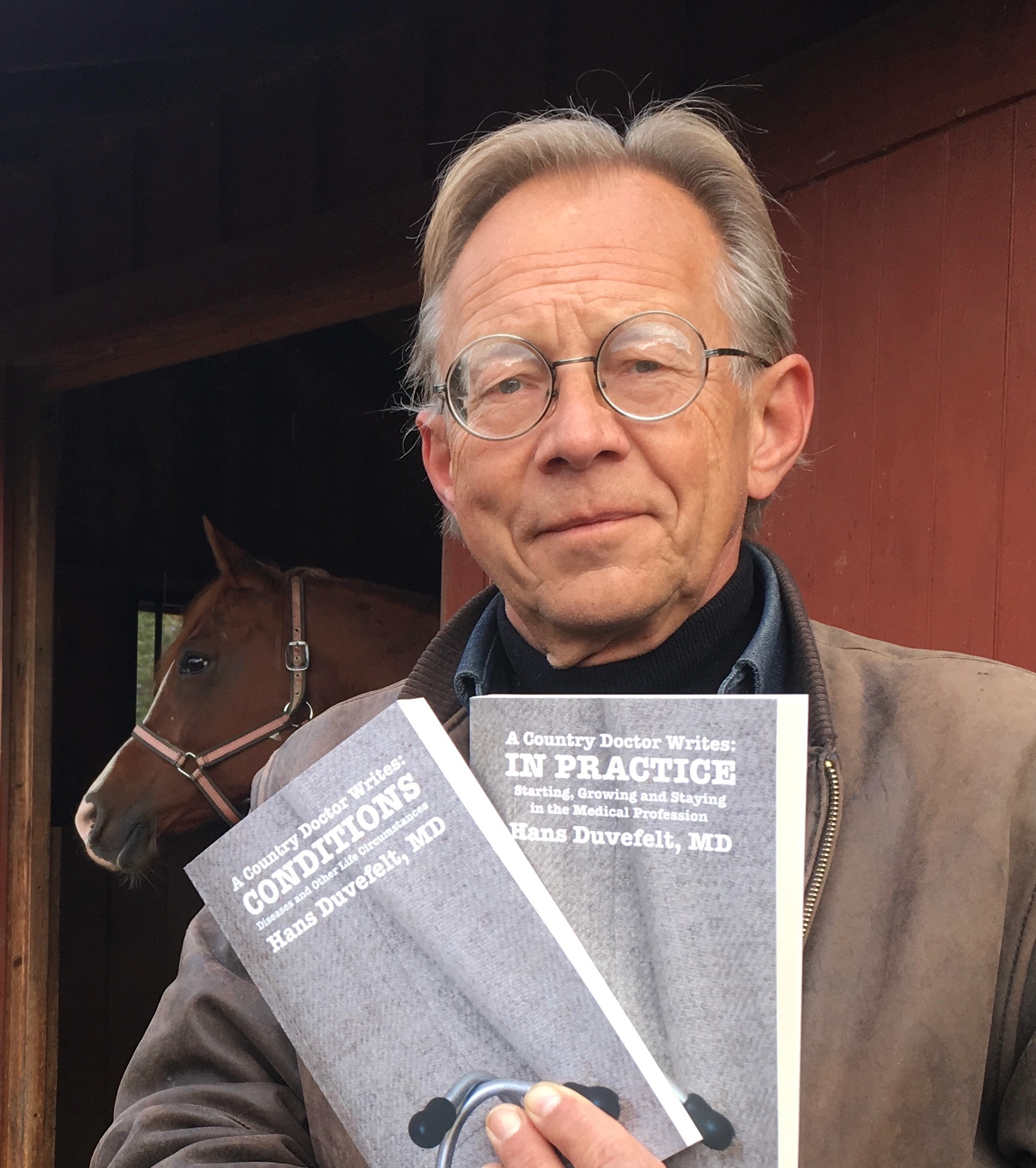
BOOKS BY HANS DUVEFELT, MD

CONDITIONS, Chapter 1: An Old, New Diagnosis

Top 25 Doctor Blogs Award

Doctor Blogs

Enter your email address to subscribe to this blog and receive notifications of new posts by email.

Mailbox

contact @ acountrydoctorwrites.com
Bookmark and Share
© A Country Doctor Writes, LLC 2008-2022 Unauthorized use and/or duplication of this material without express and written permission is strictly prohibited. Excerpts and links may be used, provided that full and clear credit is given.