Archive for the 'Progress Notes' Category


Can the Practice of Primary Care Medicine ever be Practical Again?

When I first lost power and then saw my generator fail during a storm last winter, two other failures struck. As I scrambled to fill my water containers for the horses, the failing generator delivered just enough electricity for dim lights and a slow trickle of water. And then, when the power came back on, I had no water and the furnace didn’t work.

I trudged through the snow to the pump house up in the woods and found the water pump clicking as if it tried to start, but couldn’t. I ended up a day or two later with a whole new water pump.

The furnace had power, but I saw a red light with what looked like a stick figure repair man. Other furnaces I’ve had all had a reset/start button. Not this technical wonder that I never had to mess with before.

The repair man showed me that the stick figure light was, in fact, a recessed reset button. He pushed it and the furnace started instantly. But he didn’t leave. He said he was going to make sure there were no other problems. That took half an hour and I later got a $250 bill for the emergency repair call.

I felt stupid for not having pushed the red light on my own and I don’t mind paying $250 for my stupidity. But did he really have to spend half an hour making sure that a furnace that fired and delivered heat REALLY was working?

This long story makes me think of how we practice medicine these days. Nothing is quick and easy. Everything has to be comprehensive. But some problems are really simple enough that we shouldn’t have to belabor them like my furnace repair man. His job was, or should have been, easier than the plumber’s.

Primary care, with our ongoing patient relationships, is in theory ideally suited for quickly taking care of minor problems. After all, we already have background information on our patients and shouldn’t have to start from scratch.

But, we are disincentivized and downright punished if we do just that. This is because some well meaning bureaucrats imagined that while patients are in our clutches, we might as well screen them for this, that and the other, update their immunizations and, God forbid, not let them leave if their blood pressure should happen to be out of range because they are in pain or in a hurry.

So, instead, our patients end up going to walk-in clinics, seeing providers they don’t know who practice without the shackles of the family doctor of record.

I think we need to stop pretending that today’s primary care is patient centered. It is not. It is a vehicle for top-down government control of people’s care decisions and doctors’ behavior.

Take a lesson from the pandemic:

When this country faced a public health emergency, the directives and recommendations were broadcast by the government and its agencies directly to the public. And when mass immunizations needed to be done, they took place in large arenas, even parking lots and also pharmacies. Primary care offices were deemed a last option, presumably because the Fed realized how stodgy our work flows are because of how they designed us.

We desperately need a public health system in this country. The past year has demonstrated that mass communication and mass interventions are better vehicles for public health than clinics historically geared up for treating patients one by one.

So, please take public health off our plate, because we don’t have the resources for mass education – we have doctors, PAs and NPs working in professional isolation with full schedules. Each provider is aided by one medical assistant. Primary care clinics usually don’t have registered nurses, health educators, PR people or the kind of support it would take to treat entire, even small community, populations.
I Actually Love Technology

I’ve got myself a reputation as a technology hater. Nothing could be farther from the truth. I just have no patience with bad or stupid technology, like EMRs.

If I apply the brakes going down a hill and then let go of the brake pedal, my car does not roll a whole lot faster than I wanted it to moments before – thanks to a clever computer system I know nothing about. And often, when I drive past our Caribou clinic (where I only work on Saturdays) on my way home and glance to see whose cars are still in the parking lot, the car makes an alarm sound and a red triangle lights up as if I was almost crossing the center line, even if I’m not: The car KNOWS I’m distracted.

Contrast that with my EMR: If I open a patient’s chart and go to the “medications” sidebar icon and hit the + sign, any reasonable human being would think I am about to prescribe a medication right now. Not my system. It asks me which old encounter I’d like to use, and if not, what category of new encounter I want to create. Excuse me, I’m sending a prescription right now, why do I have to spell that out?

Unless we are computer geeks, most doctors just want our technology to work. HOW is not for us; we like intuitive. We want our computers to know and adapt to how real doctors work, rather than make us work for them.

I can’t tell you how many times, when I print a lab or X-ray order for a patient , I have to walk back to the exam room from the printer in my office to confirm on my laptop that I left behind, that I really DO want to print my order. What purpose does the last confirmation screen serve? I’ve already told the computer I want to print the darn thing.

As I’m writing this outside, on my iPad Pro in my sling chair, watching dogs and horses on a quiet Sunday afternoon, I lament the fact that my clinic here up north doesn’t have an iPad EMR app and my Bucksport clinic’s EMR’s iPad app no longer works because of mysterious incompatibilities between iOS versions, app versions and the installation at the mother ship 200 miles away. Desktops are so Stone Age and laptops are so last century.

In my non-clinical work, the technology lets me work whenever and wherever I want. Most of my 777 (and counting) posts on A Country Doctor Writes were written in bed between 5 and 6 am or somewhere just before midnight!

I can run Zoom clinics from my iPhone and publish books from my iPad. Why are medical applications so far behind?

Habits for Health and Happiness

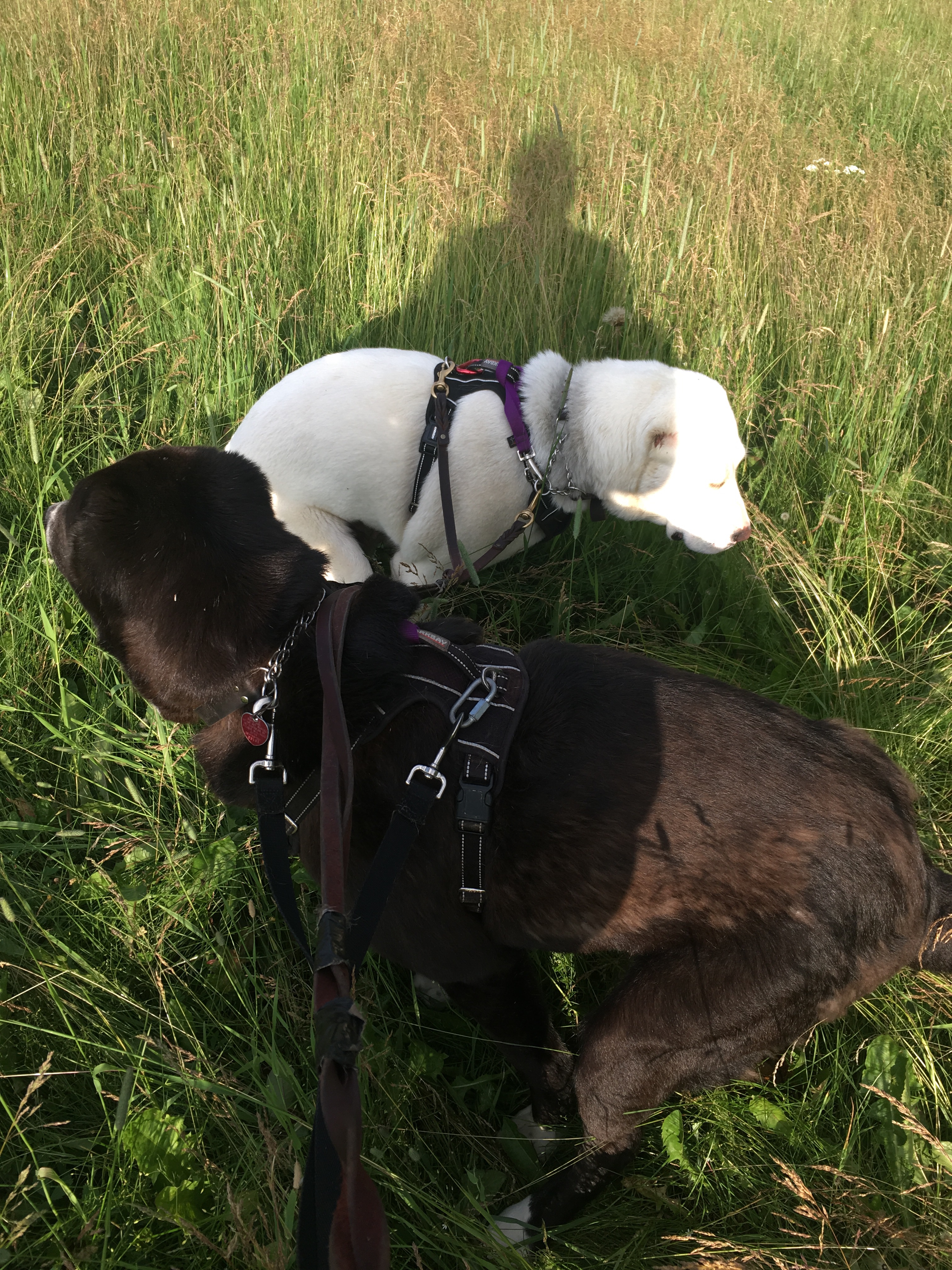
When I first adopted my black Alabai dog, she had what people call an accident. She went far into a corner of the house and did her business on the floor. She never did that again. Not because of any negative feedback from me, because I never even let her know I found out. But what I did was close off the house so we only lived in the kitchen, bathroom and my bedroom for a while. I also started to walk her as soon as I fed her, morning and night.

I took advantage of two natural phenomena: The gastrocolic reflex that at least human babies are born with, and the power of habit. The dog’s brain and intestine both knew what to expect very soon after she joined me.

Now that I have two Alabais, it is amusing and convenient to have them always pooping in tandem. (As a Swede, I use a child word but I don’t use the euphemism of dogs going to the bathroom – I find that expression silly and confusing.)


I get horses to come inside the barn at night just by whistling and bringing food; then I close the doors while they eat. They even watch for that to happen. I made them want what I want, so this works for all of us.

I have many patients who lead irregular lives: They eat and sleep seemingly at random, not because they are shift workers, but because they never saw the need to follow any given rhythm. After all, television and streaming are on 24/7 and so are many other services and distractions in our society.

Diurnal rhythms exist naturally not just for our digestive processes, but hormones, vital signs, tissue regeneration and more things that I, as a country doctor, am excused from keeping track of. I just know that habits and bodily rhythms are good for us and unless we need to work irregular hours to earn our living in this frantic society, we are better off living like most animals – according to a stable pattern.

I am amused and confused by the opposite extreme of habits I see in other patients: Some people obsess over their habits by monitoring sleep, steps, calories and vital signs on their smartphones. I think overthinking the natural processes of our bodies and our lives can be counterproductive. Our brain is not the supreme control center many people imagine it to be.

We need to avoid over-analyzing what should be automatic functions; start worrying about your blood pressure and it goes up every time you recheck it, for example. Walk your dog, cuddle your cat, listen to the birds instead. Let the light go dim when evening falls and let the sun shine in your window every morning. Plan your meals, schedule your chores, and give your brain the freedom to be creative with something other than constantly reorganizing and reinventing what should be your day and your body on autopilot.

The Gift of Time

The other day I saw a woman who had transferred her care and then came back to me. There was a time in my life when that used to bristle me. Now I’m not threatened or insulted by such switches.

This patient was struggling with depression and anxiety and had, on her own initiative, tapered off her duloxetine. Some time after that she then destabilized and in that context transferred her care. Six months later she was back in my schedule.

Our “transfer of care” appointment took a while. I’m not sure by how much we exceeded our allotted time slot. But I plodded through our last several notes and read aloud to her my documentation of how the medicine had actually made her feel better, and how she had told me about her decision to taper off it. I listened as she described how her next provider went with the flow and prescribed bupropion, because she had “failed” duloxetine.

Her new medicine didn’t help her at all. I did spend a fair amount of time just letting her tell her own story. I then reviewed my notes aloud with her about how good she seemed to be feeling before her self directed taper. I also listed the things she did that made her feel better: car rides, friends, her therapist.

She cried for a while, sitting at the edge of her seat, then wiped her tears and blew her nose.

“You have felt better than this, I remember, and you do too”, I said.

She agreed to stop the bupropion and restart duloxetine in a low dose.

“I’d like to see you back next week to make sure things are working”, I said, and she agreed.

I knocked on the door, following my usual habit, of the same exam room exactly one week later. I wasn’t even halfway into the room when the serenity, for lack of a better word, struck me.

She was sitting in a relaxed position, wearing makeup, looking straight at me with a contented smile.

“I feel so much better. I’m sleeping at night. My appetite is back, and I don’t hurt everywhere anymore. This medicine is working for me”, she said. She took a deep breath and continued “but I think what did the most was that you took the time to listen. Those 45 minutes turned things around for me.”

I think so too, even though I’m sure we didn’t spend quite that much time together, but I didn’t say it out loud. But I do believe that, not infrequently, the doctor is the treatment, at least to a degree. Connection can be healing.

When the Doctor is the Treatment

The Art and Soul of Medicine Exist in the Ordinary

The Art of Medicine is Doing the Ordinary Well

Primary care doctors don’t usually operate any sophisticated medical instruments or perform any advanced procedures. But there is still art in what we do. We take care of ordinary ailments in ordinary people and that can be done well or not so well. There is no obvious glamor in it, but when our prescriptions, basic procedures or simple advice help people feel better, we live up to our own and our patients’ hopes and expectations – and some of the time, we even exceed them.

Art is art, regardless of the medium or subject. Weren’t the old Dutch masters’ most appreciated paintings depictions of ordinary people in ordinary circumstances? Not every artist gets to paint the Sistine Chapel.

So many things in our culture are at the two extremes of poorly done and exquisite: fast fashion or haute couture, drive-up burgers or five star restaurants. Fewer things are made with care by craftspeople for individual users. Medicine needs to be more like that in order to bring real healing in many conditions.

In our everyday encounters with our patients, we are often distracted by things other than what they expect or hope to get from us. We have agendas imposed on us for preventive care and public health purposes. It is sometimes hard to do your best if you can’t concentrate on the issue at hand. Art requires focus. It is not a casual endeavor. It requires attention to detail, just as much as a vision of the big idea. It is – or should be – for each of us, in order to do our best, to find the balance between those two aspects of our work.

The Soul of Medicine is Connecting as Humans

We are not technicians. We treat the whole person, because most things in primary care are diseases that affect more than just one organ. We now also, again (historically), accept that diseases of the body may have their root causes in what we call the soul. In order to know and treat another person, we must show our own. Only if we do that will we learn enough to be of any real help to the patient who hopes to trust us enough to take our advice. We must create connection.

The English poet William Blake wrote:

“Man has no Body distinct from his Soul; for that call’d Body is a portion of Soul discern’d by the five Senses, the Chief inlet of Soul in this age.”

Thomas Moore, author of the #1 New York Times bestseller Care of the Soul (1992), writes in Care of the Soul in Medicine (2010):

“The soul, in contrast [to spirit], is grounded in every day life – home, family, friends, work, food, beauty, nature. Aristotle said that the soul is what makes a thing (or a person) exactly what it is. What makes an axe an axe , he said, is its soul. What makes me what I am essentially, what gives me my deepest identity, is my soul.

You can tell when doctors or nurses do their work with soul. They are present to us as people. They don’t hide behind their professional masks or their routine chores. They give you their attention and relate to you, if only for a short time. Here we come upon another essential sign of soul – connection.”

Connection Evolves During the Course of Doing the Ordinary

It is often during he most ordinary circumstances we make our strongest connections. That is when showing who you are seems most natural, not when the stakes are high. Over the course of several routine visits, we develop a relationship that can make it easier to talk about difficult things later on. We build credibility and trust while we deliver basic care.

As my Swedish colleague Christer Petersson wrote (quoting him again):

“It took about 10 years and quite a bit of agonizing before I discovered that I was exactly where I was supposed to be, and it took another 10 years to understand that I actually was a doctor and didn’t just work as one. During that time I learned that man is more than his digestive system and the most important events in life often happen in the seemingly uninteresting space where blood flows, boils burst and wounds heal.”

I firmly believe that unless you see your work as practicing an art and engaging soulfully with your patients, you are on the path to professional burnout and away from medicine.


I just realized none of the posts show on an iPad or a computer, but they do show on an iPhone. WordPress is working on this. In the meantime, please visit my Substack.


Osler said “Listen to your patient, he is telling you the diagnosis”. Duvefelt says “Listen to your patient, he is telling you what kind of doctor he needs you to be”.


BOOKS BY HANS DUVEFELT, MD

CONDITIONS, Chapter 1: An Old, New Diagnosis

Top 25 Doctor Blogs Award

Doctor Blogs

Enter your email address to subscribe to this blog and receive notifications of new posts by email.

Mailbox

contact @ acountrydoctorwrites.com
Bookmark and Share
© A Country Doctor Writes, LLC 2008-2022 Unauthorized use and/or duplication of this material without express and written permission is strictly prohibited. Excerpts and links may be used, provided that full and clear credit is given.

