Archive for the 'Progress Notes' Category


The Art of Diagnosis: Go With Your Gut, Dig Deeper, Step Back or Start Over

Nelson Malloy had infrequent but bothersome spells when he felt drained for half a day or more. He just couldn’t put his finger on exactly how he felt. Neither he nor I knew in the beginning what his symptoms were all about. The usual fatigue related bloodwork came back normal. His pulse in the office was exactly 50. On a hunch, I suggested tapering his lowest strength tablet of metoprolol tartrate down to half a tablet twice a day and that seemed to have solved his problem. The medication had been started after a questionable non-ST elevation myocardial infarction a few years earlier. Encouraged, he stopped it altogether and instead ended up with two hours of palpitations, triggered by a stressful event, with a heart rate upwards of 150. I advised him to resume the half tablet regimen. He may need more testing if he gets palpitations again.

Ben Chasse stumped me before with his drowsiness and his various neck and head pains. Was he just hypoglycemic with a herniated disc in his neck and an unrelated ordinary cellulitis, or something more exotic? Now, after neck surgery and off most of his diabetes medications, could his reoccurring spells of fatigue and shortness of breath be related to suddenly high blood sugars? After all, he was not anemic, his chest CT, echocardiogram and stress test were all normal and his peak flow was the same as mine. Time will tell, now that he is starting to take care of his diabetes again.

Sometimes the broader view holds the answer. It helps to ask “what else is going on” or to do a review of systems that includes things we might not think have anything to do with the chief complaint. 

Wanda Starks, years ago, puzzled me with her recurrent episodes of mild confusion, nausea and ever so slight headaches. She seemed to have a migraine equivalent, but it took ten years of infrequent by-the-way mentions before I realized what ailed her.

As I wrote about Wanda’s case back in 2008:

When you get stuck in a diagnostic dilemma you have two ways of approaching the problem. You can dig deeper and meticulously go over all the tests that have been done so far, looking for anything that could have been missed. You can also do the opposite, step back, clear your mind and listen to the patient’s story all over again. It is a little bit like those pictures in psychology class; the more you stare at them, the less likely you are to see the hidden image. Sometimes if you squint, you can see it right away.

And in 2009, in a story about Mrs. Jarvis’ spells of nausea, I also wrote about starting over:

“I am stuck,” I said. She sighed as I continued: “I must be missing something in your story.” Then, in a moment of inspiration, I got up from my stool and walked over to the exam room door as she followed my movements with suspicion and disbelief in her eyes.

With one hand on the doorknob I turned toward her and explained what I was doing:

“Pretend I’m an amnesiac or that you never met me or told me what you are feeling. I need to hear your story again from the beginning and without interruptions.”

The punch line in that story was:

Five minutes later, without asking a single further question, I knew what to do.

There are many ways to get unstuck. We must be prepared to use all of them.
When I Escalated His GERD Treatment, My Patient Got Worse. Now I Know Why

Pierre Patenaud had a long history of dyspepsia with fair control on 20 mg of omeprazole. A few months ago, he started getting worse. My first response was to check for changes in his lifestyle and increase his dose to 40 mg. When that didn’t work, I added famotidine 40 mg twice a day. He felt worse and even developed hoarseness. I prescribed sucralfate before meals and at bedtime and made a referral to one of our general surgeons for an upper endoscopy.

The other day I got a call from the surgeon.

“Mr Patenaud’s endoscopy looked atrophic and I just got a call from the pathologist. The biopsies were negative for helicopabter pylori, but he’s got giardia in his stomach.”

“I’ve never heard of that”, I said, “and he hasn’t had any lower GI symptoms.”

My literature search yielded mostly old articles, like an Italian one from 1992 linking it to helicobacter pylori, a 1994 piece in the BMJ linking it to achlorhydria (which may be why Mr. Patenaud got worse with more acid suppression) and bile reflux (bile is alkaline). The most recent piece I read was from 2009 by the WHO, reporting Egyptian data on helicobacter pylori and giardia, which often coexist as they are transmitted in the same fashion between individuals.

The lesson here is: Not all dyspepsia is due to acid excess or reflux, or even bile reflux in and of itself. And the ones that are neither of those aren’t necessarily irritable bowel related “nonulcer dyspepsia” – a strong case for scoping and biopsying difficult dyspepsia.

“This Doesn’t Usually Hurt that Much”: Patients With Fibromyalgia Spectrum Disorder

Specialists in orthopedics and general surgery often want us, the primary care doctors, to manage postoperative pain. I don’t like that.

First, I don’t know as much as the surgeons about the typical, expected recovery from their procedures. My own appendectomy in Sweden in 1972 was an open one that I stayed in the hospital for several days for (and nobody mentioned that there were such things as pain medications). I’m sure a laparoscopic one leaves you in less pain, but I don’t personally know by how much.

Postoperative pain could be an indicator of complications. Why would a surgeon not want to be the one to know that their patient is in more pain than they were expecting?

Pain that lingers beyond the postoperative or post-injury period is more up to us to manage. I accept my role in managing that, once I know that there is no complication.

I have many patients who hurt more that most people every time they have an injury, a minor procedure or a symptom like leg swelling, arthritis flare or toothache. The common view is that those people are drug seekers, taking every chance to ask for opiates.

I believe that is sometimes the case, but it isn’t that simple. I believe that people have different experiences with pain. We all know about fibromyalgia patients or those with opioid induced hyperalgesia, but pain is not a binary phenomenon. Like blood glucose, from hypoglycemia, through normoglycemia to prediabetes and all the degrees of diabetic control, pain experience falls on a scale from less than others to more than others.

I reject the notion that pain is a vital sign. When I was Medical Director in Bucksport I discouraged the use of numeric pain ratings. But I did encourage talking about the experience of pain as a subjective, nuanced and very valid consideration. We started a comprehensive pain education module for all our chronic pain patients.

I saw a patient just the other day with leg edema, who illustrates what I’m talking about:

Jim Gogan has had brief courses of hydrocodone over the years from different providers for everything from back strains to stress fractures to toothaches. Now he has very modest leg swelling that hurts him so much that he asks for pain medication.

He winced when I palpated his legs.

“This degree of swelling doesn’t usually hurt that much”, I said. “I don’t think I’ve ever seen someone needing hydrocodone for something like this.”

I went on to check the typical fibromyalgia tender points. About half of them were positive.

“Are you familiar with what’s called fibromyalgia? It’s a neurological condition where our pain sensitivity is tuned higher, like the volume of a radio. You are more sensitive to pressure and irritation in some of those spots, like you may have a touch of that phenomenon. There are treatments for that, but the scary thing about using hydrocodone or any other opiates for that is that we now know that they usually make it worse.”

I explained about opioid induced hyperalgesia. My short take is that the fast pain signals in our human nervous system give detailed information, like my left big toe hurts. If we suppress that signaling, an old remnant evolutional “lizard nervous system” gets ramped up. It is less precise, and may only tell us that there is tissue damage but it doesn’t know exactly what kind and where.

In my simple but, I believe, quite accurate explanation I then list the medications that work better when the pain signaling is in the ramped up slow nerve fibers at work in people on what I call the fibromyalgia spectrum.

If that isn’t a recognized term, like autism spectrum, perhaps we should all consider making it one.

Lo and behold, searching for “fibromyalgia spectrum disorder” there are many articles using that term, ranging from a 1993 editorial in Arthritis and Rheumatism, when the pathophysiology of fibromyalgia was still poorly understood, to a more recent 2008 review in The Journal of Clinical Psychiatry and current inferences in Pinterest and Facebook posts.

I have written before about how it can often be helpful to think of presentations that may not meet all the criteria of a given disease as still reasonable to approach as if they are milder forms on a spectrum. The longer I’m in this profession, the more sense that makes to me.

Shadow Syndromes

Another Birthday Reflection

Fifty years ago this summer I traveled by turbo-prop plane to this country for my exchange student year. I landed, delayed, at Logan airport around 2 am. My host family drove me to their home in a boxy white Studebaker wagon with a bale of hay in the back where I also put my suitcase and guitar. I had just found my musical hero that spring: James Taylor, whose songs have followed me ever since.

The impressions that year provided have shaped my life, from the optimism and the ideals of self expression of that era to the vision of the family doctor that the Marcus Welby, MD television series gave me. I traveled to New York City during that school year and was halfway up one of the twin towers then under construction. After graduation I got a Greyhound pass and saw 30 states in 30 days. Visiting my host family’s older children, I slept in an Adobe hut in New Mexico and in a hippie environment in Mendocino, California. I was smitten with the diversity and vastness of this country that seemed to have room for everybody’s American dream.

And, sometimes through planning, sometimes by circumstance, my American dream unfolded. Now, fifty years later, I find myself marveling at all those events that put me in Swedish country in northern Maine as a country doctor and a writer – the two things I always wanted to be.

Every day I live now is filled with joy because of my children, my animals, this little farm and the work I love. I no longer have the hunger of the younger man I once was.

I’ve had many gloriously happy moments and they’re only memories now. I have gradually shifted from striving for new experiences to cherishing the ones I have had. I have also, perhaps later than some, come to stop ruminating about what to do next.

From Horace’s Carpe Diem to Eckhart Tolle’s The Power of Now to James Taylor’s The Secret of Life, we must remember to live in the moment. Because only the moment is real, everything else is only memory or imagination.

So, once again, I say to myself Happy Birthday, Country Doctor.

Happy Birthday, Country Doctor

Fatigue, Tinnitus, Dizziness and Dyspnea. What’s the Diagnosis?

Mrs. Maguire never followed my advise completely or took my prescriptions exactly as prescribed, but she kept coming back for all her scheduled appointments. After her pulmonary function test came back abnormal, I gave her a sample of an anticholinergic inhaler two weeks ago and had her take her first dose as I watched. Today I entered the exam room a little bit hopeful that we were getting somewhere.

“I have to be honest with you”, she said. “I haven’t been using the inhaler you gave me, except I tried it again yesterday because I was coming here today.”

“That’s probably not long enough to know if it might help you”, I summed it up. I didn’t ask why she hadn’t really tried it. I sat quietly for a while and then she continued:

“I don’t know what’s wrong with me. I just don’t do anything anymore, only the absolute necessary. I just have no ambition, and the depression pills you had me try before didn’t help me.”

“Right, you wanted to taper off your Lexapro. How long ago did you actually stop them?”

“Last week, and I see no difference.”

I said nothing.

“You know, ever since Brian and his wife moved to Connecticut two years ago, I haven’t had the ambition to do anything. Babysitting for them was my job, and now I feel so useless. They wanted me to come live with them, but I didn’t like it there at all. I have lived here all my life.”

She teared up.

“I miss my grandchildren.”

“And you miss having a purpose”, I filled in.

“I do”, she said as she pulled a Kleenex from her purse.

“So, have you thought about what other things you could do that would give your days some purpose and structure”, I asked.

“No, like what?”

“Like the food pantry or thrift store or nursing home, maybe giving people rides, I don’t know? Melinda, our social worker, is connected with a lot of places that need volunteers. Would you like to talk with her?”

“A counselor, a psychiatrist? I don’t think I can open up to a stranger.”

“Well, she’s a social worker. She does do counseling, but she also helps people figure things out and make practical decisions, because she knows the community. And you’re telling me what’s going on.”

“Well, that’s different.”

“You don’t have to tell her anything about your feelings if you don’t want. You could just have her help you brainstorm about things you might start doing.”

“I don’t know.”

“Well, think about it. Let me know if you want to talk with her. Otherwise I’ll just see you in three months for your diabetes. But I think it could be good to brainstorm with her.”

“I’ll think about it”, she said as she got up and left the room.

We, or actually she, had finally nailed down her diagnosis and now it is up to her to decide what to do next. I knew there is nothing more I could do right now, or is there?


I just realized none of the posts show on an iPad or a computer, but they do show on an iPhone. WordPress is working on this. In the meantime, please visit my Substack.


Osler said “Listen to your patient, he is telling you the diagnosis”. Duvefelt says “Listen to your patient, he is telling you what kind of doctor he needs you to be”.


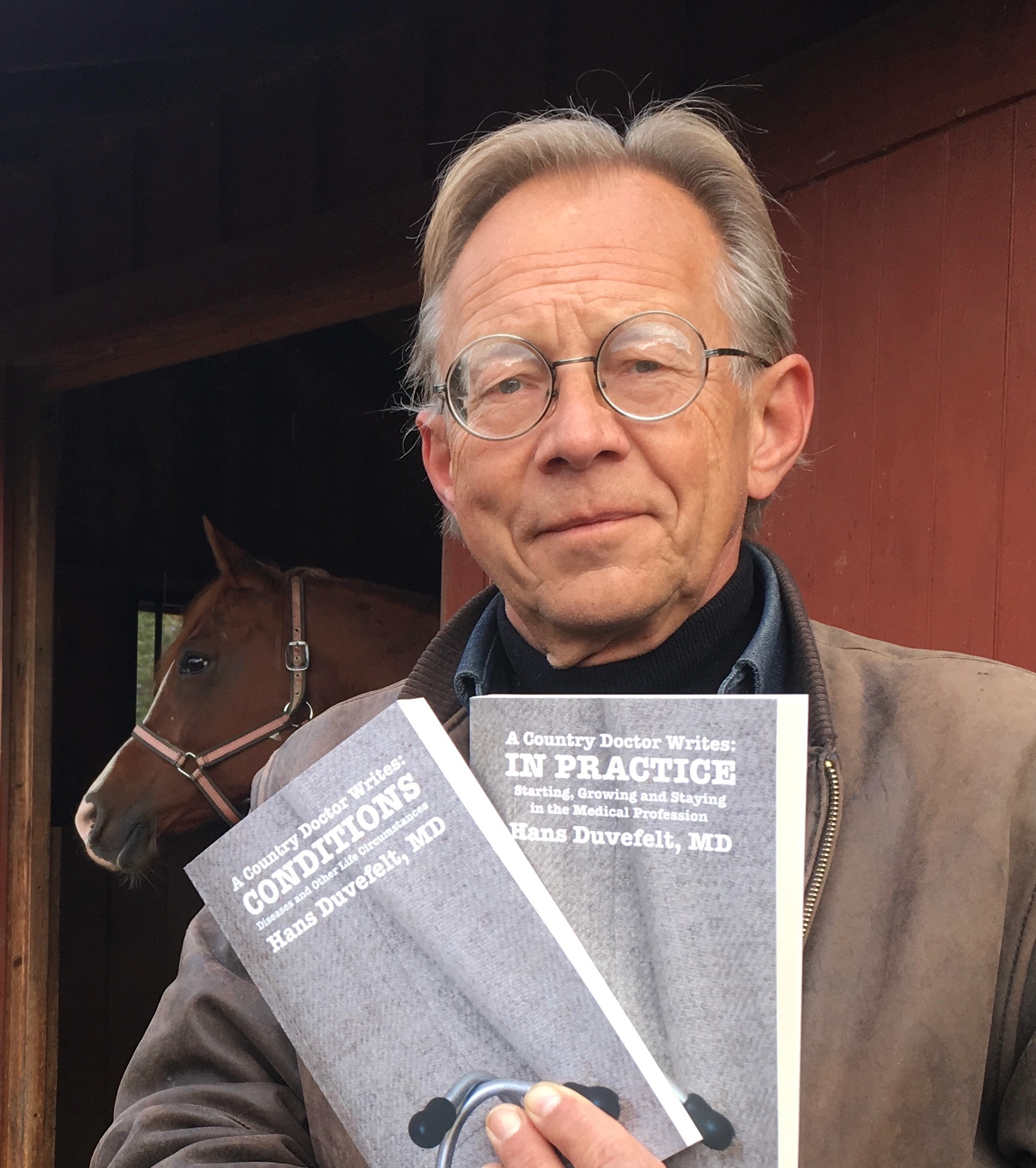
BOOKS BY HANS DUVEFELT, MD

CONDITIONS, Chapter 1: An Old, New Diagnosis

Top 25 Doctor Blogs Award

Doctor Blogs

Enter your email address to subscribe to this blog and receive notifications of new posts by email.

Mailbox

contact @ acountrydoctorwrites.com
Bookmark and Share
© A Country Doctor Writes, LLC 2008-2022 Unauthorized use and/or duplication of this material without express and written permission is strictly prohibited. Excerpts and links may be used, provided that full and clear credit is given.