Archive for the 'Progress Notes' Category


The Power of Words, 16 Years Later

One failed and one successful Primary Care/Behavioral Health integration

16 years ago I was a newcomer, at age 56, in the northernmost part of Maine. In one way I was starting over, but in another way, I was continuing what I had done in my previous job near Bangor. There, as medical director, I had a friend and ally in the behavioral health director, and both our departments underwent years of rapid growth. This was in part because we shared patients and patient experiences between our departments and had a bidirectional way of making warm handoffs. If a primary care patient was going through a difficult time with their social life or mental health, we would walk them down the hall to meet a therapist right then and there. Similarly, if a behavioral health patient looked like they had pneumonia, the warm handoff would go in the opposite direction.

The kickoff to my new employer’s effort to integrate primary care and behavioral health led to many more meetings and eventually to embedding one LCSW into each of our relatively small primary care offices. Six years later, about 10 years ago, none of them remained. The organization now employs a single psychiatric nurse practitioner for medication management. No counseling is offered.

My theory is that the behavioral health staff members felt isolated and not integrated with the primary care providers. And I think Bucksport’s success is that there are several behavioral health staff members and a bigger medical staff in the same clinic and they have meetings together, share a lunch room and have easy access to curbside conversations with each other.

The piece quoted below blends the importance of choosing the right, nonjudgmental, words to describe our patients’ symptoms and personalities with the idea that we cannot treat their seemingly physical symptoms without trying to understand the context they arose from.

The Power of Words

Yesterday afternoon I sat in a dark room with a couple of doctors and several mental health professionals and participated in a video conference about integration of primary care and behavioral health. Outside, the late summer sun shone brightly just like it did September 11 eight years ago.

The case for integration is obvious; 85% of the time the ten most common symptoms brought to the attention of primary care doctors (chest pain, dizziness, fatigue, back pain and so on) have no known somatic explanation – the cause for the symptom appears to be psychological.

Yet, the words we use to interview patients, to document the history and physical examination findings, and to present our thoughts to our patients and to our behavioral health consultants are often extremely unhelpful and sometimes downright insulting to the patient.

It seems the place to start integrating primary care and behavioral health is with our everyday choices of words we use to describe the patients we see in our offices.

The days are essentially gone when doctors spoke in technical terms to each other and other medical professionals with the purpose of keeping the patient in the dark. For example, very few of the old prescription-related Latin phrases are still being understood and used by doctors and pharmacists, and most preprinted prescription pads no longer feature the optional “label” box, which in a bygone era gave the prescribing physician the option of not revealing the name of the drug to the patient.

We are nowadays cautioned to clear our vocabulary of words which we as physicians have used and understood to mean something perfectly neutral in clinical language, yet can be offensive to patients, who increasingly often end up reading their own medical records.

In my years as a physician I have read many chart entries that read something like this:

“This pathetic 57 year-old woman returns with a litany of complaints, and seems to completely lack insight into the real cause of her misery…”

Those are words that, perhaps, may insulate a doctor from bad feelings about his/her inability to help such a patient, but they aren’t likely to help the patient manage their symptoms or psychological issues, and they ultimately don’t belong in a therapeutic relationship.

This is not Orwellian Newspeak; our words can heal, and they can hurt. These are some examples of conventional doctorspeak and suggested alternatives from the video presentation we watched by Alexander Blount, Ed. D.:

Chief Complaint = Main Concern

Suffers from = Struggles with

Refused to take = Decided against

Was noncompliant with = Didn’t see the value of

Didn’t keep appointment = Wasn’t able to be here

Arrived late = Was determined not to miss

There is a lot of talk these days in the U.S. about the Patient-Centered Medical Home. It begins here; with the way we see our patients as the center of the clinical work we do, indeed the justification for our own existence as doctors in our communities.

(I see now that I need to write about what happened with the noble idea of a patient centered primary care practice and the stilted, bureaucratic way we had to qualify for certification. Stay tuned for that one…)

My First Case of Algophobia? Or Münchausen Syndrome? Or maybe Just Another Patient with Opiate Induced Hyperalgesia, Allodynia, or Maybe Just Opiate Use Disorder?

Jimmy has a bad back. He’s fused at every level, some of them done twice. After many prescriptions of oral pain medication, he landed on Butrans, the buprenorphine patch that stays on for a week, hits the mu receptor for pain just like the regular opiates but not the depression inducing kappa receptor. It has fewer side effects in general and is less likely to cause respiratory depression if somebody were to double up on their dose. It’s even much safer in combination with benzodiazepines than traditional opiates.

My problem managing Jimmy’s medications is that he keeps getting hurt, more often than most other patients I have run into. And when he gets hurt, he reports more suffering than most other patients and he openly worries about how much things will hurt before they get better. For example, if the emergency room gives him a shot of Toradol and four days of pills to take my mouth, he worries that this will not be enough to handle the pain. I obviously tell him to wait and see, and not expect the worst. But that is what he tends to do.

Every doctor knows there are people with opiate use disorder who are just looking for their next kick and sometimes do stupid things to earn them that. We also have patients with various forms of allodynia like fibromyalgia. And opiate induced hyperalgesia is a very real phenomenon not usually triggered buprenorphine, but before Jimmy got onto that he had plenty of traditional opiates, so he may have some of that.

Real Münchausen syndrome is not about getting pain medicine. It’s about getting the medical attention that new symptoms, even if self inflicted, could bring.

My patient definitely has an anxiety disorder that could make him borrow trouble or anticipate more pain than a given diagnosis would be expected to cause him. As many times before, for example as I have written in Intuiting Alexithymia, I just had a thought that perhaps there is a diagnosis for something I am just starting to run into. With alexithymia it is the inability to describe one’s feelings. In Jimmy’s case, is there a word for when people are so worried about having pain that they are unable to be realistic about what to expect from any given injury or condition? And sure enough, there is a word for that: Algophobia. Check it out on Wikipedia and at the Cleveland Clinic.

Actor, Chameleon or Just a Good Doctor?

As doctors, we are like actors or musicians. We play roles, we play compositions that can reach deeply into the consciousness of other human beings. We can evoke feelings and sometimes bring about change if we are skilled and genuine in our delivery of the message our patients need to hear in the moment we meet them.

This is a topic I keep coming back to, with words like ACT, CHAMELEON and ROLE PLAY. I write pieces like the ones below and I use words like these with the most sincere and genuine purpose – to be the kind of doctor each of my patients needs in the moment they seek my help.

Here are three such essays from my archives:

If You Are a Doctor, Act Like One

Be the Doctor Each Patient Needs

Role Play

A Childhood Illness that Stumped a Pediatrician

Melanie’s breathing troubles started almost three weeks ago. Her pediatrician suspected cough variant asthma, but she didn’t respond that much to her medications. “Give them more time to start working”, was her recommendation.

But Melanie’s mother was worried enough to locate a pediatric pulmonologist, who saw Melanie on a day when the cough wasn’t too bad, so the specialist never got to hear her cough. He did suspect Melanie had whooping cough, even though she had been vaccinated. He explained that it was too late to start the typical antibiotic we use for whooping cough. Her mother noticed that even though she was getting better, the least bit of exercise or anxiety made her cough again. And she noticed that, now that she had a possible name for what was going on with Melanie that there was another noise after each cough that was severe enough to make Melanie a little distressed. It didn’t sound like “whoop” to her, though.

Over Easter, I spent a few nights with Melanie’s extended family who are from the town I live in.

Twice, I saw Melanie have a pretty significant coughing jag. After each short, harsh cough there was a characteristic high pitched, musical sound as she would breathe in.

“You hear that”, I said to her mother. “That’s not like wheezing with asthma. Asthmatics make noise breathing out, and whooping cough wheezes breathing in. It’s also a lower pitch and shorter than asthmatic wheezing. The medical word is stridor. I have heard it a few times in my long careeer.”

“So now that she’s able to be back is school, but gets a coughing jag with whooping after a little exercise. I don’t want her to take phys ed until she is ready”, Melanie’s mother said. “Would you be willing to call her pediatrician and tell her you’ve heard her cough and you’re sure she really does have whooping cough? That way Melanie’s might get a physical ed excuse from her doctor.”

“I’d be happy to”, I said.

So I called. I introduced myself as a family friend and that I was a Family Physician with 46 years of experience and I happened to be staying with her family and happened to hear the classic sound of whooping cough that hadn’t been documented in her earlier visits.

The receptionist said she couldn’t give me any information because there was no release in Melanie’s chart.

“I’m not asking you to tell me anything”, I told her. “I’m giving you some information, because I’ve heard Melanie’s classic whooping cough.”

I thought that was the end of this, but within minutes the pediatrician called Melanie’s mother at her office and started chewing her out for going behind her back.

All I can say is that this must be a very fragile and insecure doctor, who feels threatened by a fellow physician visiting the home of a patient calling in to simply report a clinical observation that could be helpful in the care of her patient. This was not a second opinion. But even if it were, patients have a right to get one, just like Melanie’s mother had already done with the pediatric pulmonologist.

Looking for Patterns, Looking for Change and Looking for Incongruity

I recently reposted a 2017 WordPress reflection on my Substack about how sometimes a disease evolves so slowly that you, as a continuity provider, barely notice it but another, covering, provider notices the subtle abnormalities and recognizes the pattern as a new disease.

When taking a medical history, it is often very difficult to pin down the duration of a patient’s symptoms or the speed of change. For example, patients tell me all the time that they had muscle aches on a statin drug. When I then ask if they never had them before they started that drug or if they never had them after they stopped it, I often don’t get a straight answer. And when people report alarming symptoms without mentioning that they’ve had them for decades, you could easily fall into the trap of overreacting to chronic symptoms.

The art of diagnosis is said to be 80% the art of taking a good history of the clinical symptoms. Doing an appropriate, skillful exam is probably a disappearing or at least undervalued skill. Knowing what test to order if you suspect something, and sometimes even if you have a handle on the most prominent symptom, is something your computer can help you with, from UpToDate to DxGPT.

Then there is the many facets of incongruity. Just the other day, I saw an older woman with years of gastrointestinal problems. She knew she was lactose intolerant, but when my assistant walked into her kitchen where she kept her testing equipment for her home INR blood testing for her warfarin anticoagulation, she noticed a table full of 1% milk cartons. When we pointed out that she seems to be drinking milk even though she is lactose intolerant, she responded, “but it’s only 1%”. “Yes only 1% fat, but still a lot of lactose”, I told her. “Oh, I had no idea”, was her answer. Incongruity can be an issue of what’s around in the home, how a person talks or moves when they are distracted from describing how ill they feel, and many more things.

I used to like old mysteries when I was younger. I watched Columbo and Perry Mason. I don’t watch mysteries anymore. I get enough of that in my work…


I just realized none of the posts show on an iPad or a computer, but they do show on an iPhone. WordPress is working on this. In the meantime, please visit my Substack.


Osler said “Listen to your patient, he is telling you the diagnosis”. Duvefelt says “Listen to your patient, he is telling you what kind of doctor he needs you to be”.


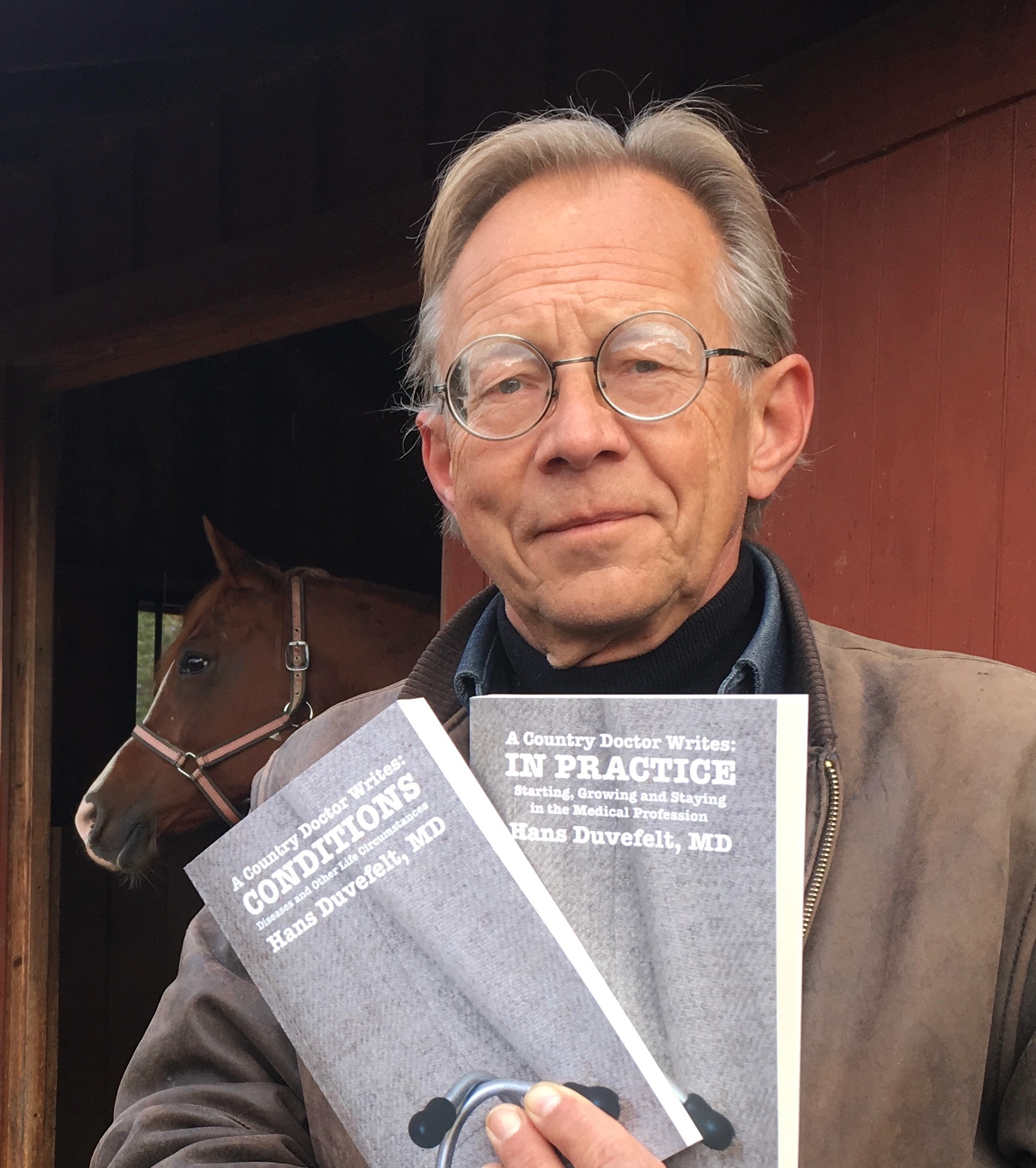
BOOKS BY HANS DUVEFELT, MD

CONDITIONS, Chapter 1: An Old, New Diagnosis

Top 25 Doctor Blogs Award

Doctor Blogs

Enter your email address to subscribe to this blog and receive notifications of new posts by email.

Mailbox

contact @ acountrydoctorwrites.com
Bookmark and Share
© A Country Doctor Writes, LLC 2008-2022 Unauthorized use and/or duplication of this material without express and written permission is strictly prohibited. Excerpts and links may be used, provided that full and clear credit is given.