Archive for the 'Progress Notes' Category


All God’s Children

Joey Lafleur was in for his four-year well child check yesterday morning, and it was a profound moment in a day that was otherwise more or less a blur of acute visits and urgent phone calls.

Joey seemed different from other babies early on to his previous provider. His doctor was Barbara Brennan, my good friend and colleague, who ended up giving up her career as a doctor because of her own health. Her early office notes, referral letters and the various specialist reports read like a medical mystery novel.

Joey didn’t reach his developmental milestones; his eyes didn’t seem right and he had an unusual, broad grin, which he always flashed. By age two he was diagnosed with Williams Syndrome, a rare genetic disorder that affects one in 7,500 newborns.

Joey, in typical fashion for Williams Syndrome children, is extremely gregarious, even with strangers. He is a favorite with the nurses. He isn’t potty trained, cannot make three word sentences, and cannot make age-appropriate drawings.

His parents elected to give him the 4-6 year-old shots yesterday, and he protested loudly. Immediately afterward, he wanted to kiss the nurses.

Yesterday afternoon I saw Marguerite Brown, an eighty-three year old woman with stubborn blood pressure and skin problems. Two months ago she had told me that her daughter, Molly DeLorme, had been diagnosed with inoperable cancer. I have been Marguerite’s doctor for ten or fifteen years, and never realized that her daughter was the woman who wallpapered our house a couple of years ago; after all these years practicing in this community I am still finding out that people I have known for years are related to each other.

Last week I had seen Molly’s obituary in the paper. The same issue of our local paper had a little “In Memoriam” piece about a six-year-old patient of mine, who was killed by falling logs several years ago. His parents are still struggling with their loss.

Marguerite Brown was somber, naturally, as I entered the exam room.

“Why did Molly have to die, why couldn’t it have been me?” she asked, rhetorically.

Tonight I answered telephone calls from two of my three adopted children. Both of them are dealing with the consequences of choices they have made in the past. I have wished for a long time that I could have spared them what they are going through right now, but I am wise enough to know that most of us have to learn things for ourselves, and cannot learn from the mistakes of our parents.

I can imagine the heartache of Joey Lafleur’s parents as they imagine what his life will be like, growing up with Williams Syndrome. I can imagine their grief as they think about all the things he will never do.

We must all remember that our children are only loaned to us. We have a natural desire to see them grow up to be healthy and happy, and more often than not I think we hope they will be a lot like us. Our task and privilege as their parents is to see them for who they are, and help them reach their potential.

A youngster with Down’s or Williams Syndrome can be more capable of receiving and returning the love of their parents than a child without genetic challenges, and a healthy child can be killed in a freak accident in the matter of seconds. The wisest parents cannot protect their children from making their own mistakes, and even the elderly often have to grieve the loss of a child.

No More Headaches!

My 11:45 patient today was Sue Maddocks, who just turned 40. She is a relatively new patient, who told me she had had daily headaches for twenty years. She was taking 20 Tylenol (acetaminophen/paracetamol) a day, and she still had unrelenting headaches along with some pretty severe neck pain. She had had MRI’s of her head and neck and tried all kinds of medications, but nothing helped.

When I first met Sue, she had problems with anemia and that is what we had to deal with first. Two weeks ago we got down to business with her headaches. It was clear that she suffered from rebound headaches; she would have to stop taking Tylenol in order to get rid of her headaches.

There are several methods described in the literature for getting rid of rebound headaches, some more drastic than others – everything from steroids to hospitalization for frequent injections of dihydroergotamine.

My proposal to Sue two weeks ago was that we give her a simple muscle relaxant, cyclobenzaprine 10 mg, 1-2 tablets every night, and that she take the leap of faith to wean herself off the Tylenol. “It’s not helping you anyway, so what do you have to lose?” I suggested. She was willing to give it a try. I warned her she probably would have worse headaches for a while. We agreed on a two-week follow-up.

It was a busy morning, but I was running on time. I took a deep breath as I entered Room 8 at 11:47, not knowing how things had gone since I saw her last. I thought about how to proceed if she hadn’t been able to cut down on her Tylenol.

I knocked and entered the room. Sue got up, gave me a big grin and shook my hand.

“They’re gone!” she exclaimed. “No headaches for a week – for the first time in twenty years!”

“That’s great”, I replied.

“Yesterday I was driving around, and I turned my head and noticed my neck wasn’t hurting – it was only holding up my head!” She was ecstatic.

“That’s all it’s supposed to do”, I said.

I wrote a refillable prescription for cyclobenzaprine and we talked about how long to take it for, and how to taper and stop it.

By twelve o’clock I was out the door and headed home for lunch – much sooner than I had imagined.

The Good Mother

Brenda Norwood was a single mother, doing her best. Her new boyfriend was not necessarily helping her deal with Sadie, and Sadie was a handful.

Sadie was the most sullen teenager I had ever run into. Her hair was orange, her eye makeup looked like something in a late night movie, and she wore a dog collar around her neck. She seemed to despise her mother.

For a brief while I thought I might be able to reach Sadie, but I was mistaken. Her attitude in general, and mostly toward her mother was so terrible that I did something I had never done before: I asked her to leave the room.

Brenda and I talked for a while alone. I gave her some suggestions about what she could do, counselors she might want to call, even the psychiatric hospital’s outreach telephone number and the youth crisis stabilization hotline.

Sadie was physically healthy, and as I wasn’t able to do much for her or her mother, I saw neither one of them for a while. Then one day I heard from Autumn what was happening with Sadie. I swear, Autumn knows more about what is going on in this community than anyone else, even when it comes to the small minority that she isn’t somehow related to!

Word was, Sadie was pregnant, and the father was Mickey Leblanc, a nineteen year old with a similar background history. We were surprised to hear that they were getting married soon after the pregnancy became public knowledge.

Imagine my surprise when Sadie and Mickey brought their newborn son to see me. I must say I didn’t quite know what to expect. There was Mickey, now working as a painter, wearing his work overalls, calm and completely focused on what his son and young wife were doing; Sadie, a pretty strawberry blonde with earnest, kind eyes and a soothing voice, was completely focused on the most beautiful baby boy, a calm, contented little soul, whose entire being seemed to be one with his mother.

Without missing a nuance of our conversation, Sadie did everything automatically for her baby as if she had done it all her life. She was in charge, and Mickey was in quiet attention, ready with a cloth or a hand when needed.

The other day I saw little Sam for his four-year-old well child visit. As usual, Sadie and Mickey were both there; Mickey in paint splattered overalls as usual.

Sam counted fingers, wrote down numbers, named colors and copied shapes for me. He walked toe-heel along the floor tiles and he hopped on one leg.

“This is the five year old stuff we’re doing at age four,” I pointed out. Sadie and Mickey both beamed.

“Sam is a great kid, you know that,” I said. “And I’ve told you this before: You two are doing a great job with him.” Still vividly remembering Sadie in her dog collar, I added: “He’s smart enough that if he gets bored or sees the adults around him not measuring up, he could turn into a real handful for you.”

They both smiled knowingly.

“Doctor, What Would You Do?”

Herbert Beal took me by surprise yesterday morning with his question. He is a 70-year-old oxygen-dependent frail man with severe emphysema and a newly diagnosed 5.9 cm asymptomatic abdominal aortic aneurysm.

The vascular surgeons at our tertiary hospital couldn’t help him, so he was referred on to Massachusetts General Hospital in Boston. They felt his aneurysm could be stented, and his local pulmonologist thought he would tolerate that procedure, but probably not an open repair with a graft.

Thursday morning I got a call from Mass. General. They wanted him to have a cardiac evaluation before the operation next week. The chief of our local cardiology group agreed to see him at 11 am Friday.

Late Thursday afternoon Mr. Beal called because he had a cold and was raising colored sputum. I agreed to see him as a “double book” Friday morning on his way to the cardiologist in town.

In the exam room was Herbert Beal and his wife, who had never come with him to an appointment before. He had rales and rhonchi in both lungs, and deserved an antibiotic, especially with surgery next week. I also offered him a flu shot and made sure they knew how to get to the cardiology clinic.

As I was about to leave the room, Mr. Beal cleared his throat and asked:

“Doctor, what would you do?”

I looked at him again, and he continued: “Would you have the surgery?”

His wife spoke softly: “Herbert and I have talked about this – I understand that death from emphysema can be very uncomfortable, and death from an aneurysm is usually quick…”

I thought for a moment before answering:

“This is a high risk situation. As long as the aneurysm can be stented, your lung doctor thinks you’ll be OK with the surgery, and you’ll soon hear what the cardiologist thinks. If stenting doesn’t work, an open repair would be very risky.”

I paused and thought again.

“We don’t know how long you’ve had this aneurysm, and we don’t know how fast it will grow. If I were in your situation, I’m not sure I’d have the procedure.”

They thanked me and went on to his cardiology appointment.

Just as I was about to leave the clinic last night I got the cardiology report – OK for the stenting, very high risk for an open repair, just as expected. I called the Nurse Practitioner I had talked to before at Mass. General.

“Oh, really”, she said. “I heard from his pulmonologist yesterday, and he told me Mr. Beal had decided against the surgery. I guess we’re still on then – I’ll email the surgeon.”

What a terrible choice to be faced with…

An Innocent Looking Rash

Ted Hall was in for a blood pressure check and flu shot today. He is a secure, big-boned man with a hint of a southern drawl. A retired military man with a son who is a decorated war hero, he has seen a lot, and seems to take everything in stride.

Wrapping up his visit, I looked at his “Problem list”, the cover sheet on the left hand side of the chart that lists his allergies, chronic medical problems, social and family history. A couple of words under “Family History” caught my eye and rekindled my memory. I asked:

“How is Brittany doing?”

He beamed. Brittany was his youngest daughter. I had seen her only once, but I have carried the memory of that June afternoon in my heart for the last 23 years.

It was a stifling hot Thursday afternoon. I was relatively new in town and Brittany Hall was a High School senior, who usually saw a colleague of mine who was off that day. She had a rash on her legs, graduation was the next day, and I agreed to see her as a “double book”.

Entering Room 11, the same room where I saw her father today, I met a pretty, blonde girl with a flowery summer dress. She didn’t look like most girls from around here, and she carried herself differently. She seemed older and more mature than most eighteen year olds.

Brittany felt fine, and was just concerned about an unsightly bright red rash on both legs. It had been there for a couple of days. She wanted it gone, or at least less noticeable by graduation the next day.

The rash that covered both calves of her fair-skinned legs was petechial and didn’t fade when compressed. The rest of her exam was normal.

“These are broken blood vessels,” I explained to her. “We need to run some blood tests.”

Fifteen minutes later I knew for certain what I had already feared. Her white blood cell count was 28,000, all the same kind of cells – she had acute leukemia, and within twenty more minutes I had arranged for her to meet with the oncologist on call at the hospital twenty miles up the road.

As she left the office with Ted, who came to pick up his daughter, she said:

“And I thought I would just get a cream to put on my legs.” 

I never saw her again, but the reports from the Cancer Clinic kept trickling in. She went through chemotherapy, delayed long enough so she could attend her graduation, and then she left for college. Ted was my colleague’s patient, and I would see him occasionally. Dr. Walls left the area, and Ted became my patient a couple of years ago.

I know I had asked him once before about Brittany, and he had told me she was well, but that time we had not pursued the subject more. Today we lingered more with the story we shared.

“She’s 42 now, you know, a beautiful woman” he said, “and she is married and has two gorgeous, healthy children. The cancer doctors had warned her she might never had children, but she had no problems.”

“I’ll never forget that day she came in with the rash on her legs,” I said.

“Me neither,” he choked.


I just realized none of the posts show on an iPad or a computer, but they do show on an iPhone. WordPress is working on this. In the meantime, please visit my Substack.


Osler said “Listen to your patient, he is telling you the diagnosis”. Duvefelt says “Listen to your patient, he is telling you what kind of doctor he needs you to be”.


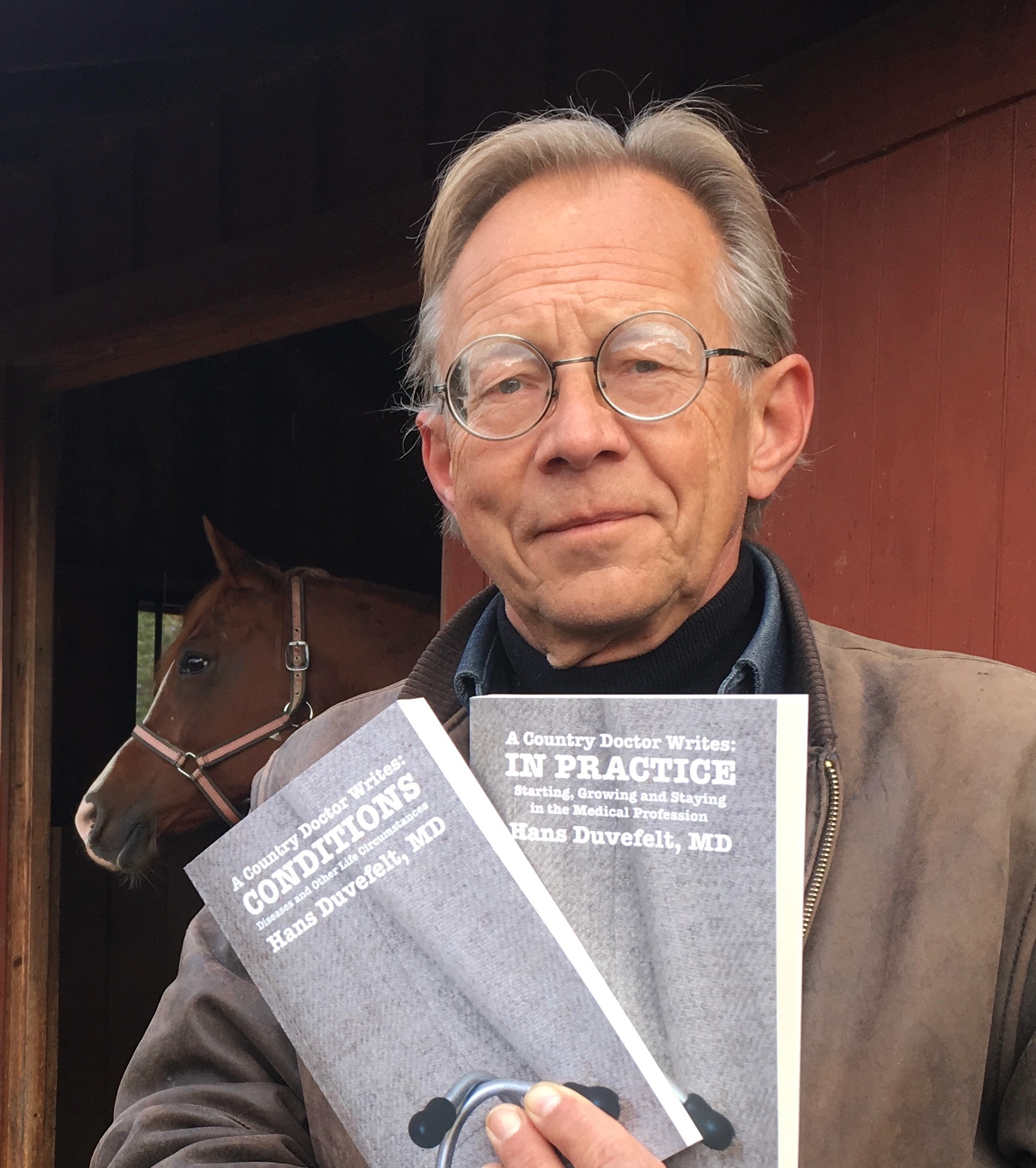
BOOKS BY HANS DUVEFELT, MD

CONDITIONS, Chapter 1: An Old, New Diagnosis

Top 25 Doctor Blogs Award

Doctor Blogs

Enter your email address to subscribe to this blog and receive notifications of new posts by email.

Mailbox

contact @ acountrydoctorwrites.com
Bookmark and Share
© A Country Doctor Writes, LLC 2008-2022 Unauthorized use and/or duplication of this material without express and written permission is strictly prohibited. Excerpts and links may be used, provided that full and clear credit is given.