Archive for the 'Progress Notes' Category


Continuity of Care

We often speak of the importance of continuity of care, but there is confusion about what this really means.

When I first joined our small clinic twenty-five years ago, continuity was the reason every medical group in the five town area had its own night-call roster. This way, patients who called after hours could reach a doctor from their own doctor’s office. Even if the covering physician didn’t know the patient, there was at least an illusion of familiarity. Continuity of care often motivated primary care doctors to do many procedures, which they nowadays may refer patients to specialists for.   Continuity of care was also the reason doctors traveled between their clinics and the hospital more than twenty miles away to care for hospitalized patients.

Over the years, some practices began sharing night call. Many primary care doctors stopped treating fractures and performing high-risk office procedures. The Hospitalist movement came to our area in the 1990’s. Many physicians stopped providing inpatient care, leaving this to specially trained, full time hospital doctors.

Many people lamented the loss of what they thought of as the old-fashioned country doctor, one who did everything and was always available. At the same time the level of sophistication in medicine made it harder for any single primary care doctor to deliver the same quality of care as a specialist in every area of medicine.

Family Medicine has struggled over the past twenty years to make peace with the new division of labor and what may look like a fragmentation of care. Family Physicians can and should be the glue that holds the fragments together. The latest name we use for this old concept is “Medical Home”.

Twenty-five years ago I had a chance encounter with another Family Physician in another community, much like my own newly adopted home town. I have seen his name now and then over the years, but we never met again after that day.

The other day I saw his name in JAMA, the Journal of the American Medical Association. He was the author of an inspiring essay about what real continuity of care is. He describes seeing a patient, who after a failed spine operation wanted to give up. Dr. David Loxterkamp knew the man from treating his aging mother and disease-stricken wife. He knew Bud had the resources to fight for his recovery, but he recognized that Bud was lost in what had happened to him. That knowledge, gained over years in the same community and through sharing in Bud’s family’s tragedies, helped Dr. Loxterkamp guide and motivate his patient to a full recovery.

Dr. Loxterkamp writes:

“Continuity of care is a pillar in the portico of primary care. But it promises more than customer satisfaction or improved health outcomes. When all we measure is the ratio of patient-physician continuity, we miss the point. The tragedy is not when others care for our patients, but when no one cares for them at all.”

“The purpose of continuity is to deepen our relationship with others, something that is utterly impossible if it never begins. It begins in every encounter where the patients feels known and – despite it – loved, or at least respected and cared for by another human being.”

“It cannot be enforced, taught or measured. It must be lived and experienced in the cross connections of real community. As physicians, we are chosen to witness the destruction wreaked by illness and age. Our challenge is to see the patient who has lost sight of himself. Thus, we are called to live where we serve, anchored against the currents of geographic mobility and “professional distance”. How else can we relocate those who have been dislodged from their identity?”

His words reflect my own experience and echo the words of Sir William Osler, the father of modern medicine, mentor to generations of physicians:

“Medicine is an art, not a trade, a calling, not a business, a calling in which your heart will be used equally as much as your head.”

“Recognize … the poetry of the commonplace, of the ordinary man, of the plain toil-worn woman with their loves and their joys, their sorrows and their griefs.”

“…gain the confidence of a patient and inspire him with hope.”

Continuity of care starts with caring.

A Bad Case of Congestion

Friday was unusually hazy, hot and humid for our northern location. My last patient before lunch was a “double book”. Nat Bruehl, an infrequent visitor to our clinic, had called about congestion and an irritated eye. Probably a case of conjunctivitis, everyone involved had concluded, and he was given an appointment within an already filled time slot for a “quick look”.

“I brought my daughter to her high-risk obstetrician’s appointment in Capital City Monday, and she made us drive with the blasted air conditioner on the whole way there and back. Ever since then my eyes seemed irritated”, Nat explained. “I figured I got a cold in them. I took some cold pills that didn’t do any good. Then, last night my right eye started to hurt like a son of a gun and now everything is a little blurry. I even had a hard time driving myself here in this rain storm.”

I looked at his face. His right eye was red, and as I looked closer, I noticed his pupil was enlarged. As I directed my wall mounted light at his eye, the pupil remained dilated and I could see that the fluid behind his cornea was gray and cloudy, barely letting the light through.

I brought him out in the hallway to look at the vision chart.

“Start with your good eye”, I asked him. Outside, lightning struck not far from the office. The earth shook and the fluorescent lights blinked.

He squinted and strained, and missed two letters on the 20/40 line. With his right eye, he couldn’t even do 20/100.

“You’ve got a true emergency”, I explained. “I think you’ve got a dangerous buildup of pressure in your eye because of an internal blockage – a case of acute glaucoma, and I want you to see an ophthalmologist today.

“But I couldn’t drive to the city”, Nat protested. “Not in this weather.”

“I wouldn’t want you to”, I warned him. “You need to find somebody else to drive you.” I also asked for his permission to bring in our head nurse and my own nurse, Autumn, to look at his eye. “I would like everyone here to see what you’ve got”, I explained.

He agreed, and I showed his abnormal eye to our nurses.

I made a call to the nearest ophthalmologist, Mike Dube, but he was off and had signed out to Jeremy Sweet over at Cityside Hospital. After hearing my case description, Dr. Sweet’s assistant gave Nate a 3 o’clock appointment.

“Now, don’t try to drive all the way there yourself”, I warned him. He agreed to find someone to drive him. I gave him directions and went back to my office to catch up on charts and grab a bite of my sandwich. Outside, the sky darkened as if night had already fallen.

The afternoon was a whirlwind. Other places may wind down on Friday afternoons, but not our clinic. Just before 5 o’clock there was a call from Dr. Sweet’s assistant.

“You were right”, she said. “He has a bad case of angle closure glaucoma and we are having a hard time getting his pressures down. It’s 50 even in his good eye. That antihistamine-decongestant he took for three days is probably what did it. Good thing you caught this – we often see people like this bounce around a bit before getting diagnosed.”

I thanked her and made sure to let the staff know about the callback. Flashes of lightning lit up the darkness outside, the thunder roared almost continuously, the floor vibrated and the rain beat hard against my office window as I finished my charts for the week.

“Needs Prior Auth”

Laura Lyons has been in and out of the hospital, the emergency room and her surgeon’s office for the past month.

A cautious, thin woman in her early sixties, Laura had experienced indigestion often, but what she had a month ago was different. She was diagnosed with acute inflammation of the gallbladder and had it removed urgently. The laparoscopic procedure seemed to go well, but shortly thereafter she had to be admitted with severe nausea and abdominal pain again. Even the injections in the emergency room didn’t control her symptoms, so the surgeon put her back in the hospital for a couple of days.

The tests showed no abscess, no remaining little gallstones in the bile duct and no bile leak. The radioactive scan showed that a fair amount of bile traveled from the duodenum to the stomach, and her surgeon prescribed an acid blocker. She seemed to get a little better and went home to recover.

About a week ago Laura developed an infection of her abdominal wall and she got some antibiotics, which seemed to help. Then the nausea and vomiting came back.

When I saw her late in the afternoon the other day she didn’t think the stomach pills were helping. She had been running a low-grade fever on and off and she had a rash, consisting of little red bumps on her torso and arms. I did a careful physical exam but made no other unusual observations to help with the diagnosis.

I racked my brain trying to find the connection between all her symptoms. I got hold of the surgeon and he didn’t know either. She needed more tests and I prepared the orders for her. If she hurried, she could still get them before the hospital lab closed. We agreed that if the shot we gave her in the office for nausea didn’t work, she should go to the ER instead of the lab.

The next morning I saw the lab tests I had ordered, and they were all normal. There were a few extra blood tests, also normal, with one of the emergency physicians listed as the ordering doctor. A few hours later there was a CT scan, also normal. Around 4 o’clock we got reports from an upper and lower endoscopy, showing nothing that would cause nausea, vomiting, fever or abdominal pain, let alone a rash. On the last page, there was only one paragraph. Under the heading “Cityside Hospital, Operative Report” was the surgeon’s conclusion that the patient’s symptoms were probably due to bile reflux into the stomach after all, and she needed to take a double dose of her acid blocker under close supervision by her primary care physician.

At 4:30 we got a fax from the pharmacy. The acid blocker prescription was rejected by Laura’s insurance. The pharmacist had written in bold ink “NEEDS PRIOR AUTH”. The prescription information had the surgeon’s name on it, but it was crossed out and replaced with mine. As I looked closer at the fax, I noticed two numbers at the top of the page. The pharmacy had faxed it to the surgeon and the surgeon had faxed it to me.

So this is where the buck stops, I thought to myself as I printed up the usual Prior Authorization form from the Medicaid website. I filled in the diagnosis “Bile reflux, post cholecystectomy with complications” and attached the last page of her endoscopy report with the surgeon’s comments about intensifying her acid blocker treatment. I do know how to jump through insurance companies’ hoops, or maybe I just have more patience with them than surgeons do.

I still don’t know what is causing Laura’s symptoms, but the surgeon clearly signed off by saying she needs high-dose acid blocker treatment under close supervision by her primary care physician.

After the holiday, I need to take a fresh look at poor Laura Lyons.

The Last Supper

George Piarelli loved food. His Italian-born wife, Bianca, made the creamiest risotto, the most tender chicken and the tangiest sausage he knew. Next to his wife’s cooking, his second passion was wine – bold, richly flavorful northern Italian wines like Bardolino, Montepulciano d’Abruzzo and Barbera d’Alba. No one ever crossed the Piarelli’s threshold without getting a back-slapping bear hug and an invitation to food and wine.

George’s stroke was devastating. He lost his powerful baritone voice and struggled to learn how to just whisper again. He lost almost all movement on one side of his body and worked for months in rehab to regain a fraction of strength.

Worst of all, George lost his ability to swallow. He had a feeding tube placed through a hole in his abdominal wall and lived on a steady infusion of nutrition solution going straight into his stomach without giving him the pleasures of the sight, smell or taste of food.

George spent many quiet hours every day in his room at the nursing home. Sometimes he watched cooking shows. Rarely he listened to Opera music.

A few months ago George asked to see me during rounds. His mouth struggled to form the words and I leaned forward until his breath touched the side of my face.

“I want to eat”, he managed to whisper.

I glanced over at Suzanne, the charge nurse and repeated his statement.

“He’s been asking all week”, she said.

“Do you think you can swallow again?” I asked.

“I know it”, he whispered.

There was a new fervor in his eyes and his face didn’t look as flaccid as before.

“Let’s order a swallow eval and see how you do”, I suggested.

He nodded his head and gave me a thumbs up with his good hand.

The modified barium swallow results came back the following week. According to the speech pathologist, George could handle certain consistencies, but not solids. George was not pleased. He wanted to eat.

“I’ll sign a paper”, he said.

I reminded him how aspiration pneumonia or choking could kill him. He looked away and ended our exchange.

Two months went by. George swallowed his nectar-thick liquids without trouble and barely spoke to me during rounds.

Near the end of last month he waved me closer and whispered:

“I can eat now.”

“Are you sure?” I asked.

“Test me again”, he answered.

His follow-up swallowing evaluation arrived at the office two weeks ago. The concluding paragraph read:

In summary there has been remarkable improvement since the previous study and the patient this time demonstrated adequate swallowing of all consistencies.

Suzanne took my verbal order to let George start trying to eat at the nursing home.

When I saw him at rounds again, Bianca was with him.

“We want to have a birthday party at home next weekend for George”, she explained.

“An Italian feast”, I surmised.

“Absolutely”, she beamed. “Saltimbocca, risotto, chicken cacciatore, all his favorites.”

“How has he done with eating here this week?” I asked.

“No problem whatsoever”, Bianca answered while Suzanna nodded in agreement.

“All right”, I said and shook George’s hand.

The following day George left in the wheelchair van.

Monday morning the fax machine at my office had the news waiting for me:

George Piarelli was admitted to the Intensive Care Unit over the weekend with aspiration pneumonia.

Feeling Like A Doctor

One of the teaching activities I am involved with is a Rural Preceptorship for medical students from one of the major medical schools.

Looking through some of the materials I received a while back, I saw a list of objectives that caught my attention. Students are expected, through their different experiences, to specifically advance in the areas of “talking like a doctor” (giving oral case presentations), “writing like a doctor” (recording chart notes), “thinking like a doctor” (applying clinical knowledge) and “acting like a doctor” (showing professionalism).

I was reminded of my experience when a Hollywood movie crew came to our area many years ago to film a horror movie with a doctor in one of the main roles. I did an insurance physical on the child star, helped the prop man get the medical items he needed and I took care of the film crew’s accidents and illnesses. I also met with the actor who played the young doctor.

Although I had never heard of him, he carried himself like someone who was used to fame and attention. He was casually dressed and looked like he could have been from downstate or even around here if it weren’t for his alligator boots.

The one question I remember him asking me was how disturbed he should be as a young physician when suddenly faced with an accident victim who has had his head partially crushed.

I thought for a while.

The closest I had come to that was early in my first residency, back in Sweden. The first night of the county fair a pretty, seventeen-year-old girl was brought in by ambulance in cardiorespiratory arrest. She was reported to have fallen off a merry-go-round. Ambulance protocols weren’t as advanced then as they are now. She arrived on a stretcher without a back board or rigid neck collar. The chief surgical resident was the doctor in charge of all things surgical in the emergency room at our community hospital. I assisted him as we relieved the ambulance crew giving chest compressions and ventilating her with a bag and mask.

Her pupils were unresponsive and her chest didn’t move with our efforts to ventilate her. As I leaned close and smelled the strange blend of blood and alcohol I have since come to associate with violent deaths, I noticed the swelling around her neck. I knew her windpipe was torn and we were pumping air into the soft tissues of her neck. The surgeon saw it, too, and ordered the resuscitation halted. Carefully, he moved her head, and we both cringed as her neck just continued to move to the side. She must have broken her neck falling off the merry-go-round.

All of it seemed surreal – the beautiful young face with unresponsive blue eyes, the swollen, limp neck and the smell of death and alcohol.

The surgeon called off the code and we covered up her face. Neither one of us said anything, but I could tell he felt as sick about it as I did.

“How disturbed do you think I should be?”

The Hollywood actor repeated his question. His earnest expression came back into focus as I cleared my mind of the images I had carried with me all these years.

“Ummm…….”, I answered, “quite disturbed”.


I just realized none of the posts show on an iPad or a computer, but they do show on an iPhone. WordPress is working on this. In the meantime, please visit my Substack.


Osler said “Listen to your patient, he is telling you the diagnosis”. Duvefelt says “Listen to your patient, he is telling you what kind of doctor he needs you to be”.


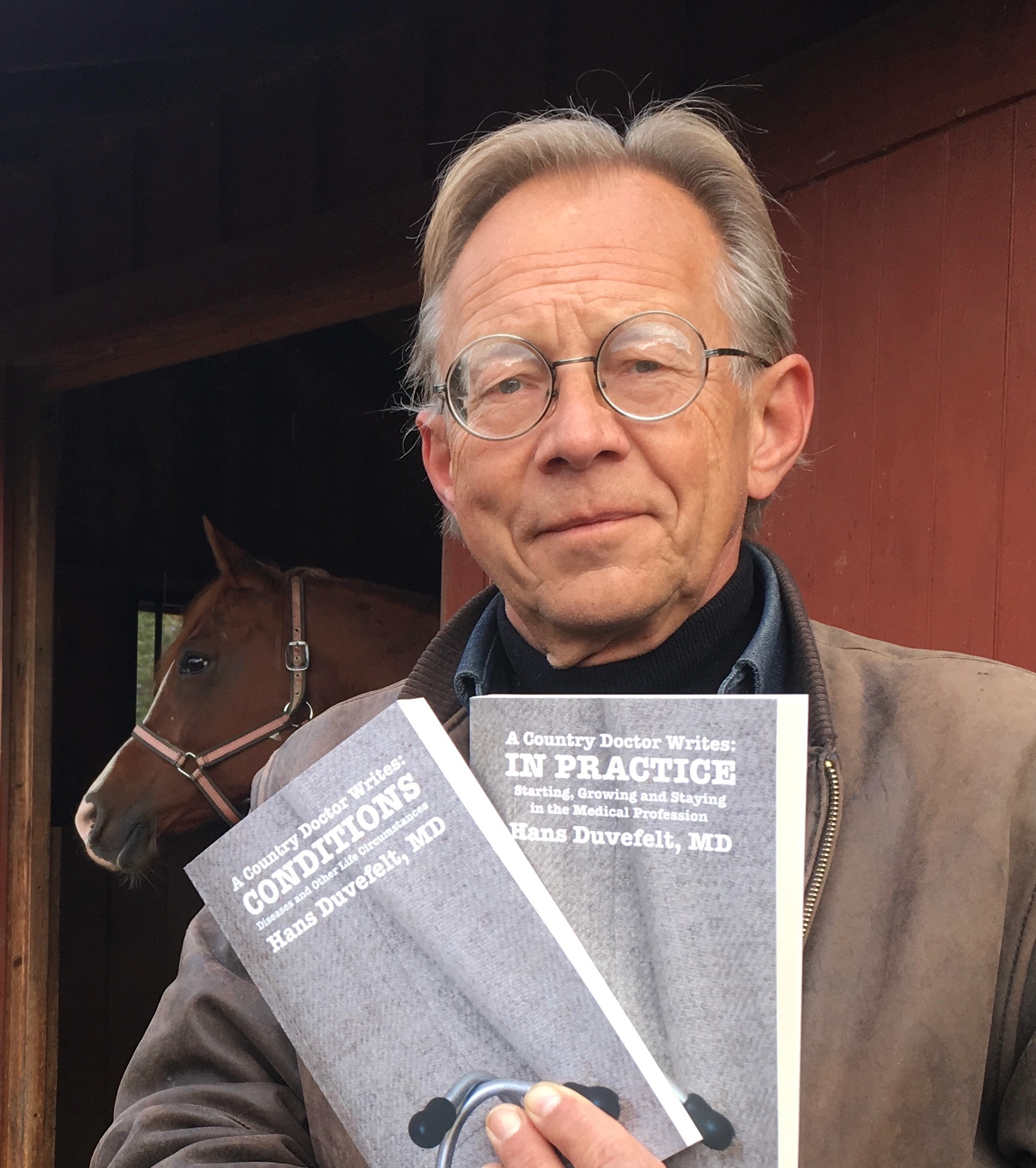
BOOKS BY HANS DUVEFELT, MD

CONDITIONS, Chapter 1: An Old, New Diagnosis

Top 25 Doctor Blogs Award

Doctor Blogs

Enter your email address to subscribe to this blog and receive notifications of new posts by email.

Mailbox

contact @ acountrydoctorwrites.com
Bookmark and Share
© A Country Doctor Writes, LLC 2008-2022 Unauthorized use and/or duplication of this material without express and written permission is strictly prohibited. Excerpts and links may be used, provided that full and clear credit is given.