Archive for the 'Progress Notes' Category


The Call

I got the call again tonight. It’s always the same:

“Hello, Doc, Officer Moran here. We have an unattended death…”

The patient’s age, gender and circumstances aren’t predictable, but it’s always the same story. Once again, someone died, who wasn’t supposed to die.

I never get used to getting these kinds of calls, even after all these years. They wake me up early on Saturday mornings, they come in the middle of a late supper, they come while I work and when I rest.

An unemployed sixty-two year-old woman on pain medications is found dead in her bed one morning; a successful businessman dies suddenly behind the wheel of his Mercedes near the golf course; a father, who lost his parental rights in a divorce, is found hanging from the rafters of his barn.

These calls last only a minute or two, but their effects linger and accumulate, one by one and over the years. They are different from losing patients to illnesses that span over time, however short. They offer glimpses into desperate recesses of people’s lives and they announce medical disasters I never saw coming.

Each call stops my day, suspends my own life, while my mind brings forth images of the patient and my last interactions with them. Was there any clue that this could happen? Did I do everything I could with what I knew at the time?

I gather my thoughts, register the emptiness, and try to return to where I was before the call came. If I am at work, I must quickly get back to a waiting patient, who expects my full attention. At home, my family understands and gives me latitude. It does take time to work through the emotions after these calls, even after thirty years in this business. That’s probably a good sign.

Fearing the Worst

Seeing George Hess last Friday, I almost gasped as I registered his dramatic weight loss over the last four months. His complexion was pasty, his cheekbones protruding and his eyes sunken, yet intense with an expression of anguish, framed by dark circles.

He seemed tired and not himself. He barely spoke at first. Harriet, his wife, listed all the symptoms George had developed since I last saw him: severe, unrelenting back pain at first, followed by steady abdominal pain, loss of appetite and later intense nausea with vomiting with most attempts at eating.

George was always thin, but now he looked cachectic after losing more than twenty pounds. His eyes showed no jaundice and his urine and bowels had normal color. His back wasn’t tender, but his abdomen was tender just about everywhere, yet soft. I couldn’t feel his liver, spleen or any tumors.

“You’ve got to help me”, he said in a quiet voice. “I can’t go on like this”. Even when he was quite ill last year with diverticulitis, he had not looked or acted like this.

“We need some bloodwork right away and then some x-rays. We should know by Monday or Tuesday what this is”, I said. In my mind I wondered if this was yet another case of pancreas cancer. I have seen several in the past five or six years. My wife, in her entire career, has never seen one.

I prescribed some pain medication and something for nausea and sent George to the lab. I needed to know if his kidneys could tolerate the CT scan contrast and I wondered if he was anemic and what his liver and pancreas chemistries would show.

By the close of business his blood test results were back – all normal, except nearly borderline kidney function for using contrast. We couldn’t get a CT scheduled until late Monday. I worried over the weekend what was the matter with George. I even described the clinical scenario to my wife over dinner as I reviewed in my mind what I knew so far about George’s case. She thought for a moment, then asked if the patient still had his gallbladder and wondered if I had considered ordering a gallbladder ultrasound before thinking pancreas cancer and CT scan.

“He just looked too sick, and his eyes had that intense, terrified stare all my other pancreatic cancer patients have had”, I explained.

Yesterday the radiologist called me and said he wasn’t comfortable using contrast. By his calculation, George was just under the creatinine clearance limit.

“Do it without contrast then”, I said. “You’ve got him there, and maybe we’ll see something.”

The rest of the afternoon went by and I didn’t hear anything from the x-ray department.

Mid-morning today the report came in. The CT scan showed no evidence of any tumors or fluid in his abdomen. It did show that in comparison with last year’s scan, George’s gallbladder was significantly larger, but no gallstones were visible. The radiologist suggested an ultrasound to better assess for gallstones.

I guess my wife was right in reminding me of one of my own favorite expressions: Common things are common.

Mechanical Voices

Today at the nursing home in the next town, where I occasionally admit patients, there was an elderly gentleman sitting in a chair right across from the nurses’ station. As he leaned forward in his chair, a red light turned on at the top of a small box on the back of his chair and a slightly metallic woman’s voice said sternly “Albert, please sit down” four times in a row. The old man just sat there, frozen, and a bewildered frown spread across his brow.

“I am sitting down”, he said in a meek and exasperated voice as one of the nurse’s aides came over. She explained to the old gentleman that he needed to lean back more in his chair as she silenced the alarm.

A curious sadness filled my heart as I returned to my charting at the nurses’ station. The mechanical voice had started inappropriately just because the poor fellow leaned forward in his chair, and at the time of day this took place, in the middle of the afternoon and right across from the nurses’ station, the whole electronic getup seemed unnecessary and a bit dehumanizing.

It reminded me of a video presentation I had witnessed about heart failure patients in their homes, sitting down in front of a computer screen with a blood pressure cuff and an oximeter. After entering their information and strapping on the blood pressure cuff, a computerized voice said “Good job!” and the elderly person would get on with their morning routine while a Registered Nurse somewhere would start her day at her computer screen and see the uploaded information from her various clients. She would then call the ones who had gained weight or showed abnormal vital signs. I remember feeling a bit disturbed about the computerized voice giving positive feedback to an elderly woman, who seemed a bit forlorn as she navigated the digital communication. I wondered how much longer it would have taken if she and the nurse had been on the telephone together at that time and chatted in person about how she was doing.

Health care without the personal touch is not what it used to be when people answered telephones and gave comfort and advise in person.

Today I also had to call the cardiology office at Cityside Hospital. The computerized voice said what she always says:

“Thank you for calling Cityside Cardiology. Please listen to the entire menu as our options have changed. If this is an emergency, please hang up and dial 911 or your local emergency number. If you are a physician or a physician extender and need to speak to a cardiologist now, please press ‘one’.” The other options were many and confusing and I was relieved I wasn’t elderly, sick or scared and trying to maneuver that system. The automated switchboards also don’t work for those of my patients who have rotary phones.

Our clinic doesn’t have the latest technology, and I am proud that we have human beings answering the telephones for our patients.

This evening, I had to call American Express to pay my monthly bill. A cheerful, youngish woman asked me to punch in my credit card number, then said “just a moment while I look up your account – okay, found it! – and for security purposes, I see that the number you are calling from matches…” Her comforting voice walked me through the transaction I have made so many times before, and even remembered my checking account number from last time. At the end, she said in a reassuring tone “You’re all set…”, gave me my confirmation and told me “you can go ahead and hang up”. She sounded nicer than many of the live voices I had talked to today. Actually, she was a pleasure to deal with.

Mechanical voices and computers can be okay if they make a transaction convenient, quick and logical, like using the automated check-in at the airport if you are an experienced traveler. But if you are unfamiliar with the system, elderly, sick or scared, you deserve a human voice with some heart and caring behind it.

Dinner With A Homeopath

My friend Dr. Barbara Brennan invited us for dinner this weekend. I had not heard from her in quite a while. She had called me two years ago, after I wrote about her decision to give up her practice when she became ill.

This time her call was prompted by a couple of things I wrote recently. I had used Hippocrates’ word “miasmic” in “A Walking Time-Bomb” and I quoted Hippocrates’ words about “love of humanity” in “Bitter Medicine”.

After the usual greetings, Barbara took us into her home office, which still looked like a physician’s study, but along one wall was a new set of bookcases, filled with less familiar titles.

“I’ve been studying”, Barbara explained, as her hand moved along books with homeopathic titles.

Samuel Hahnemann, physician and the founder of homeopathy, used Hippocrates’ word “miasm” for chronic diseases and inherited states of dis-ease. I was aware of that, but Barbara quickly brought my wife and me up to date on how this concept applies to modern homeopathy and modern diseases.

Barbara has been studying homeopathy online, at her own pace because of her condition, and is quite far along because of her foundation as a brilliant allopathic physician. Barbara also swears that the homeopathic remedies have helped her regain her health and her stamina.

Ironically, Hahnemann is the one who coined the term “allopathic”, and it was not intended to be a term of flattery. The mainstream medicine of Hahnemann’s time relied on bloodletting, purges and many other barbaric treatments, which didn’t stand the test of time. Hahnemann was a well read linguist, who supported his growing family by translating scientific texts because he couldn’t bring himself to embrace the medical practice of his era. He was, however, quick to adopt the germ theory and many of the emerging concepts of disease.

Over an exquisite dinner with Italian haddock with risotto and a nice Chianti, Barbara told us that not only is she now a student of homeopathy, she had also been helped by it. She is getting her energy back, and she is starting to feel well again.

One of Barbara’s mentors, Dr. Luc De Schepper, is, like Samuel Hahnemann, a European physician, who turned toward homeopathy when he didn’t find traditional medicine to address all the needs of his patients. In the concluding chapter of his book “Hahnemann Revisited” he quotes the same Hippocratic passage I quoted in my recent blog post:

“if an opportunity arises for helping a poor man, one should do so as best as one can, for he who loves men must also love the art of healing.”                                                                Hippocrates

Dr. De Schepper continues:

“Allopathic medicine is in a devastating financial crisis, with hospitals going bankrupt all around us and nearly 50 million Americans lacking health insurance; homeopathy can offer health care which is both effective and extremely cost-effective. Many allopathic medicines and procedures cause painful or harmful side effects, to the point that allopathic practitioners come to my school in despair, declaring that they cannot in good conscience continue to practice what they know…

…Let us look beyond the obvious, however, and consider our role as healers, our relationship with our patients, and our purpose in healing… 

…In homeopathy the dynamic between practitioner and patient is more balanced, which provides greater empowerment and involvement to the patient and greater fulfillment to the practitioner.”

I listened to Barbara, to the passion and conviction in her voice; I watched her new vitality and felt her energy. She has more of it now than in her prime as an allopath. I looked at some of the modern texts she was reading and I thought to myself: Did we, the allopathic physicians, simply drop our Olympic torch? Have other kinds of practitioners stolen our fire, or did our negligence inspire them to step in where we used to be?

As I read in a Wall Street Journal article this weekend that the diabetes drug Avandia can now only be prescribed as a last resort due to its links to cardiac deaths, I remembered how, not very long ago, there was pressure on my profession to prescribe it routinely and early in the course of diabetic treatment because it was supposed to decrease death rates in diabetics.

Are today’s allopathic physicians becoming the bloodletters and purgers of a new dark era of uncaring brutality in medicine, leaving the torch of compassion for humanity and passion for healing to be carried by practitioners of what we disdainfully call alternative medicine?

Doing Nothing

“To do nothing is sometimes a good remedy.”      Hippocrates

Hippocrates

Edna Frost is 88 years old, a slender, slow-talking woman with a dry sense of humor and a blood pressure that’s all over the place. At best, she runs ten points higher than any of her previous doctors wanted to put up with. At worst, she flirts with systolics over 200, but that doesn’t seem to be a common occurrence.

Edna has been my patient for the past three or four months. She moved up here from Georgia to live with her daughter, who retired this summer.

When I first met her, Edna didn’t mince her words:

“These medications make me sick”, she announced. “They make me tired and dizzy and sick to my stomach.”

I looked through her old medical records. She had been on everything imaginable, and nothing really controlled her blood pressure better than the three medications she came to me on, a beta-blocker, an ACE inhibitor and a diuretic.

In our first visit we agreed to cut her beta-blocker dose in half, since that one was my first suspect, even though her blood pressure didn’t drop when I asked her to stand up. The evidence today seems to favor the other two over beta-blockers as far as heart attack and stroke prevention. I asked her to bring her blood pressure cuff to her next visit, so we could compare hers and mine to make sure our readings agreed.

The second visit took place with the same symptoms, the same erratic home blood pressure readings and a good match between Edna’s blood pressure cuff and mine. I suggested we stop her beta-blocker completely. I didn’t have to ask her twice.

Our third visit came and Edna was just as tired, dizzy and nauseous as before, and her blood pressure was still all over the map. This time I asked her to stop her ACE-inhibitor.

Visit number four brought no good news, so we switched and had her stop the diuretic and restart her ace-inhibitor. I was a little apprehensive about stopping everything, given the small blood pressure spikes she seemed to have now and then.

At the fifth visit, with side effects and blood pressure readings completely unchanged, I threw in the towel and gave her permission to stop everything.

She grinned and thanked me.

Today I saw Edna back, off everything and with the same erratic home blood pressure recordings, low 140’s most of the time, 165-170 very occasionally. But she was all smiles and said, for the first time since I met her:

“I feel great!”

I wanted to make sure I had understood her correctly. “You feel better now than on any of the blood pressure medicines you have taken over the years?”

“Absolutely!” Her conviction was clear.

I took a deep breath and continued: “So far I haven’t seen the medications make any difference in your blood pressure. It’s still possible some other combination of medications might control your blood pressure better, but I can’t promise you they would be side-effect-free.”

“I’d rather leave things the way they are.”

I knew her answer before I asked: “Would you want to go without blood pressure medication, even if that means your risk of stroke or heart attack is higher than if we can bring your blood pressure down some?”

“Yes, because I don’t want to feel sick the way I did before.”

“I understand, and I admit you’ve tried just about everything”, I told her. “Actually, your blood pressure would have been called normal for someone your age thirty years ago, and the pendulum has started to swing back in that direction. Some of the journals have been writing that we are pushing older patients’ blood pressure too low and may be causing complications from low blood pressures.”

“See, you shouldn’t worry about my blood pressure!” She reached over and poked my arm.

I smiled. “Perhaps not, but I have to tell you that it may start to climb some day, and you’d need to let me know if it does.”

“Why would it?”

I explained: “Sometimes the fluid pill you were taking continues to affect a person’s blood pressure for months after they stop it.”

Surprised, she raised her eyebrows. “So, how often would you want me to check my blood pressure?”

“Twice a week.”

“I’ll do that – for you.”

“And I’d like to check it again in the office some time after New Year’s”, I said, almost expecting resistance.

“I’ll let you”, she said, already getting up from her chair.

Edna and her daughter left the office clearly relieved. Sometimes the treatment seems worse than the disease.


I just realized none of the posts show on an iPad or a computer, but they do show on an iPhone. WordPress is working on this. In the meantime, please visit my Substack.


Osler said “Listen to your patient, he is telling you the diagnosis”. Duvefelt says “Listen to your patient, he is telling you what kind of doctor he needs you to be”.


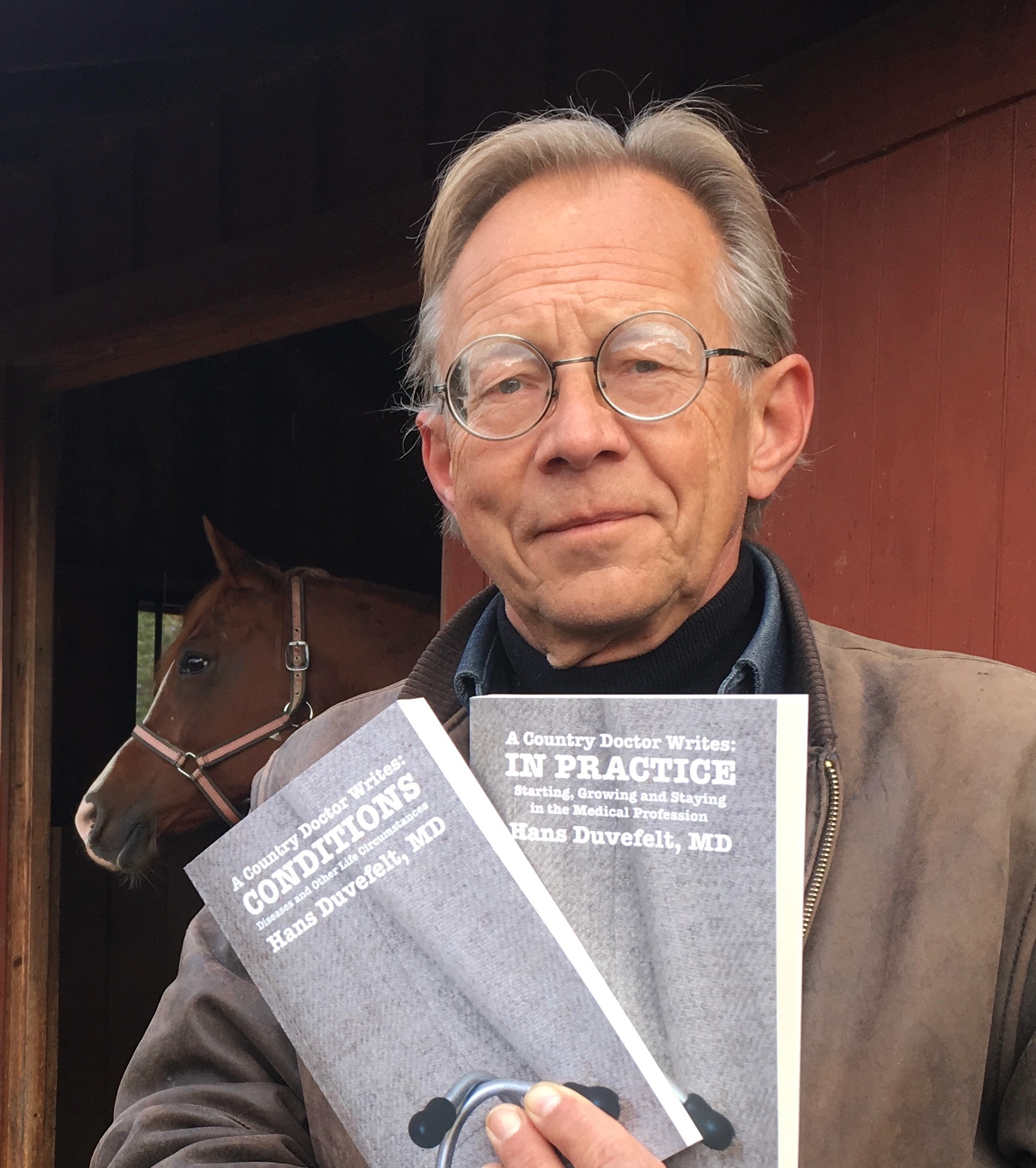
BOOKS BY HANS DUVEFELT, MD

CONDITIONS, Chapter 1: An Old, New Diagnosis

Top 25 Doctor Blogs Award

Doctor Blogs

Enter your email address to subscribe to this blog and receive notifications of new posts by email.

Mailbox

contact @ acountrydoctorwrites.com
Bookmark and Share
© A Country Doctor Writes, LLC 2008-2022 Unauthorized use and/or duplication of this material without express and written permission is strictly prohibited. Excerpts and links may be used, provided that full and clear credit is given.