Archive for the 'Progress Notes' Category


Two Red Herrings

Rodney Grussman is a mild-mannered, unassuming seventy-year-old man with diabetes, emphysema and valvular heart disease. I see him every three months to monitor his bloodwork and his symptoms. He sees his pulmonologist about twice a year and has a couple of nodules in his right lung Dr. Welch is following.

At his last three-month-visit everything seemed fine, except he was at the tail end of a cold, which seemed to have left him slightly short of breath. His exam was normal, his oxygen saturation hovered around his baseline, and we agreed that he would let me know if he didn’t bounce back over the next week or so.

Almost two months later, Rodney came back to see me.

“Doctor, I am so winded. I have lost my stamina since I had that cold.”

His exam was unchanged. I wondered if he could have had a silent heart attack or if something was going on with his lungs. His EKG was unchanged, but his chest x-ray suggested a couple of new, very small nodules in his left upper lobe.

I ordered an echocardiogram because of his leaky valve and referred him back to Dr. Welch for his opinion.

The echo showed no deterioration of Rodney’s pump function; his ejection fraction was still 40%, just like three years ago. That is a little lower than the 55% considered normal. His valves looked about the same as two years ago.

I waited for Jerry Welch’s report, but didn’t hear anything for a while. Then I found out that he was trying to get insurance approval for a PET-scan because the new nodules in Rodney’s left lung looked suspicious on a non-contrast CT scan. Due to his compromised kidney function, Rodney can’t have intravenous contrast dye with his CT scans.

The PET-scan finally came back normal. Rodney came back to see me. His pulmonology report focused on the new lung nodules much more than Rodney’s shortness of breath.

As I listened to Rodney’s story again, it struck me: His heart was still decent, his lungs no worse than before, but what about the oxygen carrying capacity of his blood? A simple blood count showed he was quite anemic, and his stool test was positive for blood. He’s getting his upper and lower endoscopy next week.

I hadn’t considered all my ABC’s from my emergency training – A for Airway, B for Breathing and C for Circulation, although for more chronic conditions, perhaps it should be A for Anemia, B for Breathing and C for Circulation.

A Red Herring

When Joel Mulholland fell off his garage roof last winter he must have hit every bone in his upper body. The muscular, tattoo-armed, motorcycle-riding fifty-five-year old, who had never complained of pain or even taken a sick day before, became almost unable to work.

His x-rays at the emergency room showed no fractures and his blood tests during our office follow-ups showed no evidence of any inflammatory disease. Our local rheumatologist, Norm Fahler, saw him several times and made a diagnosis of cervical myofascial syndrome. I followed Joel for his cholesterol medication. The blood tests showed no sign of muscle damage from the medication. I even asked him not to take the pills for a month to make sure they weren’t causing his muscle and joint pain.

The muscle relaxant and nonsteroidal medications offered him some relief, but the physical therapy did not. Joel was discouraged. He had a brand new Harley-Davidson motorcycle sitting in his new garage, and he told me he was beginning to wonder if he would be able to ride it when spring came.

Joel’s neck seemed to get slowly better. He had full range of motion and not as much tenderness as before, but his shoulders were in constant pain and his range of motion was not improving.

He had some heartburn, so I gave him an acid blocker, concerned that his arthritis medication might be putting him at risk for an ulcer. That took care of his indigestion, but soon thereafter Joel’s appetite started to dwindle. We did some blood tests again and I made a follow-up appointment for the following week.

The day after our appointment Joel’s wife called. This was unusual; he never let anyone else speak for him. She reported that he was nauseous and had vomited twice that morning. I called in some nausea medication and advised Sandy to bring him to the hospital if the vomiting wasn’t controlled with the medication.

That weekend felt like the first day of spring. The sun was bright, the roads were dry, and there were motorcycles in town and on the County road. I kept thinking of Joel and his new Harley-Davidson. What was wrong with him?

Monday morning’s faxes from the hospital brought the answer: Joel was admitted for intractable vomiting. His blood tests were normal, except for some signs of dehydration. His scans showed a normal looking liver, pancreas and gallbladder, but there was a little fluid at the bottom of his right lung and in the upper lobe there was a large tumor that had not been visible on plain x-rays.

I copied the hospital reports to the rheumatologist, who called me right back. Joel’s muscle and joint symptoms, in retrospect, were part of a paraneoplastic syndrome. “We were fooled”, Dr. Fahler said. “The fall from the roof was a red herring. It was cancer pain all along.”

Joel did get to ride his Harley-Davidson just a few times during the two short months of therapy he had before his cancer got the upper hand again.

“I Need A Doctor When I’m Sick!”

My new patient leaned back in the exam room chair and fixed his eyes on me.

“I don’t need a doctor to tell me that I need a bunch of tests or medications. I know that if I lost weight and ate better I might live longer.” He paused as if to measure my reaction before continuing:

“I know my heart isn’t in good shape. All I’m looking for is a doctor who will give me my fluid pills and treat me if I have a cold or get cellulitis or something that’s fixable. Can you do that for me?”

“Sure”, I nodded.

“You know, the last few doctors I had all wanted to run my life and tell me what to do, but it’s my body and I don’t want to take a bunch of statins and things that don’t help me feel better now.”

“So you didn’t stay with them…” I began. He was talking faster now, and interrupted me:

“One even fired me because I refused to do what he told me! And I fired the next one before he had a chance to do the same thing. I could just see where that one was headed!”

His face was getting red and he shifted in his chair.

“Well,” I began, “I never tell anybody what to do.”

He raised his eyebrows. I continued:

“My job is to give you options and help you find ones that work for you. There’s no law that says people have to take cholesterol pills or go for colonoscopies. You don’t have to change the oil in your car every 3,000 miles unless you want to, right?”

He grinned.

“If you never change the oil, your warranty might be void, but your car may work just fine anyway.”

He nodded. “I get ‘ya.”

“Here’s what I would ask of you if you keep me as your doctor: If I prescribe your fluid pills, I would want to see you and get some basic blood work maybe twice a year to make sure the pills I give you don’t cause any problems with your potassium or kidney function.”

“That sounds reasonable”, he said, sounding relieved.

“Other than that”, I continued, “you see me if you need me.”

“It’s a deal!” He shook my hand.

He hesitated for a moment.

“About this colonoscopy thing. I had a prostate exam by a specialist a couple of years ago, and he said I didn’t need a scope…”

“Urologists do a different kind of scope. They do cystoscopies to look inside the bladder. That’s probably what he was referring to and not a colonoscopy.”

“Huh, really?”

“Yes. Didn’t someone in your family have colon cancer?”

“My brother did. He’s got a bag now. He’s five years older than me.”

“Hmm, you might want to get checked then. Your risk is increased because of that.”

“Yeah, maybe I should. Would you do it in my situation?”

“I would and I did. It’s in my family history, too, so I had one a few years ago.”

He thought for a moment.

“Okay, Doc, set me up!”

“Sure. We’ll set you up with the gastroenterology group at Cityside.”

“Thanks. I’ll see you in six months.” He shook my hand again and added:

“Unless I get sick and need you sooner!”

“Will You Be My Doctor?”

My new nursing home admit greeted me with his fist raised as I made my way down the corridor to the nurses’ station. His eyes locked onto mine and he waved his fist in the air while hollering:

“Twenty-two! Twenty-two!”

I had no idea what he was trying to tell me. I stopped and laid my hand on his other, half-flaccid, arm.

“I’ll be back to talk with you in a little while, I promise.”

He lowered his fist, seemed to relax, and nodded at me.

Greg Booker, the charge nurse told me, was very quick-tempered and had already punched another resident earlier in the day. He had suffered a stroke as a result of a cardiac arrest at the factory where he worked as a foreman. While at the acute care hospital, he had regained much of the strength in his right arm and leg, but he was unable to speak in sentences and struggled to utter even single words.

“And, by the way, he hates to take medicines”, nurse Alice added. “Good luck talking with him. He’s got a really short fuse.”

Mr. Booker’s medical history was well documented in the hospital discharge summary. So was his social history. He was single with no family nearby. Without being able to speak, his life was changed forever, as profoundly as if he had remained paralyzed. I wondered if his short temper was related to injury to his frontal lobe resulting in difficulty controlling his impulses, or if it was just a reflection of his frustration at not being able to say what he wanted to get across, or possibly both.

I entered his room. He stood up and offered his right hand. His face grimaced as he worked to raise his arm and form the words:

“Doctor…uhm…I…I have…eh…twenty-two…uhm…I mean…why…twenty-two meh…aaah…”

He ran his left hand through his unruly salt-and-pepper colored hair and his face contorted as he made a high-pitched grunt.

“Twenty-two”, he said, exasperated.

“You’re taking twenty-two pills a day?”

“Yesss!” he nodded emphatically.

“That sounds like a lot. Let me listen to your heart and lungs and check your circulation and things, and we’ll see if we can’t get rid of some of those pills.”

“Okay. Okay!”

He cooperated for the exam, which, other than his expressive aphasia and mild residual right-sided weakness, was normal.

“All right, let’s go over these medications together. Did you take any medications before you got sick?”

His mouth moved, he squinted and his cheeks contracted asymmetrically.

“Not any” he said after a while.

We both leaned over his chart as I started at the top of his medication list.

“This is just an aspirin. It cuts middle-aged guys’ heart attack risk by 25%. Even I take one of these every day.”

“Oh-kay” he blurted with the emphasis on the second syllable.

“This one is for cholesterol. It also cuts heart attack and stroke risk, by up to 50%. I think we should keep it, but these next two are basically vitamins. I don’t think you have to take them at all.”

“Oh-kay.”

“This one is a stool softener. Are you constipated?”

He shook his head. I crossed out the third pill and we continued down the list. His blood pressure pills stayed, but it didn’t seem like he needed to take his fluid pill three times a day. He showed no signs of heart failure or fluid overload.

“I think we can stop two of the three doses of this fluid pill. If we weigh you every day we’ll see if you start to hold on to fluid without them.”

“Oh-kay” he smiled. We were on a roll.

“Now, this one is for prostate trouble. Did you have slow urination before your heart attack or did you have to get up to go to the bathroom a lot at night?”

“Na-ah!” He shook his head vigorously.

“I bet you had a Foley catheter for your urine for a while when you were really sick. You’ll probably be able to stop it.”

He beamed.

After we had finished, he still had plenty of pills left to take, but it was obvious from his expression that he was pleased.

He started to work on saying something again. After several false starts he was able to say:

“After…I mean…uhm…after this…uh…after I’m…uh…after I’m here…will…will…will you, will you…will you…”

He slapped himself in frustration but no more words would come out.

His eyes met mine and he shrugged.

“Are you asking if I will be your doctor after you get done here?”

He grinned. “Yesss!”

“I’d be honored to.”

He grabbed and shook my hand and suddenly his right hand seemed strong and purposeful.

A Deadly Interaction

I, like most primary care physicians, have many patients on chronic “blood thinners”. Warfarin, essentially the same chemical as rat poison, is the most common drug we use, and it can be difficult to manage. Because its effects are counteracted by vitamin K, simple dietary changes like eating fewer or more greens can change the effects of warfarin. There are also many drug interactions to keep in mind.

Because of these interactions we never assume that patients can stay on the same dose of warfarin indefinitely. Some people’s numbers vary enough to warrant testing a few times per week. Our clinic’s minimum standard is that even stable patients get a blood test once a month to monitor the medication’s effect.

We measure the “prothrombin time”, or how many seconds the blood takes to clot, and “INR”, International Normalized Ratio, which is, roughly speaking, how long a patient’s blood takes to clot compared to an untreated person’s blood. We typically strive for an INR of 2 to 3, which is 2 or 3 times the normal, untreated, clotting time.

Antibiotics are among the most common drugs that interact with warfarin. Only a handful of antibiotics are safe in this regard. Penicillins, cephalosporins and nitofurantoin are choices we don’t worry about. Azithromycin sometimes interferes, and common urinary antibiotics like sulfa and ciprofloxacin almost always interfere to some degree.

Florence Fitch, an elderly patient of mine with atrial fibrillation, had a urinary tract infection and had seven days of ciprofloxacin prescribed by another doctor. She ended up in the hospital with an intestinal hemorrhage and needed two units of blood.

Today I saw Gwen Hubert. She has high cholesterol and atrial fibrillation. She must have been on warfarin and simvastatin for ten years. Her numbers were always quite stable. When I saw Gwen the last time, she had complained of fairly significant muscle aches. Her cholesterol was perfect and her creatine phosphokinase (CPK) test didn’t show any sign of muscle damage. Still, even when there is no damage, people on simvastatin as well as all the other statins can have bothersome muscle aches.

At our last visit, Gwen and I agreed that she would not take the simvastatin for three to four weeks. If there was no difference, she was to start her cholesterol pill again and see me a month or so later.

She had had an INR drawn the other day and her level was high enough that we had called her to tell her to skip a day of warfarin and start taking a lower dose after that.

Gwen was concerned when I saw her.

“I’ve never had a high INR before. Do you think starting the simvastatin again caused a problem with my warfarin?”

I looked at her flowsheet. About the time we stopped her simvastatin her INR had dropped. I hadn’t thought much of it and just increased her warfarin dose a little. The following week her number was higher, but still not in range, so we had her increase her dose some more. That took care of it. Then, when she started the simvastatin again, her INR went up to 4.

“I haven’t seen simvastatin do that before, but I’ll look it up.”

Our usual drug interaction website didn’t respond. The first result on my Google search was an abstract of an article from Oslo, Norway, published in 2007:

An 82-year-old white female was admitted to the hospital because of an international normalized ratio (INR) value greater than 8, which was detected at a routine follow-up visit to monitor warfarin therapy. Four weeks earlier her lipid-lowering therapy had been switched from atorvastatin 10 mg daily to simvastatin 10 mg daily. She had been treated with 2.5 mg of warfarin daily for almost 30 years due to episodes of deep venous thrombosis and lung embolism. Her INR had been stable within the treatment range (2.0-3.5) for more than 2 years before the INR increase. Upon hospitalization, she was given 5 mg of vitamin K orally. A few hours later she lost the feeling and movement of her right arm and a computed tomography scan showed major bleeding in the left cerebral hemisphere. She died the following day.

DISCUSSION: One study has shown a lack of interaction between warfarin and atorvastatin. In comparison, 3 studies have shown significant increases (10-30%) in warfarin effect and/or reductions in dose requirement after starting concomitant simvastatin treatment. The interaction mechanism between simvastatin and warfarin is not known but is possibly associated with reduced elimination of warfarin. Use of the Naranjo probability scale showed that the likelihood of warfarin-induced INR increase following the switch to simvastatin was probable.

CONCLUSIONS: Atorvastatin and simvastatin appear to differ in their potential to interact with warfarin. Clinicians should be aware of the interaction risk when starting simvastatin treatment in patients on warfarin therapy. 

In Gwen’s case, restarting a drug she had been on for over a decade could have had the same deadly effect.


I just realized none of the posts show on an iPad or a computer, but they do show on an iPhone. WordPress is working on this. In the meantime, please visit my Substack.


Osler said “Listen to your patient, he is telling you the diagnosis”. Duvefelt says “Listen to your patient, he is telling you what kind of doctor he needs you to be”.


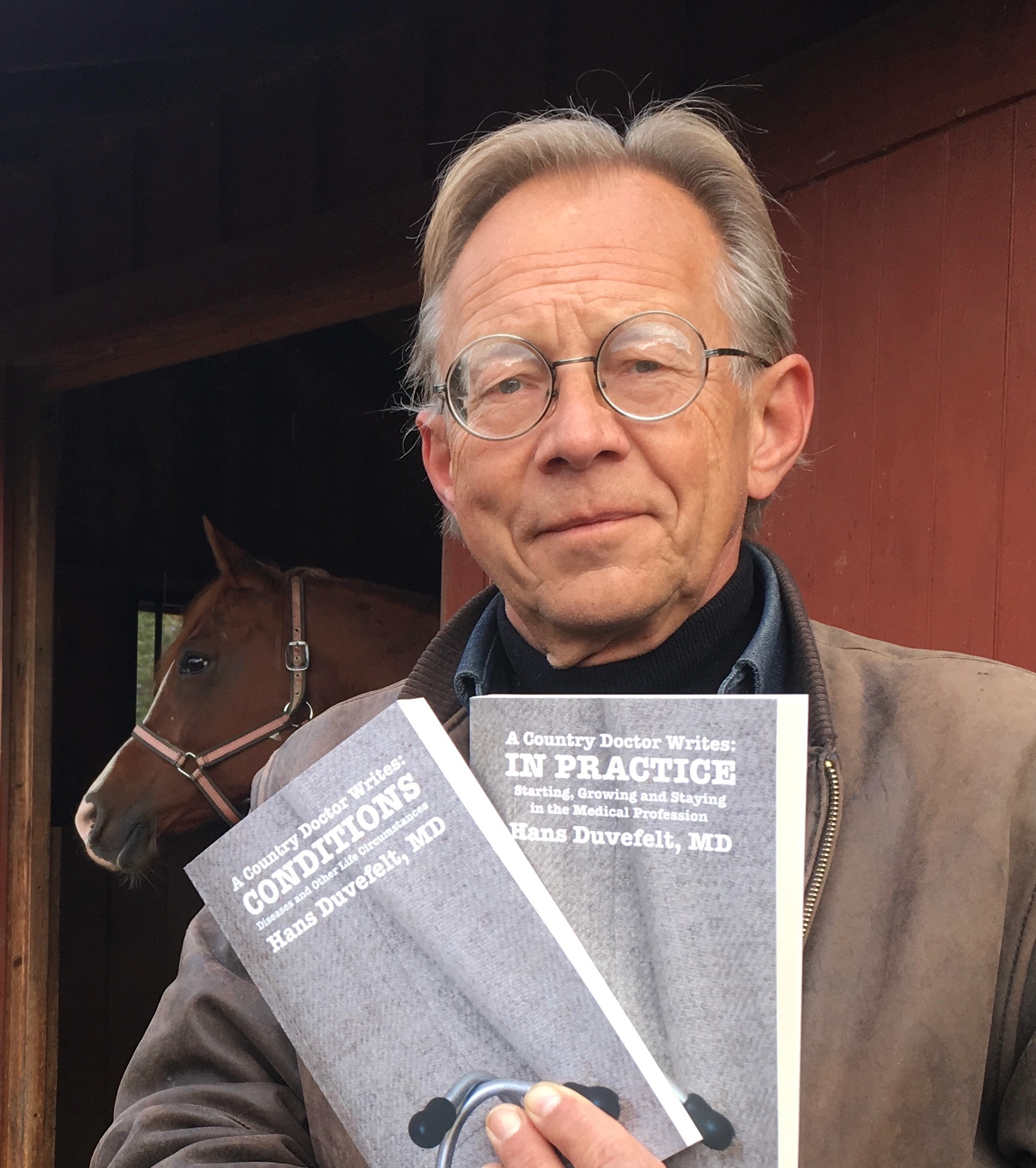
BOOKS BY HANS DUVEFELT, MD

CONDITIONS, Chapter 1: An Old, New Diagnosis

Top 25 Doctor Blogs Award

Doctor Blogs

Enter your email address to subscribe to this blog and receive notifications of new posts by email.

Mailbox

contact @ acountrydoctorwrites.com
Bookmark and Share
© A Country Doctor Writes, LLC 2008-2022 Unauthorized use and/or duplication of this material without express and written permission is strictly prohibited. Excerpts and links may be used, provided that full and clear credit is given.