Archive for the 'Progress Notes' Category


Touching the Mezuzah

First published in 2012.

A mezuzah (Hebrew: מְזוּזָה‎ “doorpost”; plural: מְזוּזוֹת mezuzot) is a piece of parchment (often contained in a decorative case) inscribed with specified Hebrew verses from the Torah.

ט וּכְתַבְתָּם עַל-מְזֻזוֹת בֵּיתֶךָ, וּבִשְׁעָרֶיךָ. {ס} 9 And thou shalt write them upon the door-posts of thy house, and upon thy gates. {S}
                                        Deuteronomy 6:9

It’s almost 4:30 and I have three more patients to see before my Christmas mini-vacation can begin. Snow and sleet are beginning to fall outside. Our lab tech, who leaves between 3 and 3:30, just called from home to warn the rest of us that she had seen nine moose on Route 1, probably attracted by the road salt.

“Three encounters in thirty minutes”, I think to myself, “and neither of them completely straightforward”. I used to shudder when healthcare administrators called medical office visits “encounters” , but the more I have thought about it, the truer the word rings to me. Two people meet briefly and try their best to communicate in spite of sometimes very different viewpoints and agendas. I remember the phrase “Marriage Encounter” from my first visit to this country in the early 1970’s – an event where couples learn to see each other with new eyes and communicate more effectively.

I have three fellow human beings to interact with and offer some sort of healing to in three very brief visits. Three times I pause at the doorway before entering my exam room, the space temporarily occupied by someone who has come for my assessment or advice. Three times I summarize to myself what I know before clearing my mind and opening myself up to what I may not know or understand with my intellect alone. Three times I quietly invoke the source of my calling.

4:35 – In Room 1 sits Bill Boland, the fellow who always sasses me for my habit of knocking on the exam room door before I enter. He had been in with pneumonia and his x-ray came back suspicious for a tumor. The purpose of today’s follow-up visit is to make sure he is feeling better and to tell Bill he will need more testing. I raise my hand in an automatic door knocking gesture, but catch myself and instead touch the doorframe briefly and take a slow breath before entering the exam room, ready to deliver the disturbing news.

4: 50 – In Room 2 sits Wally Parker, here to talk about his blood sugars. His wife is in the hospital with a lower GI bleed, and her colonoscopy showed an ulcerated tumor that is almost certainly malignant. “Why is he here tonight instead of at Mary’s bedside?” I ask myself as my hand reaches for the doorframe. At the same time I try to clear my mind of my own clutter and my guesses why he has chosen to keep this appointment under these circumstances.

5 o’clock – The child in Room 3 is an 11-month-old with a fever. He belongs to the pediatric group in town, but probably the slick roads and the late hour are the reasons he is here. A new patient, and a sick child at that, requires me to be unhurried and receptive. I must be aware of how well we connect, so neither this child’s young mother nor I miss something important in our encounter. In this case, the child has an ear infection and the mother is a registered nurse with an older child at home who has recurrent ear infections.

At 5:15 I wish Autumn and the new receptionist a Merry Christmas before I leave through the back door.

Route 1 is covered with snow and the large flakes coming right at me make it impossible to see with high beams. I drive slowly with only my low beams, and don’t see a single moose.

Our house is all lit up for Christmas. In one of the sunroom windows shines the metal star-shaped lamp that hung in my bedroom window when I was a child. I remember coming home from school in the dark, looking up at my star on the third floor of our Swedish apartment building, even closer to the Arctic Circle than where I live now.

I can see my wife in the kitchen window, but she can’t see me in the darkness outside. I quickly stomp the snow off my boots on the wooden steps outside the door. My hand touches the doorframe for balance, physical and spiritual, and as a brief gesture of love and blessing:

I am home. It is Christmas.

A Country Doctor Watches Marcus Welby, M.D.

The year is 2012. A 58-year-old veteran Family Physician who has just finished a day with more human heartaches than clinical triumphs settles down among the pillows with his wife in front of his MacBook to watch a movie, delivered wirelessly over the Internet:

The year is 1969. A 62-year-old veteran General Practitioner who has just seen his health threaten to fail him, speaks passionately to a group of doctors about how general practice is not dead and general practitioners are not dinosaurs. For the next 98 minutes he proves how much he cares, how well he knows his patients, and how often he is willing to go out on a limb when he feels there is an ethical stand to be taken.

The pilot episode of “Marcus Welby, M.D.” was called “A Matter of Humanities” (how often do you hear that word in medical circles today?). In his passionate speech to the young doctors at the hospital where he had just been treated for his heart attack, he said (and I paraphrase):

We aren’t treating a this or a that, we are treating our patient.

That is pretty much what Family Practitioners say today, and we still aren’t dinosaurs. In fact, the “new” or re-born idea of the Patient Centered Medical Home and other such political reforms may make us more central to the health care machine than we have been since the days when the big HMOs wanted us as “gatekeepers”. Regardless of how our standing with the politicians and insurance companies has come and gone, our patients have kept on coming to see us.

In 2012 more than a few people speak disdainfully about how “the days of Marcus Welby are long gone”. Google has 17,600 search results for that exact phrase, if that is any indication. But many people seem to speak of him without actually having watched or at least remembering much of the show.

I have heard people scoff at his clinical understanding, and I remember once seeing an episode where he used a car battery to deliver a shock to a patient’s heart. But, this was Hollywood fiction – let’s not forget that Marcus Welby himself was a fictional character – and defibrillation and cardioversion were relatively new inventions.

Marcus Welby and his fictional colleagues obviously practiced with the medical knowledge of that time. We may smile at how his attending physicians kept him in the hospital for twelve days or more for a simple heart attack. That may seem archaic by today’s standards, but it may actually have been more humane than what we are doing today with our same-day surgeries and drive-by deliveries.

The purpose of most episodes of Marcus Welby, M.D. was not to illustrate the clinical aspects of a particular disease or its treatment. Most of the stories were about how disease affects people and how a wise and caring physician can help his patients, even in situations when there is no cure to be offered.

An interesting theme in the show is the mentor relationship between Welby and his young associate, Dr Kiley. In spite of his youth, fashionable (for his time) hair and motorcycle, the younger physician represents a more conservative view than Welby. The older physician is more liberal, less distrustful of human nature, and more altruistic than his protégé.

It is obvious that doctors in 1969 had less advanced tests and treatments to offer their patients than we have today, but the ironic thing to me is that Marcus Welby’s patients got a lot more in a way because of his exceptional personal involvement, passion and courage. In that sense, the shows are totally refreshing. Medicine today, with its focus on guidelines and measurable data, has become a rather faceless bureaucracy. I think I know why many people still remember and mention the Marcus Welby character by name. He gave medicine a face, a personal flavor that people still want today. There is a lot of talk and theorizing these days about how medical care is organized and delivered. For example, we read about Accountable Care Organizations; whatever happened to accountable individuals?

Medical knowledge is always subject to change, but the ethics of medicine are a lot more timeless. Marcus Welby, M.D. tells the human stories as they relate to the medical facts of that era, and they are still captivating and thought provoking 43 years later.

My wife and I will be back for more of Marcus Welby, M.D.

Blood – The Doctor Giveth and the Doctor Taketh: Myths, Beliefs and Evidence

This Country Doctor learned something interesting at Grand Rounds the other day. One of the Cityside hematologists gave a talk about blood transfusions that made me think about how slow the medical profession is to change its beliefs and its practice, even when faced with overwhelming evidence that we are doing the wrong thing.

It turns out our profession has been wrong about the benefits of transfusing anemic patients, just like our predecessors were wrong in their belief that bloodletting was helpful.

For thousands of years medical practitioners used bloodletting, drawing off sometimes very large quantities of blood, as a treatment for various illnesses. After this treatment was proven useless and dangerous in 1628 by Harvey, the practice continued for more than 200 years. It is said to have brought on George Washington’s death in 1799 after 9 pints of his blood was withdrawn. Samuel Hahnemann, the physician who founded Homeopathy, looking for kinder, gentler treatments for his patients, wrote in 1809:

“The more refined humoralists, in addition to the impurities in the blood, alleged, besides, the existence of a pretended, almost universal, plethora, as an excuse for their frightful, merciless bloodlettings.”

Analyzing why it took so long to eliminate this type of treatment, Kerridge and Lowe wrote in 1995:

“That bloodletting survived for so long is not an intellectual anomaly—it resulted from the dynamic interaction of social, economic, and intellectual pressures, a process that continues to determine medical practice.”

Legend has it that early adopters of non-bloodletting didn’t dare to withhold this “treatment” for their sickest patients. They, like modern day physicians, were afraid of “doing nothing”.

Today, bloodletting is only used for a handful of conditions where the patient actually has too many red blood cells or too much iron in the blood. But we have gone too far in the opposite direction, thinking that most anemic patients could benefit from a couple of extra units of blood.

In 1999 The New England Journal of Medicine wrote authoritatively about several negative effects from transfusions. Since then the evidence has continued to mount against transfusion in medical patients with anemia. Bleeding surgical patients are in a different category.

But for many years we transfused our sickest patients in hope of helping them do better. When they didn’t, we usually didn’t blame the transfusion, but thought they were just too sick to fully benefit from transfusion. This is exactly what happened in the days of bloodletting.

The new findings about the negative effects of transfusion were ignored, perhaps even swept under the carpet. After all, giving blood seemed like such an obvious thing to do.

Even though we know that anemic patients are more likely to suffer for example heart attacks due to low oxygen delivery to their tissues, it turns out that blood transfusion to correct anemia actually further decreases oxygen delivery to heart muscle tissue. Transfused patients have a greater risk for illness and death than non-transfused patients, all the way down to degrees of anemia that usually raise the hair on every physician’s back. Even our own (autologous) blood donation has this effect due to changes in blood cells and plasma caused by handling and storage. Transfused blood cells have a tendency to be less flexible and slippery than normal blood cells and have been proven to block tiny blood vessels and thereby keeping patients’ own, healthy, blood cells from getting through.

A chilling fact is that even though blood between 30 and 42 days old carries a dramatically greater risk of negative effects than blood less than 30 days old, we still continue to offer it to patients without informing them of the additional risk we subject them to.

The increased risk for illness and death extends well beyond the immediate period after transfusion: We are now seeing an increased cancer risk in people who have received blood transfusions several years ago.

The International Consensus Conference on Transfusion and Outcomes issued this statement in 2009:

“There is little evidence to support a beneficial effect from the greatest number of transfusions currently being given to patients. The vast majority of studies show an association between red blood cell transfusions and higher rates of complications such as heart attack, stroke, lung injury, infection and kidney failure and death.”

At Cityside and many other hospitals, the threshold for transfusion in medical patients has been lowered, and surgical patients sometimes have their operations postponed in order to manage anemia with iron infusions and erythropoietin injections to allow the patient to build up their own blood supply before surgery. And if transfusions are given, they are kept to a minimum.

Such changes in practice are likely to happen in other areas of medicine if we are willing to really practice evidence based medicine and not just do what sounds like a good idea. Too many things have sounded good and turned out bad to make that a defensible strategy.

I can’t help thinking about how uncomfortable many doctors have been over the years when treating Jehovah’s Witnesses, whose religion forbids them to accept blood transfusions. That belief may actually have saved many lives.

Medicine is an ever-changing practice, and it is humbling to realize how doctors sometimes harm their patients by doing what seems to be the right thing to do.

Dr. Martin H. Fischer said it well:

”It is not hard to learn more.  What is hard is to unlearn when you discover yourself wrong.”  

Negative Expectations

Andrea Smythe needed something for her depression, but she was leery of medications. Her counselor had recommended trying an antidepressant, and I agreed.

Andrea told me nobody in her family ever took an antidepressant, and none of her friends ever did.

By the time I had dutifully explained about initial nausea, the risk for suicidal ideation and the possibility of inducing a manic episode in undiagnosed bipolar patients, Andrea was squirming in her chair. I didn’t even get to the risk of weight gain and sexual dysfunction before she told me she’d rather do something “natural”.

“Who wouldn’t, after that introduction”, I thought to myself. So we talked about St John’s Wort and other nonprescription alternatives, all less studied but without foreboding government-mandated warnings.

This is the age of informed consent. Anything you don’t say about possible adverse effects can be used against you. That’s why most lawsuits against cigarette manufacturers fail – after all, they warned smokers about the dangers of using their product.

Even when patients agree to take the medication suggested by their physician, the negative expectations can be a hindrance to the beneficial action of the medication – a real nocebo effect. This is the opposite of the placebo effect that some people tend to dismiss as imaginary. Ancient physicians, the fathers of modern medicine and cutting-edge neuro-immunologists all tell us the human body’s ability to heal is helped or hindered by the patient’s state of mind. In many psychiatric diseases this is axiomatic.

I, for one, always look to align my treatment plan with any potentially available placebo force, for lack of a better word.

“Did you ever know anyone who took an antidepressant?” I usually ask. If the answer is yes, I ask which one and how it worked. If the other person is a family member, I not only have a chance for insight into my patient’s positive or negative expectations but also into their genetic predisposition for response or non-response to certain medications.

If the patient believes one medication is more likely to work than another, I would have to feel very strongly about any other medication I might want to suggest in order to pass up all the positive expectations – call it placebo effect if you want – that the patient just offered to the therapeutic situation.

This is where all the practitioners of non-allopathic medicine have several advantages in today’s health care climate; they are not required to warn patients about rare side effects of their treatment, and they are sometimes more able to listen to their patients’ beliefs and preferences without worrying about what insurance companies, managed care organizations or treatment guidelines tell them to do.

The other day I saw a dramatic example of the nocebo effect; Rachel Ruel had been plagued by horrendous attacks of abdominal pain for several years until I started her on a very low dose of metoclopramide, taken only as needed during these attacks. The medication controlled all her dysmotility symptoms and she was finally able to live a normal life. This was long before the 2009 “black box warning” issued by the Food and Drug Administration about the risk for tardive dyskinesia. We talked about the risk for this rare facial movement disorder and Rachel always felt the relief she got from the medication was so significant that she was willing to take the small risk of side effects.

When I last saw Rachel, she had a tooth infection and secondary jaw pain. She had been sure this was the beginning of tardive dyskinesia, so she had not taken metoclopramide at the beginning of her latest attack two days earlier. She was still miserable with abdominal pain. Her unrelated jaw symptoms had escalated her fear of developing tardive dyskinesia, and I was in no position to talk her out of that fear. I had nothing to offer her, except a referral to a university gastroenterologist.

She left my office still fearful and in pain, but she made the least frightening choice she could make in that moment. I am still wondering if I could have handled our visit differently.

Cell Phones Welcome

Many doctors’ offices have little signs discouraging the use of cell phones. Personally, I find them useful more often than annoying or disruptive.

The other day I saw Mrs. Jonah for a sinus infection. She had lost her private insurance and ended up on Medicaid, the insurance for low-income Americans. When her insurance changed, we had to change several of her medications, because Medicaid didn’t cover what she used to take. Mrs. Jonah told me that one of her new medications wasn’t working for her and the step care on the Medicaid website was confusing. I pulled out my cell phone – not a smart phone for this country doctor, but a waterproof one suitable for working around our little farm.

I know our state’s Medicaid office doesn’t keep you on hold forever, and the people who answer the phone actually have the answers to your questions. Within a couple of minutes I had e-prescribed a new medication to her pharmacy along with an antibiotic for her sinusitis and Mrs. Jonah left the office with a smile and the words “you make things happen”.

I also pulled out my cell phone when Mrs. Gordon’s blood pressure was higher than I had ever seen it and she seemed confused about how many blood pressure medications she was actually taking. The pharmacy told me she hadn’t picked up her lisinopril since February.

Bud Swensen told me his little red pills made him itch, so he stopped taking them. I couldn’t figure out which medication he was referring to. He called his wife on his cell phone and we settled the issue right then and there.

Frank Garr always gives me a hard time if I happen to be running late. That is what happened when I last saw him. He said he was running out of his sleeping pills. According to my records, he should have had a refill left. I called his pharmacy to verify this. He looked demonstratively at his watch and said “I’m deducting this from our fifteen minutes”.

“I’m making this call for you”, I replied.

“Fair enough”, he said.

Norm Parsons was having a terrible time with his rapid atrial fibrillation. His cardiologist in the state capital had really wanted him on a beta blocker because of his mild heart failure. Norm had tried them before and had to stop because of side effects. He was beet red, huffing and puffing, and said “this is exactly what happened last time I tried metoprolol”.

A quick cell phone call to his cardiologist gave me permission to switch Norm to diltiazem, even though it theoretically is less ideal for rapid atrial fibrillation with heart failure. Norm’s e-prescrition for the new medication, my office note and the cardiologist’s documentation of the medication change happened quickly and in real-time.

One thing I don’t do with my cell phone is take incoming calls. I have my phone on “vibrate” and check for missed calls or messages between patient visits. But for straightening things out with pharmacists and colleagues, I wouldn’t want to be without my cell phone.


I just realized none of the posts show on an iPad or a computer, but they do show on an iPhone. WordPress is working on this. In the meantime, please visit my Substack.


Osler said “Listen to your patient, he is telling you the diagnosis”. Duvefelt says “Listen to your patient, he is telling you what kind of doctor he needs you to be”.


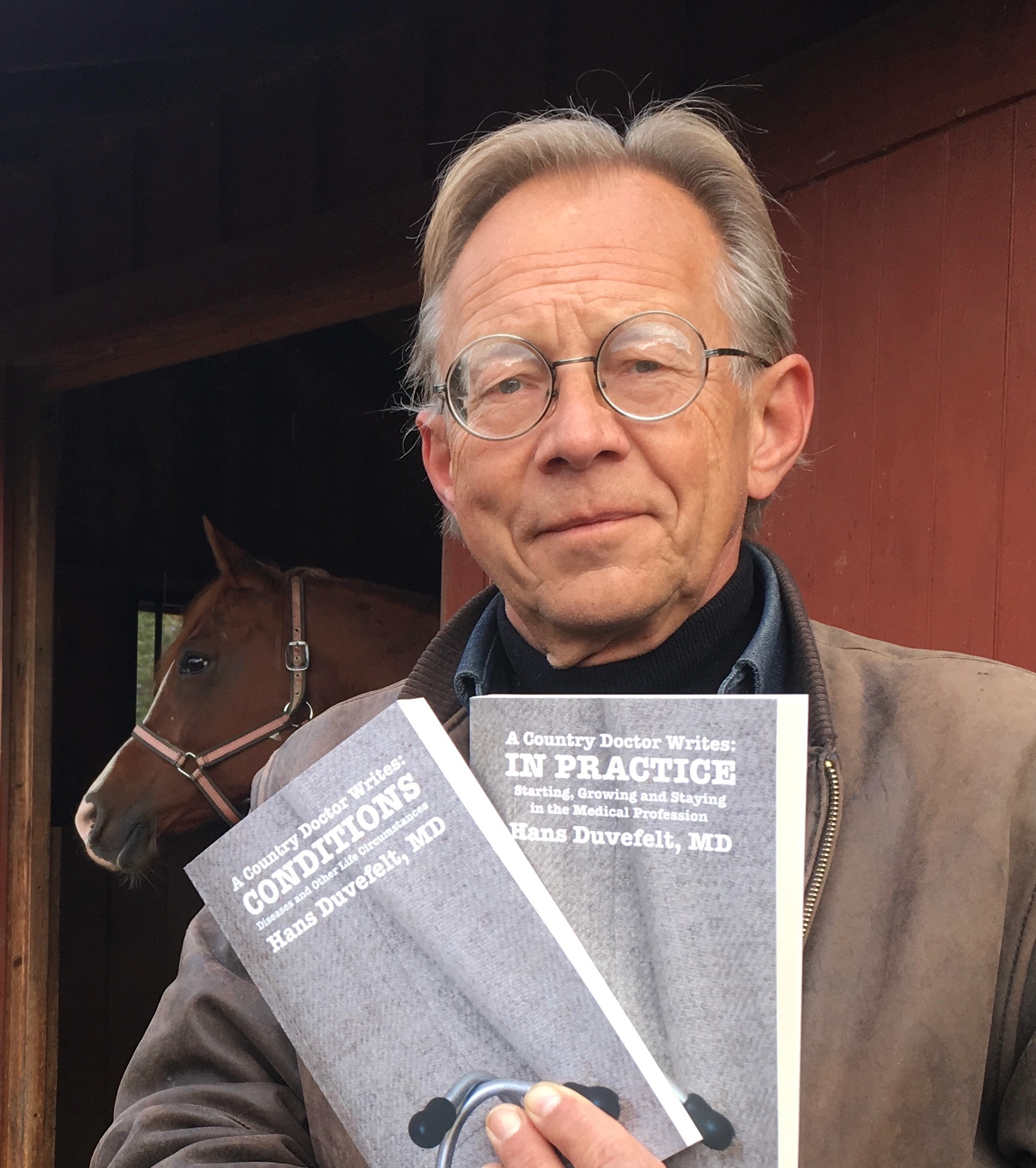
BOOKS BY HANS DUVEFELT, MD

CONDITIONS, Chapter 1: An Old, New Diagnosis

Top 25 Doctor Blogs Award

Doctor Blogs

Enter your email address to subscribe to this blog and receive notifications of new posts by email.

Mailbox

contact @ acountrydoctorwrites.com
Bookmark and Share
© A Country Doctor Writes, LLC 2008-2022 Unauthorized use and/or duplication of this material without express and written permission is strictly prohibited. Excerpts and links may be used, provided that full and clear credit is given.