Archive for the 'Progress Notes' Category


Today’s Masterpiece

“Make every day your masterpiece.”

             Coach John Wooden

“…to do the day’s work well and not to bother about tomorrow. You may say that is not a satisfactory ideal. It is; and there is not one which the student can carry with him into practice with greater effect. To it more than anything else I owe whatever success I have had — to this power of settling down to the day’s work and trying to do it well to the best of my ability, and letting the future take care of itself.” 

William Osler


Whether you are America’s most legendary basketball coach, the father of modern medicine or a busy primary care doctor in a remote rural area, there is only one right way to get through each day. In the practice of medicine with its daily ration of two dozen fellow human beings in some sort of need, we often only have one chance to get it right.

As a young man and newly trained physician, I spent a lot of time thinking about the future. I know I sometimes devoted less attention to the here and now than I should have.

Today I carry with me all kinds of memories of the past; some are useful clinical impressions and life experiences that help me be a better doctor, others are sentimental distractions I need to manage in order to be effective in the present moment.

I am also distracted by the future. The changes in health care we all face have me thinking about how things will be different tomorrow, what new skills I will need and which old ones will be obsolete. I also find myself spending too much time thinking about what’s wrong with health care today and imagining how things ought to be.

Most days we primary care physicians don’t diagnose any rare diseases, and we don’t usually know right away if our efforts will produce any lasting results. We know we are constantly being measured and evaluated by insurance companies, employers and many others – even the pharmaceutical companies track our prescription habits. We strive for quality certificates and worry about satisfaction surveys. We devote increasing time and energy to mastering the new technologies of health care delivery and documentation.

Today I spend more time e-prescribing a new medication for my patient with inoperable sciatica than I do choosing the drug and the dose in the first place. If I don’t specify capsules or tablets, or if I should neglect to put in “by oral route”, which I always thought was obvious with both capsules and tablets, the script won’t go through. I start thinking about what I would like to say to the IT people or how I would change the technology if somebody would just give me the opportunity.

Tonight over dinner Emma asked me one of those questions only she can ask me:

“In your work as a doctor, are you striving to meet your patients’ needs or your own?”

Before I had time to swallow and clear my throat, she continued:

“Because if you’re in it to fill your own needs, you’ll never be happy, since health care is not run by you or any other doctor anymore. If you focus on how things ought to be instead of doing the best for your patient in the reality of the moment, you’ll never be satisfied. If it’s not enough for you to know you did your best for that patient, then you’re in it for the wrong reasons.”

There are days when I clearly see that I made a difference in the life and welfare of a fellow human being because I saw what needed to be done and put my abilities to use. Those are the days I come home and tell Emma that I feel good about being a doctor.

Then there are those days when I talk about what kinds of things stood in my way of being a good doctor – excuses, really, when I think about them. My patients certainly aren’t interested in what my obstacles are. All they want from me is my best effort under the circumstances:

The lab closed early, the computer is malfunctioning, the specialist’s report is missing, the insurance doesn’t cover the medication and the road to the hospital is icy and snow-covered, but the patient is still sick. I am his doctor. Today’s work is today’s work. What more can I do besides make it my masterpiece for today? Isn’t that all I set out to do from the beginning?
“I’m Sorry Mrs. Jones, But You Have Albuminurophobia”

Last week I saw several older patients who were fretting about their mildly reduced kidney function. All of them were women in remarkable health, but each one had at one time or another had a brush with hospital medicine:

Mrs. Allard had a mastectomy five years ago, Mrs. Perlman had an episode of clostridium difficile colitis last year after taking antibiotics for a dental infection, and Mrs. Jones had just finished rehab after a knee replacement. All three women had been labeled as suffering from chronic kidney disease during their hospitalization.

Mrs. Allard was in on Monday. She never fails to ask what her Glomerular Filtration Rate is when she comes in for her visits. Every time I have to reassure her that her numbers are stable. She struggles to believe me when I tell her that her frequent urination is not a warning sign of impending kidney failure.

“GFR is chemistry, bladder spasms are a plumbing problem”, I tell her every time. “They are not related.”

“I don’t want to end up on dialysis and I have read that people with kidney disease are more likely to have heart attacks. My nephrologist tells me that, too. Mrs. Perlman said last Tuesday. Between her quarterly visits with Harold Wesson, the Chief of nephrology at Cityside Hospital, she worries enough to always mention her kidneys when she sees me for other things.

“But, Doctor, I have Stage III kidney disease!” Mrs. Jones said with obvious fear in her voice. It was Thursday afternoon and we really should have been talking about the dark mole on her right thigh.

“That doesn’t mean you’re in any real danger…” I began. She looked suspicious. “In fact, your kidney function two years ago was exactly the same.”

“Are you telling me I had kidney disease already then?” Her eyes widened.

“To the same degree, yes. Do you remember how I asked you to stop taking ibuprofen for your sore knee because it could harm your kidneys?”

“Yes, that’s when you gave me those prescription pain pills.”

“Precisely. I was concerned then that we needed to be kind to your kidneys – that’s pretty much all we do when people have what we call Stage III chronic kidney disease.”

“But you never told me I have kidney disease.”

“I didn’t use the word because I feel it alarms people more than it helps them. We talked about what helps the kidneys and what hurts them; we got you off the ibuprofen, we tightened up your blood pressure control with a new medication and we lowered your cholesterol. All those things help your kidneys work better and last longer.

“But Stage III – I mean, how many stages are there? How close to dialysis am I with Stage III disease?”

I was ready for her question. With all the patients like her I have seen, especially lately, I have put together some articles and teaching materials.

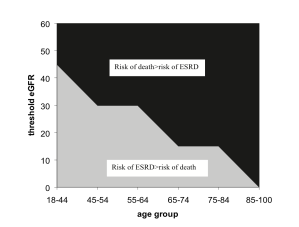
“I have been a doctor since 1979 and I can count on one hand the patients I have cared for that ended up on dialysis or dying from kidney failure. Look at this graph”, I said and pointed to the latest addition to my bulletin board. “You’re 74, and your GFR is 54. This graph shows that at your age, your GFR would have to be somewhere around 15 to make you more likely to die from kidney failure than something else.

She stared at the graph.

“So 54 is actually not a bad GFR?”

“Well, it’s not normal in terms of perfection, but it is very common. Even people who aren’t perfect can live a long and happy life.”

“So you’re saying I shouldn’t worry?”

“Not about your GFR specifically. Remember to be kind to your kidneys, like we have talked about.”

She nodded.

“Now, here’s the bad news”, I explained. “People with even mild kidney disease statistically are more likely to have heart attacks, strokes and other cardiovascular problems.”

She started to raise her eyebrows, and I hurried to continue:

“But, and this is important: I’m not smart enough to know what’s the chicken and what’s the egg. Do they have kidney disease because they have hardening of the arteries everywhere, or does the kidney disease itself cause it to happen?”

I continued:

“So we do the usual things – good diet, cholesterol, blood pressure. And we don’t just focus on the GFR.”

“I can’t help worrying about the numbers”, Mrs. Jones said.

“There’s a name for that”, I told her. “We call it albuminurophobia.”

“Really?”

“Really. There is a medical term for just about everything these days.”

She shook her head.

“Now, about this mole”, I continued…

How to Clicker Train Your Doc

My eyes played a trick on me the other night, or perhaps it was my subconscious. Emma and I were reading by the fire – my nose was in one of my medical journals and she had a stack of animal behavior books next to her while looking intently at the screen of her laptop computer.

As I was reading along I registered the sound of the dogs snoring rhythmically nearby. My eyes glanced over my magazine’s headlines with words like guidelines, accountable care, pay-for-performance, evidence-based and quality.

I had just made the quiet observation that there are innumerable forces that create and use buzzwords like that when trying to tell front-line doctors like me how we should do our jobs without really thinking for ourselves when Emma broke the silence in our living room.

“This is really interesting”, she said. “The way clicker training works may be by stimulating the amygdala of animals, so they feel instant joy before they consciously become aware that the trainer approves of what they just did.”

I knew a fair amount about clicker training; Emma has been using it on our canine family members and I have seen it work wonders with our adolescent female German Shepherd.

“Isn’t it just a conditioned response like Pavlov’s bell?” I asked as I looked up from my journal.

“Well, some people seem to think the actual sound of the clicker may be a more direct way to stimulate the amygdala than other sounds or words people use in training.”

My eyes moved from my wife’s face, framed by her beautiful long brown hair, to her eyeglasses reflecting the light from her computer screen, to the stack of books next to her. Suddenly my mind jolted at the title of the book on top. For a split second I thought it said:

How to Clicker Train Your Doc 

Emma was back to reading her webpage. The dogs snored peacefully. My mind was spinning.

Physicians are not quite subjected to clicker training, but we are certainly recipients of signals that are aimed at our preconscious minds, if not our amygdalas. All those people and institutions that try to influence physicians’ behavior are trying to get into our minds below the radar of our critical thinking, just like advertisers work on all of us. They use feel-good messages that try to do what clicker training does to our pets – create new behaviors we would otherwise not pick up on our own.

But doesn’t it go deeper than that for most doctors? It seems to me we often make ourselves do things that run counter to our nature. We do what others say we are good at, even when there’s no one around to cheer us on – even when doing it is to our own ultimate detriment. We end up using our burnout skills because we have created our own conditioned responses.

I opened my own laptop and started reading about clicker training and the amygdala. Wikipedia gave me the following quote:

“Clicker–trained animals become great problem–solvers, develop confidence, and perform their work enthusiastically.”

Just like doctors…

Morbus Iatrogenicus

Morbus Iatrogenicus

From Latin morbus (disease), Ancient Greek iatros (doctor, healer), -genēs  (born) – similar to Latin genus (kin): Disease caused by the physician.

*

“There are some patients that we cannot help; there are none whom we cannot harm.”

Attributed to Arthur L Bloomfield

John Fernald in room 4 was clearly not right. He seemed drowsy, weak and disoriented and he had a low-grade temperature. His wife and I had to help him up on the exam table. His chief complaint was chills.

John was a tall man, generally very healthy. He had an enlarged prostate and took pills for his urinary frequency. Over the past eighteen months he had gone for a couple of PSA tests and they were steadily rising, but just barely over the upper limit for a man his age with a good size prostate gland.

Three days before, he had undergone a prostate biopsy by his very competent urologist at Cityside Hospital. John had received the usual antibiotics after the procedure, but he sure looked septic to me.

John said very little, but his wife, Zena, was in complete agreement with sending him over to the hospital for admission.

Across the hall in room 1, John’s contemporary and neighbor, Bill Boland, sat awkwardly in the exam room chair with an expression somewhere between pain and motion sickness.

He had a habit of always sassing me for knocking on the exam room door before entering. “Don’t knock, for Pete’s sake, it’s your room!” he usually yelled as I entered the room. Then, he would always stand up from his chair to greet me with a firm handshake.

“Pardon me if I don’t get up”, he moaned.

He was in my schedule for back pain.

“What happened to your back?” I asked.

“I have no idea. It’s been aching for a week now, and it’s just getting worse.”

“Any injury? Did you fall or lift anything heavy?”

“No, nothing.”

“Any pain or tingling down your legs?”

“Negative.”

“Do you feel better when you lie down?”

He shook his head. “No it aches the same…”

By that time I was worried. When a man in his age bracket has back pain, it is more likely to be something ominous than it is in a young or middle-aged person. The fact that his pain didn’t get better at rest was particularly disturbing.

I flipped through his chart. When was his last blood count, chemistry panel? Any risk factors for cancer? Had he had his screening tests for colon and prostate cancer? Nothing seemed unusual or less than up-to-date. In fact, he had just had a colonoscopy a month earlier by our top gastroenterologist to follow up on precancerous polyps removed three years before, and this time his scope had yielded two more polyps but no cancer.

On his physical exam I noted there was no pain when I tapped over his kidneys. Tapping on the lower spine caused him severe discomfort, but there was no muscle spasm or tenderness. He had drops of sweat on his forehead, but no fever.

I ordered bloodwork and an MRI. Autumn was able to get his MRI for the following afternoon. Bill and I agreed to touch base the next morning about his results.

John Fernald with his fever got settled into the hospital and Bill Boland with his back pain went to the pharmacy for some pain medication. I kept thinking about the two neighbors as my day continued.

Two days later, John was still in the hospital and on intravenous antibiotics. His blood cultures were positive and in all likelihood his blood poisoning was a direct complication to his prostate biopsy, which turned out to be negative for cancer.

Bill, my back pain patient, sounded uncomfortable when he answered the telephone. His bloodwork showed signs of inflammation and his MRI showed osteomyelitis of his lumbar spine. We arranged for admission to the hospital for blood cultures and intravenous antibiotics for him, too. I had never seen a bone infection develop as a complication from a colonoscopy before, but I had read about the possibility. Could this be what was going on with Bill?

That was almost three years ago. John Fernald’s PSA is a little higher than it was, but neither his urologist nor John are eager to go ahead with another biopsy. Bill Boland still has back pain, but it is mild and seems to get worse when he stands at the workbench in his shop too long. He has noticed some blood in his stool a few times lately and, technically, he is due for another colonoscopy.

“I’m not having one of those again, Doc, I’ll tell you that. You can’t tell me I got that spinal infection from anything else but that scope test!

John is now of the age when he is less likely to die from a newly diagnosed prostate cancer than something else like a heart attack or stroke. Bill faces a 2% ten-year-risk that any new precancerous colon polyp will turn into a cancer. And in ten years he’ll be 80 years old.

First, do no harm.

Squandered Jing

“If you carelessly squander your jing then you create a situation of potential harm to your health and longevity. Eastern medical schools all say this.”


                      William Bodri


”So, you need a referral to a pulmonologist?”

“Yes, I’ve been to the University Health Center almost every month since August and they’re getting tired of seeing me there.”

“Did you have much trouble with your asthma when you were younger?”

Kaitlynn and her mother exchanged a quick glance and a mutual head shake. The young woman continued:

“No, they called it exercise-induced asthma then, and I just used an inhaler before sports.”

“And now you’re on Pro-Air, Claritin, Advair and Singulair?” She nodded yes to my rhetorical question as I finished my thought: “And you’re still miserable.”

I knew all she seemed to want from me was a pulmonology referral for when she got back to the University after break, but I was intrigued and I wanted to do a good job facilitating the consult.

“What’s your best and worst peak flow?”

“400 on a good day, 200 when I’m sick.”

“Did you ever have a chest x-ray?”

“Yes, the clinic sent me for one.”

“Do you know what it showed?”

“My lungs were too inflated, I think.”

“Are you exposed to cigarette smoke?”

“The guy I live with smokes, but not inside.”

“You have an apartment?”

“Yes.”

“Any pets?”

“Two cats.”

“Did you grow up with cats?”

“No.”

“Do you have wall to wall carpeting?”

“Yes.”

“Any mold problems?”

“I don’t think so.”

“Is there anything you think might be bothering your asthma?”

“Well, my best friend has a dog and I think I’m worse around the dog.”

I started my physical exam while continuing to ask Kaitlynn questions. I noticed the ‘allergic shiners’ under her eyes. Her nose was congested and she had coarse, sonorous rhonchi and higher-pitched wheezes in both lungs.

“Do you ever have heartburn?”

“Actually yes. I was diagnosed with a hiatal hernia when I was very little and there was some problem with my swallowing.”

I finished my exam and sat down across from Kaitlynn and her mother.

“I think definitely you need some testing”, I began. “You could have some other, rare, lung disease, but this is probably asthma. The question is what caused it to get worse. You could be allergic to your cats, because no amount of medication can stop you from reacting to your own cats who live in your apartment if you have a severe allergy to them.”

She looked down. I continued:

“You may have stomach acid going into your lungs while you sleep, or you could be aspirating small amounts of food or fluids and your lungs could be reacting to that. Or, maybe your childhood asthma just got worse – it sometimes does that in your age group.”

Mother and daughter were both nodding. I felt I had achieved a fair amount in just a few minutes. As my eyes met Kaitlynn’s, she looked amused. She turned toward her mother, who was almost grinning. I thought I must have really somehow impressed them with my quick analysis. I cleared my throat.

“Here’s my suggestion: Let’s get a blood test today to screen you for some common allergies like cat and dog, and let’s pick a pulmonologist near the University…”

Kaitlynn and her mother exchanged looks again.

“I already had a blood test. Doctor Freese did that the first time I saw him, but I haven’t heard the results yet.”

“Who is Doctor Freese? The Student Health doctor?”

“No, the lung specialist.”

I raised one eyebrow and squinted with the other eye.

“Have you already seen a lung specialist?”

“Yes, and he said the same thing you did”, Kaitlynn giggled.

I sighed.

“So you didn’t need me to refer you to a lung doctor – you needed an insurance referral, so his fee will be covered by your insurance…”

“That’s right. We thought you knew that.”

“I didn’t, but we’ll take care of it.”

The two of them got up from their chairs simultaneously, gave each other another bemused look and said good-bye as they left the room.

There I stood, watching them leave and thinking I had just spent some jing I could have used better somewhere else.


I just realized none of the posts show on an iPad or a computer, but they do show on an iPhone. WordPress is working on this. In the meantime, please visit my Substack.


Osler said “Listen to your patient, he is telling you the diagnosis”. Duvefelt says “Listen to your patient, he is telling you what kind of doctor he needs you to be”.


BOOKS BY HANS DUVEFELT, MD

CONDITIONS, Chapter 1: An Old, New Diagnosis

Top 25 Doctor Blogs Award

Doctor Blogs

Enter your email address to subscribe to this blog and receive notifications of new posts by email.

Mailbox

contact @ acountrydoctorwrites.com
Bookmark and Share
© A Country Doctor Writes, LLC 2008-2022 Unauthorized use and/or duplication of this material without express and written permission is strictly prohibited. Excerpts and links may be used, provided that full and clear credit is given.


