Archive for the 'Progress Notes' Category


A Country Doctor’s Unlived Life

“Just as colleges introduce our young people to knowledge of the world important for the first half of life, there should be colleges for forty-, fifty-, and sixty-year-olds to prepare them for the challenges of the second half…”

Robert A. Johnson & Jerry Ruhl

During my vacation I went to the eye doctor to have a refraction done for a pair of reading glasses. Reading my iPad at night with my progressive lenses forces me, now that I am pushing sixty, to turn my head uncomfortably upward to read through the bottom of my thick eyeglasses. With a pair of dedicated reading glasses, I will finally be able to read up close in dim light with my eyes looking straight ahead.

One of the books I am reading is by Jungian therapists Robert A. Johnson and Jerry Ruhl, “Living Your Unlived Life: Coping with unrealized dreams and fulfilling your purpose in the second half of life”. Of course, that’s stretching it for me – last third is a more accurate description of my current location on life’s roadmap.

Back when I really was closer to the halfway mark, I read Johnson’s “He: Understanding Masculine Psychology” and “Transformation: Understanding the Three Levels of Masculine Consciousness”. The title of my current read, “Living Your Unlived Life”, really spoke to me when I first came across it a couple of years ago: I could have done so many different things, but I made decision after decision that eliminated those options and put me where I am right now. And sometimes, in moments of doubt, I wonder what my life would have been like if I had made a different choice at one of those virtual forks in the road. I knew from age four that I wanted to be a doctor, and ever since I first visited this country, I knew I wanted to be a country doctor here. I got exactly what I wanted, but I didn’t quite consider all the consequences of making a life for myself so far away from my family and everything I grew up with.

I was a Scout, very good with map and compass, and spent many a night by a warm fire under the stars in the vast Swedish forest, Kolmården. Some of us played guitar, all self-taught, and we shared chords and riffs as the evenings grew cold and the others went to sleep in their lean-tos deep inside their mummy sleeping bags. One of my friends, C., was a year older, taller, better looking, and more confident and outgoing, but we became close over the years. He was taking business classes in High School. I already knew I wanted to be a doctor. We lost touch after I started Medical School. The only time I see his face now is on the cover of The Wall Street Journal and when I occasionally watch TV during travel; he is the head of one of the world’s biggest multinational corporations. I sometimes wonder how come I couldn’t also have been a successful businessman, but then, I don’t even like to balance my checkbook, so why would I think I could have made it in the world of finance?

Closer to home, my High School classmate, J., also knew all along he wanted to be a doctor. He stayed on at the University Hospital where he went to Medical School, went into a subspecialty, got his Ph. D., and has been head of his department for many years. He has more influence in a vastly larger organization than I have, and his life seems more straightforward in the sense that he made his career right in his own back yard; he didn’t move halfway across the world and away from his family to find his life’s work. But sometimes when we talk, he speaks of my life as more exciting; considering the path not taken causes a twinge in each of us.

I just got an email again from my army buddy, L., who also started Medical School in Uppsala when I did. A few months into our first semester, his debut novel was published. A year and a half later, he dropped out of Medical School to write full time. He was just awarded one of the most prestigious literary prizes in Sweden. Before I even met L., I harbored secret dreams of writing a great novel. Forty years later, he is still putting them out, and my first one is still more of an idea than an actual draft. In his latest email, he expressed his admiration and approval of my Country Doctor lifestyle and confessed he was jealous about my having goats.

As I sit here near the end of my week off, I think of where I am in life right now. The minutes go so fast at work, and the evenings and weekends at home are so short; I don’t often have time to think as much as I have this week. While we were cooking this afternoon, Emma said, “This is the first time you’ve really just been home for a whole week in years.”

I know the psychological task for people my age is to make peace with who we are, and to gather up those dreams and desires we never seemed to have parted with willingly, as well as the wounds we never took time to heal; we must now give them their rightful, if only symbolic, attention in our lives in order to be whole persons.

The central idea in “Living Your Unlived Life” is that the “unlived” parts of our lives can be lived out in totally symbolic form – “Doing something by not doing it”. Symbols, unlike signs, have many interpretations and can even encompass seemingly opposite notions.

So, my only multinational business is being both a Swede and an American, practicing modern, yet old-fashioned primary care medicine in rural America among French-Canadian patients.

My only sphere of professional influence is my exam rooms and the community I serve. My life is here, and it is rich with nuances, contradictions and memories. I have few regrets, and even they make up part of the unique substance of my life.

My only literary calling, at least for now, is to keep adding to this five-year-old weblog about how it feels to do the work I do.

A Minute of My Time

Countless times during the course of my day, some person, entity or task vies for my time and attention.

“If I could just have a minute of your time” begins a request to also see the spouse of a scheduled patient, a sales pitch from a pharmaceutical “rep” or home oxygen vendor, a phone call from a visiting nurse, a message from a far away relative of an elderly patient in tomorrow’s schedule or a plea to complete the form Mr. Henderson forgot to bring with him for yesterday’s appointment. Unspoken, the same request lies behind every email, fax, memo, journal and invitation that finds its way to my office. A minute of my time doesn’t seem like too much to ask.

In years past I would consider such requests with a constant awareness of how much my time was worth to my employer. “Seven dollars a minute”, I would say, only half joking, when non-patients asked for a minute of my time. That is the “opportunity cost” for a minute of a family practitioner’s time in today’s American health care industry.

Lately, and probably not a minute too soon, I have started to very seriously ponder what each minute of my time is really worth. And I now understand better that time isn’t measured in dollars. Sometimes it isn’t even measured in minutes.

To the patients that entrust me with their care, a minute of my time could make the difference between a good visit and a less than satisfying one. It could make the difference between making the right diagnosis in the first visit or much later. To the far away relative, a minute could mean the difference between needless worry, calm reassurance, or planning a last trip to see their loved one before it is too late.

The emails, memos and invitations obviously pale in comparison to the things I originally went into medicine for, but I have tended to become distracted by the interruptions. And the dollars-per-minute way of thinking is really a very large distraction, too: Again and again I have found that when I don’t watch the clock I am more effective as a physician and more powerful as a healer. I diminish the value of my professional skill, experience and wisdom by thinking of my work in flat rate terms. A minute at a bus stop isn’t the same as a minute at the Symphony, is it?

And, thinking of my employer’s “opportunity cost” – what about my own? My organization will probably be there long after my time is up, so how much is a minute worth to me, since I have fewer of them? I know what the real answer is, I have just had trouble claiming it for myself: My time is invaluable, priceless.

When our horse started to colic today and I left the office early, four patients with routine appointments had to be rescheduled. I made sure they were safe before I drove home to help my wife handle the situation. In years past I would have struggled with guilt, but today I didn’t.

I have come to realize that your days are numbered in the pressure cooker that medicine today can be if you aren’t well rounded in your life. You can’t help others if you aren’t taking reasonable care of yourself. This doesn’t mean that one should be selfish, but it also means one shouldn’t be forever self-sacrificing.

Every time I watched the “safety on board” presentation before takeoff, I have startled at the idea of putting your own oxygen mask on before helping others with theirs. But it is good advice.

My goal is to live long and work until the end in my profession. I want to be the kindest, wisest physician I can be. I also want to be the kindest, wisest human being I can be.

It was about time I let go of my dollars-per-minute yardstick for the value of my time at work. It is also high time for me to think of all of my remaining minutes, 13 million if I live as long as my parents, as absolutely priceless.

The horse is doing fine. The goats are chewing their cud. The barn is warm and cozy under the starlit late winter sky. It is well below freezing and the crusted snow crunches under the cleats of my winter boots as I walk back across the yard to our little red farmhouse.

My stay-at-home vacation has started. I intend to spend it wisely.

Touching the Mezuzah

First published in 2012.

A mezuzah (Hebrew: מְזוּזָה‎ “doorpost”; plural: מְזוּזוֹת mezuzot) is a piece of parchment (often contained in a decorative case) inscribed with specified Hebrew verses from the Torah.

ט וּכְתַבְתָּם עַל-מְזֻזוֹת בֵּיתֶךָ, וּבִשְׁעָרֶיךָ. {ס} 9 And thou shalt write them upon the door-posts of thy house, and upon thy gates. {S}
                                        Deuteronomy 6:9

It’s almost 4:30 and I have three more patients to see before my Christmas mini-vacation can begin. Snow and sleet are beginning to fall outside. Our lab tech, who leaves between 3 and 3:30, just called from home to warn the rest of us that she had seen nine moose on Route 1, probably attracted by the road salt.

“Three encounters in thirty minutes”, I think to myself, “and neither of them completely straightforward”. I used to shudder when healthcare administrators called medical office visits “encounters” , but the more I have thought about it, the truer the word rings to me. Two people meet briefly and try their best to communicate in spite of sometimes very different viewpoints and agendas. I remember the phrase “Marriage Encounter” from my first visit to this country in the early 1970’s – an event where couples learn to see each other with new eyes and communicate more effectively.

I have three fellow human beings to interact with and offer some sort of healing to in three very brief visits. Three times I pause at the doorway before entering my exam room, the space temporarily occupied by someone who has come for my assessment or advice. Three times I summarize to myself what I know before clearing my mind and opening myself up to what I may not know or understand with my intellect alone. Three times I quietly invoke the source of my calling.

4:35 – In Room 1 sits Bill Boland, the fellow who always sasses me for my habit of knocking on the exam room door before I enter. He had been in with pneumonia and his x-ray came back suspicious for a tumor. The purpose of today’s follow-up visit is to make sure he is feeling better and to tell Bill he will need more testing. I raise my hand in an automatic door knocking gesture, but catch myself and instead touch the doorframe briefly and take a slow breath before entering the exam room, ready to deliver the disturbing news.

4: 50 – In Room 2 sits Wally Parker, here to talk about his blood sugars. His wife is in the hospital with a lower GI bleed, and her colonoscopy showed an ulcerated tumor that is almost certainly malignant. “Why is he here tonight instead of at Mary’s bedside?” I ask myself as my hand reaches for the doorframe. At the same time I try to clear my mind of my own clutter and my guesses why he has chosen to keep this appointment under these circumstances.

5 o’clock – The child in Room 3 is an 11-month-old with a fever. He belongs to the pediatric group in town, but probably the slick roads and the late hour are the reasons he is here. A new patient, and a sick child at that, requires me to be unhurried and receptive. I must be aware of how well we connect, so neither this child’s young mother nor I miss something important in our encounter. In this case, the child has an ear infection and the mother is a registered nurse with an older child at home who has recurrent ear infections.

At 5:15 I wish Autumn and the new receptionist a Merry Christmas before I leave through the back door.

Route 1 is covered with snow and the large flakes coming right at me make it impossible to see with high beams. I drive slowly with only my low beams, and don’t see a single moose.

Our house is all lit up for Christmas. In one of the sunroom windows shines the metal star-shaped lamp that hung in my bedroom window when I was a child. I remember coming home from school in the dark, looking up at my star on the third floor of our Swedish apartment building, even closer to the Arctic Circle than where I live now.

I can see my wife in the kitchen window, but she can’t see me in the darkness outside. I quickly stomp the snow off my boots on the wooden steps outside the door. My hand touches the doorframe for balance, physical and spiritual, and as a brief gesture of love and blessing:

I am home. It is Christmas.

A Country Doctor Watches Marcus Welby, M.D.

The year is 2012. A 58-year-old veteran Family Physician who has just finished a day with more human heartaches than clinical triumphs settles down among the pillows with his wife in front of his MacBook to watch a movie, delivered wirelessly over the Internet:

The year is 1969. A 62-year-old veteran General Practitioner who has just seen his health threaten to fail him, speaks passionately to a group of doctors about how general practice is not dead and general practitioners are not dinosaurs. For the next 98 minutes he proves how much he cares, how well he knows his patients, and how often he is willing to go out on a limb when he feels there is an ethical stand to be taken.

The pilot episode of “Marcus Welby, M.D.” was called “A Matter of Humanities” (how often do you hear that word in medical circles today?). In his passionate speech to the young doctors at the hospital where he had just been treated for his heart attack, he said (and I paraphrase):

We aren’t treating a this or a that, we are treating our patient.

That is pretty much what Family Practitioners say today, and we still aren’t dinosaurs. In fact, the “new” or re-born idea of the Patient Centered Medical Home and other such political reforms may make us more central to the health care machine than we have been since the days when the big HMOs wanted us as “gatekeepers”. Regardless of how our standing with the politicians and insurance companies has come and gone, our patients have kept on coming to see us.

In 2012 more than a few people speak disdainfully about how “the days of Marcus Welby are long gone”. Google has 17,600 search results for that exact phrase, if that is any indication. But many people seem to speak of him without actually having watched or at least remembering much of the show.

I have heard people scoff at his clinical understanding, and I remember once seeing an episode where he used a car battery to deliver a shock to a patient’s heart. But, this was Hollywood fiction – let’s not forget that Marcus Welby himself was a fictional character – and defibrillation and cardioversion were relatively new inventions.

Marcus Welby and his fictional colleagues obviously practiced with the medical knowledge of that time. We may smile at how his attending physicians kept him in the hospital for twelve days or more for a simple heart attack. That may seem archaic by today’s standards, but it may actually have been more humane than what we are doing today with our same-day surgeries and drive-by deliveries.

The purpose of most episodes of Marcus Welby, M.D. was not to illustrate the clinical aspects of a particular disease or its treatment. Most of the stories were about how disease affects people and how a wise and caring physician can help his patients, even in situations when there is no cure to be offered.

An interesting theme in the show is the mentor relationship between Welby and his young associate, Dr Kiley. In spite of his youth, fashionable (for his time) hair and motorcycle, the younger physician represents a more conservative view than Welby. The older physician is more liberal, less distrustful of human nature, and more altruistic than his protégé.

It is obvious that doctors in 1969 had less advanced tests and treatments to offer their patients than we have today, but the ironic thing to me is that Marcus Welby’s patients got a lot more in a way because of his exceptional personal involvement, passion and courage. In that sense, the shows are totally refreshing. Medicine today, with its focus on guidelines and measurable data, has become a rather faceless bureaucracy. I think I know why many people still remember and mention the Marcus Welby character by name. He gave medicine a face, a personal flavor that people still want today. There is a lot of talk and theorizing these days about how medical care is organized and delivered. For example, we read about Accountable Care Organizations; whatever happened to accountable individuals?

Medical knowledge is always subject to change, but the ethics of medicine are a lot more timeless. Marcus Welby, M.D. tells the human stories as they relate to the medical facts of that era, and they are still captivating and thought provoking 43 years later.

My wife and I will be back for more of Marcus Welby, M.D.

Blood – The Doctor Giveth and the Doctor Taketh: Myths, Beliefs and Evidence

This Country Doctor learned something interesting at Grand Rounds the other day. One of the Cityside hematologists gave a talk about blood transfusions that made me think about how slow the medical profession is to change its beliefs and its practice, even when faced with overwhelming evidence that we are doing the wrong thing.

It turns out our profession has been wrong about the benefits of transfusing anemic patients, just like our predecessors were wrong in their belief that bloodletting was helpful.

For thousands of years medical practitioners used bloodletting, drawing off sometimes very large quantities of blood, as a treatment for various illnesses. After this treatment was proven useless and dangerous in 1628 by Harvey, the practice continued for more than 200 years. It is said to have brought on George Washington’s death in 1799 after 9 pints of his blood was withdrawn. Samuel Hahnemann, the physician who founded Homeopathy, looking for kinder, gentler treatments for his patients, wrote in 1809:

“The more refined humoralists, in addition to the impurities in the blood, alleged, besides, the existence of a pretended, almost universal, plethora, as an excuse for their frightful, merciless bloodlettings.”

Analyzing why it took so long to eliminate this type of treatment, Kerridge and Lowe wrote in 1995:

“That bloodletting survived for so long is not an intellectual anomaly—it resulted from the dynamic interaction of social, economic, and intellectual pressures, a process that continues to determine medical practice.”

Legend has it that early adopters of non-bloodletting didn’t dare to withhold this “treatment” for their sickest patients. They, like modern day physicians, were afraid of “doing nothing”.

Today, bloodletting is only used for a handful of conditions where the patient actually has too many red blood cells or too much iron in the blood. But we have gone too far in the opposite direction, thinking that most anemic patients could benefit from a couple of extra units of blood.

In 1999 The New England Journal of Medicine wrote authoritatively about several negative effects from transfusions. Since then the evidence has continued to mount against transfusion in medical patients with anemia. Bleeding surgical patients are in a different category.

But for many years we transfused our sickest patients in hope of helping them do better. When they didn’t, we usually didn’t blame the transfusion, but thought they were just too sick to fully benefit from transfusion. This is exactly what happened in the days of bloodletting.

The new findings about the negative effects of transfusion were ignored, perhaps even swept under the carpet. After all, giving blood seemed like such an obvious thing to do.

Even though we know that anemic patients are more likely to suffer for example heart attacks due to low oxygen delivery to their tissues, it turns out that blood transfusion to correct anemia actually further decreases oxygen delivery to heart muscle tissue. Transfused patients have a greater risk for illness and death than non-transfused patients, all the way down to degrees of anemia that usually raise the hair on every physician’s back. Even our own (autologous) blood donation has this effect due to changes in blood cells and plasma caused by handling and storage. Transfused blood cells have a tendency to be less flexible and slippery than normal blood cells and have been proven to block tiny blood vessels and thereby keeping patients’ own, healthy, blood cells from getting through.

A chilling fact is that even though blood between 30 and 42 days old carries a dramatically greater risk of negative effects than blood less than 30 days old, we still continue to offer it to patients without informing them of the additional risk we subject them to.

The increased risk for illness and death extends well beyond the immediate period after transfusion: We are now seeing an increased cancer risk in people who have received blood transfusions several years ago.

The International Consensus Conference on Transfusion and Outcomes issued this statement in 2009:

“There is little evidence to support a beneficial effect from the greatest number of transfusions currently being given to patients. The vast majority of studies show an association between red blood cell transfusions and higher rates of complications such as heart attack, stroke, lung injury, infection and kidney failure and death.”

At Cityside and many other hospitals, the threshold for transfusion in medical patients has been lowered, and surgical patients sometimes have their operations postponed in order to manage anemia with iron infusions and erythropoietin injections to allow the patient to build up their own blood supply before surgery. And if transfusions are given, they are kept to a minimum.

Such changes in practice are likely to happen in other areas of medicine if we are willing to really practice evidence based medicine and not just do what sounds like a good idea. Too many things have sounded good and turned out bad to make that a defensible strategy.

I can’t help thinking about how uncomfortable many doctors have been over the years when treating Jehovah’s Witnesses, whose religion forbids them to accept blood transfusions. That belief may actually have saved many lives.

Medicine is an ever-changing practice, and it is humbling to realize how doctors sometimes harm their patients by doing what seems to be the right thing to do.

Dr. Martin H. Fischer said it well:

”It is not hard to learn more.  What is hard is to unlearn when you discover yourself wrong.”  


I just realized none of the posts show on an iPad or a computer, but they do show on an iPhone. WordPress is working on this. In the meantime, please visit my Substack.


Osler said “Listen to your patient, he is telling you the diagnosis”. Duvefelt says “Listen to your patient, he is telling you what kind of doctor he needs you to be”.


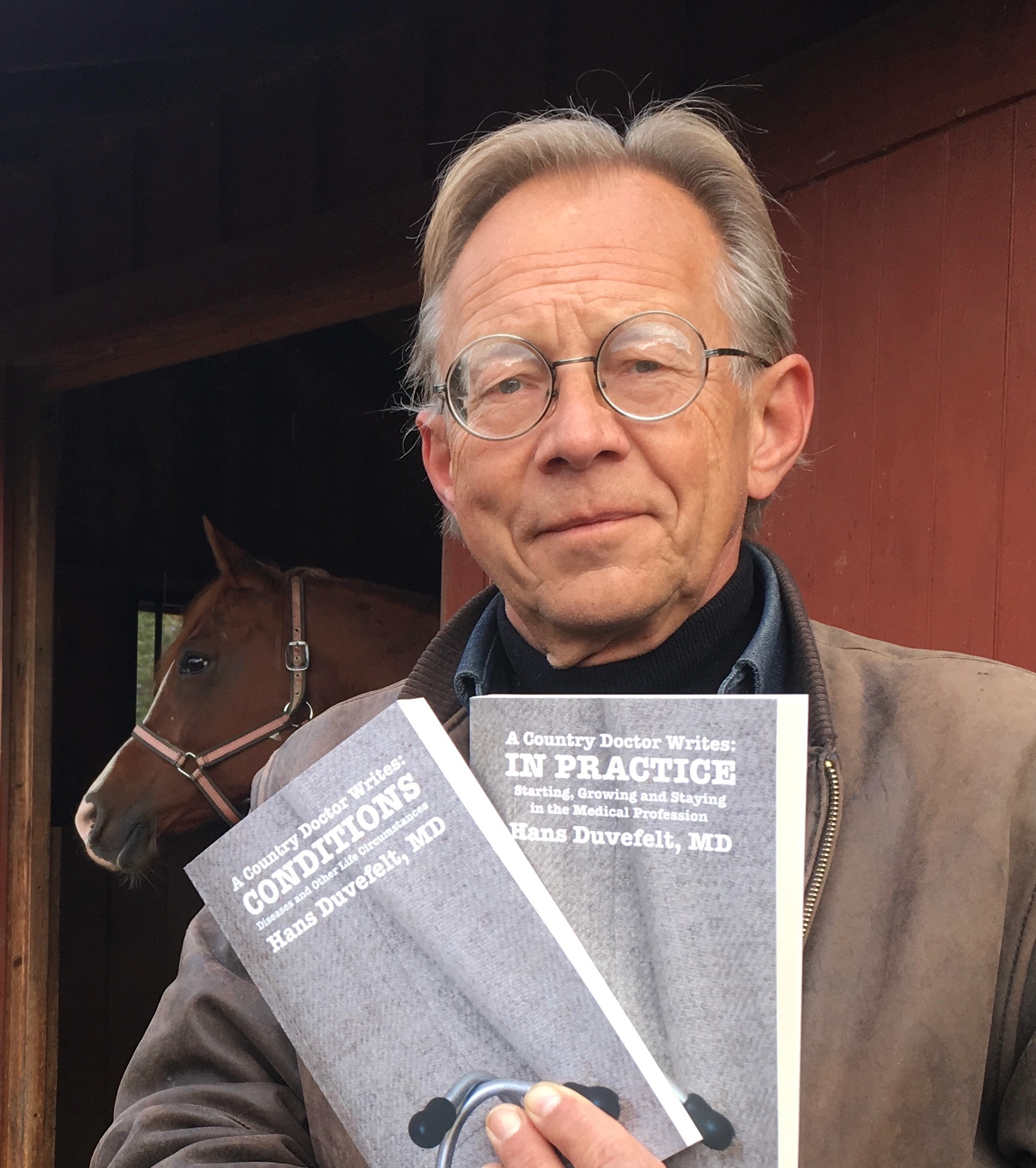
BOOKS BY HANS DUVEFELT, MD

CONDITIONS, Chapter 1: An Old, New Diagnosis

Top 25 Doctor Blogs Award

Doctor Blogs

Enter your email address to subscribe to this blog and receive notifications of new posts by email.

Mailbox

contact @ acountrydoctorwrites.com
Bookmark and Share
© A Country Doctor Writes, LLC 2008-2022 Unauthorized use and/or duplication of this material without express and written permission is strictly prohibited. Excerpts and links may be used, provided that full and clear credit is given.