Archive for the 'Progress Notes' Category


Quality or Conformity Revisited

In 2009 I wrote a post titled “Quality or Conformity“, where I pointed out that many of the quality measures in primary care have more to do with whether doctors follow guidelines than if they deliver care that helps patients live long and well. There is a tendency to focus quality efforts on measuring what is easy to measure, rather than what matters the most.

That phenomenon is called the Streetlamp Effect, named after the man who was found searching for his car keys not in the dark alley where he lost them, but under the corner streetlight where he could see better.

Last night and tonight I read four articles in The New England Journal of Medicine and JAMA that made me think again about how elusive an ideal quality is in primary care.

The Case Record of the Massachusetts General Hospital for the week of May 23 was a 12-year-old girl with celiac disease, behavioral symptoms and fatigue. Her final diagnosis was Addison’s disease, a deficiency of the body’s natural steroids. The piece mentioned that most sufferers of this condition live with its often-debilitating symptoms for 2-5 years before diagnosis. The girl in this article had been hospitalized several times before the correct diagnosis was made (at MGH, of course!).

The other piece in The New England Journal was about how Fee-For-Service payment was going to go away and be replaced by payment schemes based on relative value units and adherence to clinical guidelines for chronic disease. This piece specifically mentioned that treatment of (acute) illness would have far less value than managing chronic diseases.

I thought of the man who had been to the emergency room twice before I diagnosed him with scabies a few months ago. Doesn’t accurate diagnosis with new presenting symptoms count for anything anymore?

The first article in JAMA was a very broadly written piece about the future of quality measurements under Obamacare. The second article, written by a group of primary care doctors, was titled “A View From the Safety Net”. These doctors described the difficult choices they had to make between doing what mattered most to their underserved minority population or scoring better on quality measures dictated by outside authorities when they didn’t have enough staff or money to do both. The Obamacare article mentioned striving for patient-centered measures, but it remains to be seen how patient-centered we are going to be allowed to practice in the future.

Quality is still in the eye of the beholder. People in Government, insurance and academia prefer easily quantifiable data and still hold on to arbitrary or outdated numeric targets, even when the evidence to support them is controversial or refuted by science. They are often like the man under the streetlight.

Doctors on the frontlines, who live and breathe the complexity of health, disease and patients’ everyday socioeconomic challenges, know that for every clever metric someone can think up to measure quality, there are countless other factors that can render the quality parameters meaningless. What good does it do to prescribe the right medications for someone with chronic illness when the patient can’t afford them or keeps forgetting to take them?

In the same month my original post was published in 2009, for example, the American Diabetes Association revised its blood sugar targets for older diabetics. The evidence has shown that our usual targets were low enough to cause harm to many frail patients, yet doctors in this country are still given poor report cards if they practice with their patients’ safety and the new evidence in mind.

So, what is quality?

Quality is easing suffering and giving hope, not crunching numbers.

Quality is treating each patient in a sensitive, caring and competent manner.

Quality is serving the patient’s best interest with societal good in mind, not serving society with only an eye toward the individual patient.

Quality is having not only systems to promote safety and good practice, but people who care and invest their talents and abilities for the good of the patient.

Quality is diagnosing a rare disease like Addison’s early enough to give an adolescent girl her teenage years before they are gone.

Quality is making the diagnosis of a common disease like scabies in five minutes in a patient who has already cost himself weeks of discomfort and his insurance the dollar value of two emergency room visits and three prescriptions.

Quality is doing what matters to the patient. If we accept, even endorse, patients’ right to decide whether or not to be resuscitated if their hearts should stop, aren’t we then also allowed to listen to our patients and together with them formulate a care plan that they feel comfortable with for their chronic illness without fear of retribution by some Government or insurance reviewer for not following some more or less arbitrary guideline?

Quality is a word that lacks universal meaning. Every dictionary I have looked in has scores of definitions. It is a word people use for their own purposes.

We must be careful about letting others define the standards for our profession. If people with a more financial and less scientific and humanistic viewpoint set all the standards, technicians and computers will replace doctors.

The quality of a church service is, in my opinion, not adequately measured by how freshly painted the murals are, how well matched the choir uniforms are, how well-shaven the minister is or how clear his voice is when he puts his notes aside and speaks from the heart. If the Government were to set quality standards for churches, those things might be major quality indicators.

Fortunately, Church and State are separate in this country; health care and Government are no longer.

Health care, like religion, has a lot of intangibles, and even its substance is the source of many disagreements. I think that just like people go to church for different reasons, they seek health care for enough different reasons that our quality measures need to be very patient-centered, without losing sight of our “substance”, our foundation of science and humanity.

Quality is about addressing both the intangibles and the substance. Most of us know it when we experience it ourselves; the problem is building systems that guarantee it.

A Samurai Physician’s Teachings

Every now and then the title of a book influences your thinking even before you read the first page.

That was the case for me with Thomas Moore’s “Care of the Soul” and with “Shadow Syndromes” by Ratley and Johnson. The titles of those two books jolted my mind into thinking about the human condition in ways I hadn’t done before and the contents of the books only echoed the thoughts the titles had provoked the instant I saw them.

This time, it wasn’t the title, “Cultivating Chi”, but the subtitle, “A Samurai Physician’s Teachings on the Way of Health“. The book was written by Kaibara Ekiken (1630-1714) in the last year of his life, and is a new translation and review by William Scott Wilson. The original version of the book was called the Yojokun.

The images of a samurai – a self-disciplined warrior, somehow both noble master and devoted servant – juxtaposed with the idea of “physician” were a novel constellation to me. I can’t say I was able to predict exactly what the book contained, but I had an idea, and found the book in many ways inspiring.

The translator, in his foreword, points out the ancient sources of Ekiken’s inspiration during his long life as a physician. Perhaps the most notable of them was “The Yellow Emperor’s Classic on Medicine”, from around 2500 B.C., which Ekiken himself lamented people weren’t reading in the original Chinese in the early 1700’s, but in Japanese translation. One of his favorite quotes was:

“Listen, treating a disease that has already developed, or trying to bring order to disruptions that have already begun, is like digging a well after you’ve become thirsty, or making weapons after the battle is over. Wouldn’t it already be too late?”

Ekiken’s own words, in 1714, really describe Disease Prevention the way we now see it:

“The first principle of the Way of Nurturing Life is avoiding overexposure to things that can damage your body. These can be divided into two categories: inner desires and negative external influences.

Inner desires encompass the desires for food, drink, sex, sleep, and excessive talking as well as the desires of the seven emotions – joy, anger, anxiety, yearning, sorrow, fear and astonishment. (I see in this a reference to archetypal or somatic medicine.)

The negative external influences comprise the four dispositions of Nature: wind, cold, heat and humidity.

If you restrain the inner desires, they will diminish.

If you are aware of the negative external influences and their effects, you can keep them at bay.

Following both of these rules of thumb, you will avoid damaging your health, be free from disease, and be able to maintain and even increase your natural life span.”

On the topic of Restraint, the Yellow Emperor text states:

In the remote past, those who understood the Way followed the patterns of yin and yang, harmonized these with nurturing practices, put limits on their eating and drinking, and did not recklessly overexert themselves. Thus, body and spirit interacted well, they lived out their naturally given years, and only left this world after a hundred years or more.

People these days are not like his. They drink wine as though it were berry juice, make arbitrary what should be constant, get drunk and indulge in sex, deplete their pure essence because of desire, and thus suffer a loss of their fundamental health….Thus they fizzle out after fifty years or so.”

During the Ming dynasty, a prominent physician wrote:

“Premature death due to the hundred diseases is mostly connected to eating and drinking.” 

That quote still carries relevance today.

Interestingly, Ekiken sees medications, herbs, acupuncture and all the available treatments of his time as a last resort because they are unbalanced interventions to counter the imbalance of the body. Almost a hundred years later, Samuel Hahnemann coined the word allopathy for this type of treatment.

Ekiken wrote at length about what distinguishes a mediocre physician from a good one. For example, he describes the good physician as less in a hurry to prescribe medications. One of his many aphorisms seems uncannily relevant to today’s emphasis of guidelines over individualized treatment:

“A good doctor gives medicine in response to the condition of the situation…This is not a matter of adhering to one absolute method. It is rather like a good general who fights his battles well by observing his enemies closely and responding to their changes. His methods are not determined beforehand. He observes the moment and is in accord with what is right.”

Quoting Confucius, he ends his description of a good doctor:

“A good doctor warms up the old and understands the new”.

May all of us remember and respect the wisdom of the 2500 B.C. text, now almost 5000 years old, as it speaks of “avoiding overexposure to things that can damage your body”. It reminds me of all the lectures I have attended on diabetes and heart disease where the speaker devotes exactly one sentence to this topic, and then spends the rest of the time talking about all the interesting drugs we have to counteract the effects of our exposure to harmful or excessive foodstuffs.

A little samurai discipline and restraint could help most of us…

Doctoring in the Here and Now

I used to be a stickler for time. One of my first blog posts was about how it felt to go to work without my wristwatch.

I also used to be very particular about knowing the purpose of each visit, partly to help me manage my time, and partly to help me feel prepared and in control of the visit.

I often questioned why my colleagues’ patients would sometimes end up in my schedule for issues that seemed to me safe to wait until the patient’s own provider was available.

Over the last five years I have relaxed about these peeves of mine. I have become more accepting of the fact that patients don’t think in terms of how many minutes they have assigned to them as well as the fact that many patients can’t or choose not to tell the front desk staff why they want to see me on a given day.

Thinking about the way I used to be, I was more efficient than my employer expected me to be, but I don’t believe I quite lived up to my full potential as a healer. There were already then systems in place that made sure the housekeeping aspects of health care weren’t missed for very long if I were to digress in the visit – we had our chronic disease registries and recall systems for pap smears, mammograms and immunizations.

Lately, I have come to think more and more about the physician’s duty to ease suffering. So much of modern medicine is about population and disease management, and there are so many pressures on our time and attention that physicians seem to have little left to offer patients who are suffering, physically or emotionally.

But the systems to manage the measurable aspects of medicine are there, backed up by even more computer power, and we physicians may just need to step back from the numbers long enough in every encounter with each fellow human being to allow us to be open and see our patients as individuals. We need to listen actively to hear their unique agendas. We have teams behind us now to help manage the housekeeping details; we have health coaches and case managers and more nurses than we used to. But since only we have the title “Doctor”, we need to have our senses open to those things only we get to hear.

My wife, reflecting on her years delivering primary health care, always says: “I never had just a Diabetes visit. There was always something else.”

The sad truth is that the health of a nation is more dependent on public health, socioeconomics and the prevailing attitude among the majority of the population. The quality of medical care matters very little. For example, a healthy diet together with an active lifestyle is at least as good a weapon against heart disease as all the cholesterol pills and interventional cardiology that money can buy. It doesn’t take a medical degree to change the attitude of a nation, and trying to do it on a case-by-case basis with each patient at $7 a minute is not effective population management – not that I don’t try every single day.

So, what is the role of the physician in today’s health care system? I believe we are the ones who can best help patients make sense of their symptoms and also understand what the health care system can and cannot do for them.

With common human experiences given names that make them seem like diseases, and with our nation’s increasing confusion about even common ailments and preventive measures in spite of the glut of information out there, physicians can bring wisdom and empathy to a system that provides neither. Since we are closer to the mysteries of birth, disease and death than most people, we need to be there for our patients to turn to when the angst of life afflicts them.

I believe the new systems we have all been required to put in place to meet all the public mandates are actually blessings in disguise. If we are wise, we can meet our quality and productivity metrics through the use of the technology at our disposal and at the same time rediscover and cultivate the ancient art of doctoring. Because the phones at my clinic as well as every other doctor’s office keep ringing, not with patients asking to have diabetes follow-ups, but with patients who have a new concern, a new fear, or the courage – just today, or they will lose their momentum – to finally tell someone their deepest fear.

Pausing, as I do every time before knocking on the exam room door, I clear my mind and I am ready:

“Hi, I am D—. What can I do for you today?”

Absolute Risk

Gladys Peppercorn was in to see me the other day, very concerned about a letter she had received from one of the Cityside gastroenterologists.

In very formal words, the letter said the GI office had tried several times to reach her in order to schedule her next upper endoscopy to monitor her Barrett’s esophagus and would she please call them back to schedule the procedure so they could monitor her for her increased cancer risk.

“You know me, I don’t want any unnecessary procedures”, Gladys said as I read the letter she handed me. She had only gone for the test two years ago because she had experienced heartburn for years, and at that time certain foods had been a little difficult to swallow. Her test really came out okay except for the Barrett’s esophagus. Her biggest problem with swallowing was some age-related stiffness of her esophagus.

Gladys’ age was not apparent when I looked up from reading the letter. Ninety years old in just a couple of weeks, she looked radiant, healthy and on top of the world in her purple silk blouse and khaki slacks.

“I do hear you, and I’m going to do some math with you”, I said as I pulled my chair over next to hers and minimized the EMR on my tablet computer and opened UpToDate, the medical database from Boston many doctors use as a reference.

“Okay, here are the numbers”, I began as we both peered at the small screen.

“Having Barrett’s increases your risk of esophageal cancer 30-fold”, I said, pointing at the website. Her eyebrows rose slightly. I continued:

“That would be like me saying that wearing purple increases your risk of getting hit by lightning 30-fold. Would that stop you from wearing this blouse?”

“No, it’s my favorite color”, she smiled.

“And thirty times nothing is nothing!” I concluded. She agreed.

“Look here”, I pointed. “Studies have shown between 1.2 and 4.3 cancer cases per 1000 person years in people with your condition. Let’s exaggerate and call it 5 cases per 1000 patient years. That means that out of a hundred people like you, in the next ten years only five would get cancer and 95 would not.”

She nodded slowly.

“So you have at least a 95% chance that you will not get esophageal cancer in the next ten years, probably more in the order of 96-98%.” I continued: “And then you have to weigh that risk against the risk of anesthesia or the procedure itself causing you harm in some way.”

“I know I don’t want the procedure!” Gladys smiled and rose from her chair. I quickly got up, too. She stretched her hand out toward me and thanked me.

“I always feel better after talking to you”, she said.

I shook her hand and thought that she probably used to wear white lace gloves on warm days like this when she was young.

Sharing Territory

How are we educated by children, by animals!

                       Martin Buber

In my forties I was the father of three teenagers. I knew enough psychology to perhaps avoid a few common blunders, but nowhere near enough to do a great job raising the three of them. It would be fair to say I learned from them as we went along.

As an only child, I had lived with many expectations to be just the kind of son my mother always wanted to have. I decided early on not to live vicariously through my children. It is a classic, almost archetypal thing for parents to do; wanting for their children all those things they never had themselves. It seems so natural when you love someone to want the best for them and to want to protect them from harm and mistakes in their lives.

One of my first girlfriends’ father was a minister. He introduced me to Martin Buber’s “I and Thou”. I think he was trying to caution me not to be possessive about his daughter. I did learn soon enough on my own that we cannot love and control a person at the same time.

Love requires freedom, even the love of a child. I set out knowing my children were not miniature versions of me, but their own individuals. The fact that all three were adopted made it more obvious that they might not have come into this world with my traits, likes or dislikes, but that should hold just as true for biological children.

A colleague of mine from India once said about her youngest son, “I hope he grows up to be a good person”. It seemed so simple, yet wise: All we as parents can do is give our children the best start we can and hope for the best. An exasperated neighbor once said about her son, “There comes a time when all you can say is I love you, good luck“.

All three of my children have said, in one way or another, that they appreciated my respect for them as individuals. They have also pointed out that they respected me for letting them know when I disagreed with them.

With my children now around 30 years old and my grandchildren still blissfully young, the only experience I have with teenagers these days is as patients in the office. I can certainly draw from my having lived with three teenagers in those situations, but I am drawing more and more from the past few years’ lessons I have learned from P., our white Arabian Princess.

An 800 lb horse who thinks most humans are likely to hurt her or mistreat her is like some of the teenagers that have come into my office. Domination is unlikely to work with a fearful animal of flight with the power to escape or punch your lights out.

Much of what I have done with P., I figured out myself. Emma also pointed me in the direction of horse trainer Carolyn Resnick, whose “Waterhole Rituals” are a foundation for relationship building between horse and human.

P., fresh from the horse rescue, was suspicious of Emma, who had defended her gelding from the kicks and nips P. tried to inflict on him. Perhaps I seemed like the best choice P. had for an ally, knowing nothing about horses, and expecting nothing in particular from her. Perhaps I reminded her of her first owner, the man who named her and raised her from a foal.

Our white Arabian horse gave me a sense of awe. She was so beautiful; I had never seen the facial expressions and body language of a horse up close quite like that before. Her eyes could be glaring when she looked across the pasture at some danger in the nearby woods I couldn’t discern. Whenever she looked at me and I just stood or sat still in the barn or on the other side of the fence from her, her eyes grew soft and kind. If I got up or made a sudden move, they would widen and the whites would show, her neck would stiffen, her tail would rise and every muscle in her body would tighten. Sometimes she would run away from me. If I just sat there quietly, she would come back with a kind, quizzical look, as if to say, “What are you, what are you doing?”

Instinctively, I was doing the first of the Waterhole Rituals, Sharing Territory. By now, four years later, P. and I trust each other, and she will do almost anything for me. She nickers when I approach her and we go for walks around the pasture, side by side, without halter or lead rope. I clean her stall around her and she moves politely when I ask her to.

A horse will naturally move away from an approaching stranger, but is likely to come over and investigate a stranger standing or sitting still inside the horse’s territory. If the stranger walks away, the horse will likely follow.

This is how I have also come to understand working with teenagers. Just like P., they don’t assume your intentions are good and they don’t like it when you tell them what to do, but if you show that you are interested in them and if your interest is genuine, they may want to know you better. But their senses are exquisite – they can smell deceit or trickery miles away and if you come on too strong, they will run like wild mustangs (or white Arabians).

Which brings me back to Martin Buber:

There are two kinds of relationships we can enter into. One is the “I-It” relationship, where we view ourselves as controlling the “other” by taking pleasure from it/him/her or even just by analyzing or classifying it according to our worldview.

The other kind of relationship Buber named “Ich-Du” in German. It has been translated as “I-Thou”, even though “Du” is an informal, intimate word for “you” and not at all as formal as “thou”. This is a relationship where we meet on a level that is free from selfishness, judgment, opinion, even reflection or analysis. It is an intimate encounter between two beings in their most authentic form. This is also the type of encounter man has with God or the Universe when all the trappings of religious ceremony are removed.

An “I-Thou” encounter lacks structure and content. It has no agenda, because any kind of purpose would objectify the “other” and make it an “I-It” encounter. It is simply entering the common space where both of our innermost beings exist.

“Sharing Territory” almost says it better, especially in light of the fact that Martin Buber actually first thought of the I-and-Thou relationship when he as a pre-teen developed a relationship with a horse.

In “Between Man and Man”, he describes a fleeting moment, when he connected with the horse on a level that stirred an awareness in him and briefly brought him into a universal experience where the horse wasn’t just a horse, but a part of a common “Other”, previously unknown to the young Martin Buber:

“When I was eleven years of age, spending the summer on my grandparents’ estate, I used, as often as I could do it unobserved, to steal into the stable and gently stroke the neck of my darling, a broad dapplegray horse. It was not a casual delight but a great, certainly friendly, but also deeply stirring happening. If I am to explain it now, beginning from the still very fresh memory of my hand, I must say that what I experienced in touch with the animal was the Other, the immense otherness of the Other, which, however, did not remain strange like the otherness of the ox and the ram, but rather let me draw near and touch it. When I stroked the mighty mane, sometimes marvelously smooth-combed, at other times just as astonishingly wild, and felt the life beneath my hand, it was as though the element of vitality itself bordered on my skin, something that was not I, was certainly not akin to me, palpably the other, not just another, really the Other itself; and yet it let me approach, confided itself to me, placed itself elementally in the relation of Thou and Thou with me. The horse, even when I had not begun by pouring oats for him into the manger, very gently raised his massive head, ears flicking, then snorted quietly, as a conspirator gives a signal meant to be recognizable only by his fellow-conspirator; and I was approved. But once–I do not know what came over the child, at any rate it was childlike enough–it struck me about the stroking, what fun it gave me, and suddenly I became conscious of my hand. The game went on as before, but something changed, it was no longer the same thing. And the next day, after giving him a rich feed, when I stroked my friend’s head he did not raise his head. A few years later, when I thought back to the incident, I no longer supposed that the animal had noticed my defection. But at the time I considered myself judged.”

“Sharing Territory”, be it with a horse or a human being, is the purest form of encounter there is. I did not specifically set out to “heal” the wounds of my rescue horse any more than I personally believe I have the power to “heal” a troubled patient. But I have often seen that when you enter the space created by stripping away prejudice, projection and preconception, profound healing is possible.


I just realized none of the posts show on an iPad or a computer, but they do show on an iPhone. WordPress is working on this. In the meantime, please visit my Substack.


Osler said “Listen to your patient, he is telling you the diagnosis”. Duvefelt says “Listen to your patient, he is telling you what kind of doctor he needs you to be”.


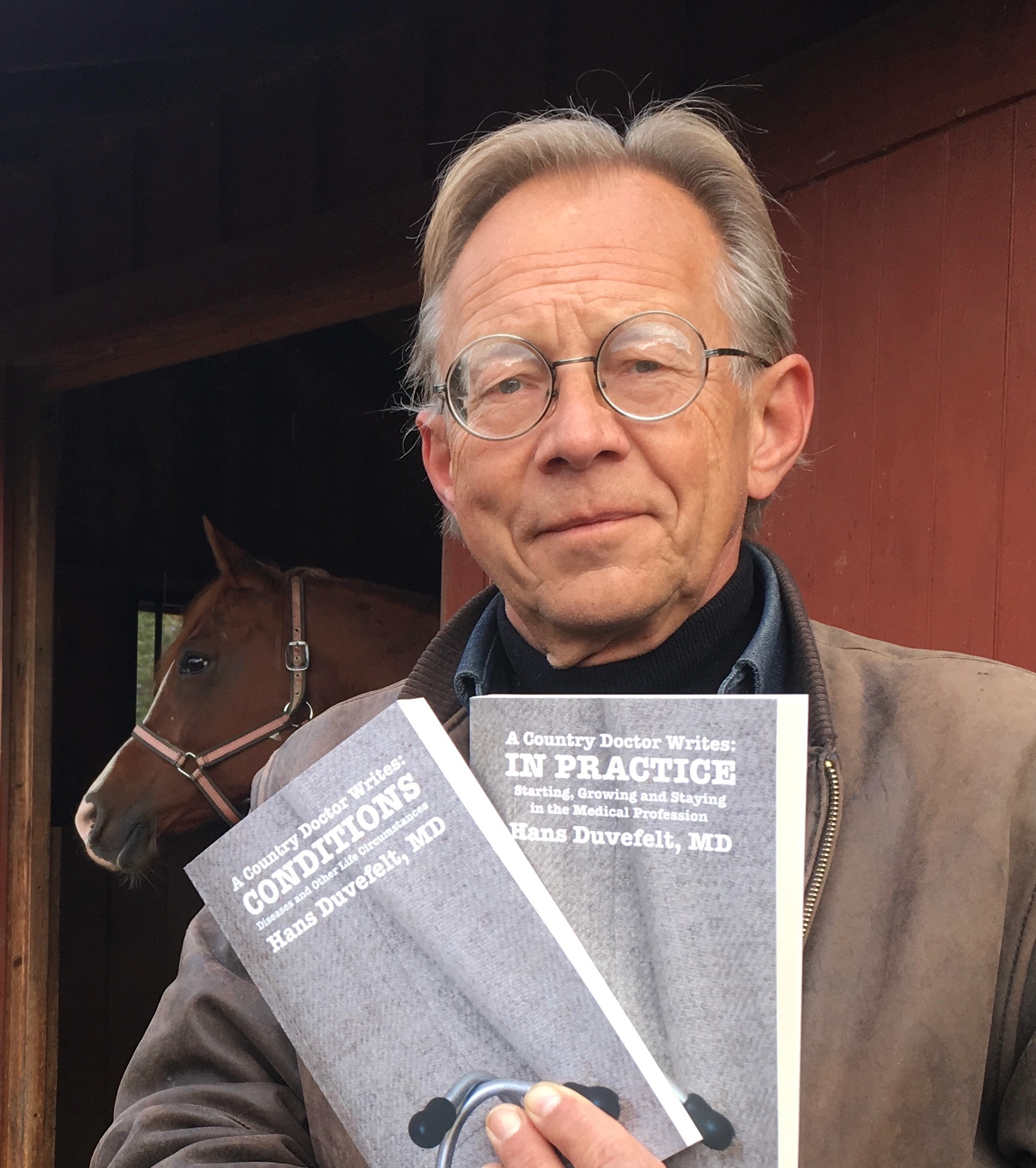
BOOKS BY HANS DUVEFELT, MD

CONDITIONS, Chapter 1: An Old, New Diagnosis

Top 25 Doctor Blogs Award

Doctor Blogs

Enter your email address to subscribe to this blog and receive notifications of new posts by email.

Mailbox

contact @ acountrydoctorwrites.com
Bookmark and Share
© A Country Doctor Writes, LLC 2008-2022 Unauthorized use and/or duplication of this material without express and written permission is strictly prohibited. Excerpts and links may be used, provided that full and clear credit is given.