Archive for the 'Progress Notes' Category


Angry Docs

“Holding on to anger is like grasping a hot coal with the intent of throwing it at someone else; you are the one getting burned.”
Buddha

“I came to realize that if people could make me angry they could control me. Why should I give someone else such power over my life?”
Ben Carson, M.D.

“Depression is rage spread thin.”
Santayana

“Depression is the inability to construct a future.”
Rollo May

The other night I got an email with a survey from the AMA. I don’t recall ever getting one from them before. Not that I have been all that involved with the politics of healthcare; I joined the AMA when I was a senior resident, a newcomer to American medicine, and bought life and disability insurance through them.

In all the years of change and upheaval in American medicine, I have never been asked my opinion on what I need in order to do my job well or how I feel about my chosen profession. Until now, that is. And now, they skipped over any questions they might have had about what I need; they went straight to the more ultimate questions:

The AMA wanted to know if I’m burned out or depressed and if I hate my EMR. They also wanted to know if I am contemplating changing practice location, dropping out of medicine, retiring or committing suicide.

And I had somehow gotten the impression that the AMA was one of the drivers of change for the last thirty years. But maybe I was misinformed.

Clearly, the questionnaire indicates that the medical establishment is quite worried about its constituency.

In “Bitter Medicine” I wrote about how outside forces have distorted the traditional doctor-patient relationship. I also wrote about how doctors need to see their patients as suffering kinfolk and doctoring as having a higher purpose.

The four years that have passed since that piece have been years of increasing physician dehumanization through “Meaningful Use” and other bureaucratic mandates. I have seen more signs of anger and bitterness in doctors and there has been a great deal written about physician depression and suicide.

But what is this anger really, what is the nature of this depression, what are their consequences, and is there a way out?

In psychodynamic theory, Abraham postulated in 1911 that depression can be self-directed anger in people with narcissistic vulnerability. Freud linked depression to anger at oneself after a perceived or actual loss of a person one felt ambivalent toward.

Brenner, while I was in medical school, saw depression as resulting from symbolic castration or more or less actual disempowerment. Aggression towards the person who causes the feelings becomes self-directed instead out of fear of the other person.

Physicians, or rather, people who choose to become physicians, often think of themselves as more dedicated and perhaps even smarter than other people. We carry the world on our shoulders and sometimes feel we are different from other people. These are essentially what psychologists describe as narcissistic personality traits. I believe many of us are vulnerable to and apt to react with strong emotions to real or perceived rejection or loss of power, such as what has happened in our profession in the last 30 years.

The reality of today’s patient encounter is that some of the preciously short time we have allotted is spent fulfilling the requirements of the healthcare system that may or may not directly benefit each patient. That leaves little time for diagnosis and treatment, and even less for relief of suffering. And, of course, if we are trapped in our own suffering, we cannot help relieve that of our patient.

Physician anger and depression may, ironically, be as great an obstacle to good patient care as the Government mandates, insurance company obstacles and Health Information Technology shortcomings we doctors are so upset with.

Venting our frustration with the system is a waste of our patients’ appointment time. At most, we may need to briefly explain what can and cannot be done in the minutes we have together. And harboring feelings of depression or helplessness distracts us from the necessary engagement with each patient.

There may be ways for physicians to effect change of the system, but the place for that is not the exam room. There is also the possibility of opting out of the system. But for all of us who choose to stay, every patient encounter with a fellow human being deserves our full attention and genuine compassion.

Thinkers from all different religions and schools of thought have all said the same thing: We have a choice whether to cultivate our anger or not. Most tell us we can’t suppress it, because it has a way of expressing itself in other ways, even as illness.

Physician anger or depression that stems from powerlessness, like all anger, has an antidote. Borrowing from Buddhist thought, the antidote is love and the path is mindfulness.

Thich Nhat Hanh writes:

“When we embrace anger and take good care of
our anger, we obtain relief. We can look deeply into
it and gain many insights. One of the first insights
may be that the seed of anger in us has grown too
big, and is the main cause of our misery.”

“In a time of anger or despair, even if we feel
overwhelmed, our love is still there. Our capacity to
communicate, to forgive, to be compassionate is
still there. You have to believe this. We are more
than our anger, we are more than our suffering.
We must recognize that we do have within
us the capacity to love, to understand,
to be compassionate, always.”

He also says something that points out Westerners’, including Western doctors’, emphasis on formal education compared with cultivating our well-being. Hearing about divorce rates and alienation of other family relationships among physicians, these words should make us stop and think. Not that we should have forgone our education, but why do we think our life, well-being, and our relationships don’t also require effort and time?

“Getting a university degree may take you six or even eight years, and that is quite a long period of time. You may believe that this degree is important for your happiness. It might be, but perhaps there are other elements that are more important to your well-being, and to your happiness. You can work on improving the relationship between you and your father, your mother, or your partner. Do you have time for this? …You are willing to put aside six years for a diploma; do you have the wisdom to use just as much time to work out a relationship? To deal with your anger?”

Our anger demands attention, but not encouragement. Like Buddha’s hot coal, it hurts the one who carries it. When we are angry, like many of us are with the system, we need to examine our anger. Are we angry more or less because we can’t have our way? Are we angry because we think health care politics need to change? In the first case, our anger is only hurting us; in the second, it needs to be turned into political action.

We need to stop banging our heads against the wall. Yes, our tools aren’t as good as we would like, those who pay us don’t know enough about what we do, and the Government is fixated on form without function.

But did Hippocrates have top-notch equipment, did Albert Schweitzer have all the resources he needed, and did Michelangelo always have the right paints and brushes? Sure, we could all do better if only….but we’re just wasting our breath, using up valuable time and watering the seeds of anger and depression if we harbor such thoughts in the exam room or at home. We can take them to the political arena, but we must not let them poison our patient care, our home life or our souls.

“I Also Tame Wild Horses”

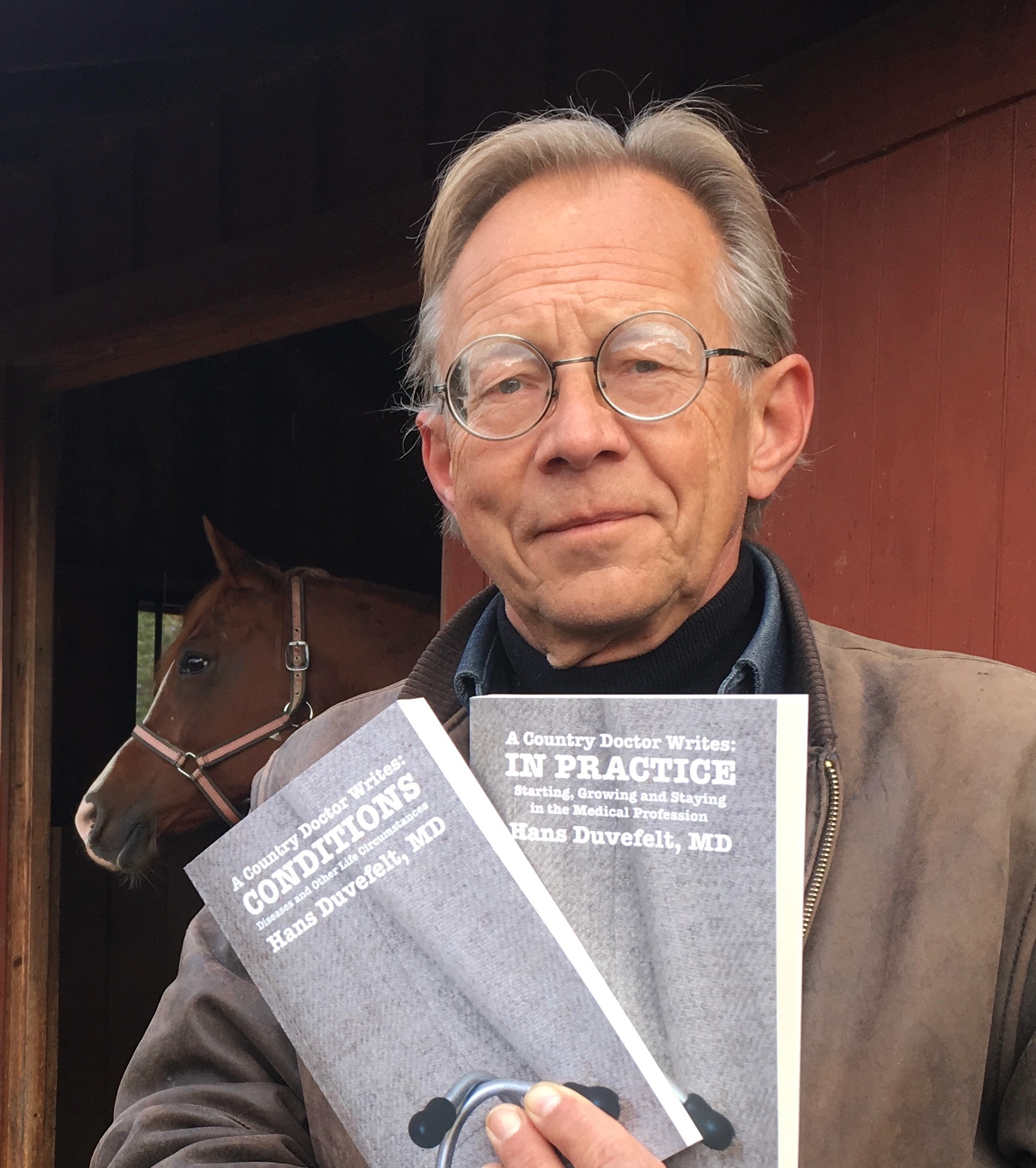
Autumn’s 17 month old nephew from out of town had been visiting with us in the office the other day. He sat in his mother’s arms as Autumn showed her sister, April, around the clinic. We had made brief eye contact then. He had the hesitant look of quiet amazement as he looked around our busy office. I minimized the EMR on my big computer screen and showed him the picture of my white Arabian horse standing next to me, all bundled up in my thick leather jacket with a blaze orange vest over it. Dylan’s eyes locked on to the screen as the two women talked. They stayed locked on and he didn’t seem to register my attempts to make contact. After a few minutes, April signaled she had to be going. Autumn and I both waved and Dylan strained his neck, gaze still fixated on my computer screen as his mother turned around and stepped into the hallway.

Friday, Dylan was in my schedule for fever and vomiting. Both his mother and father were there and Autumn was in the room with them.

Dylan didn’t appear to be all that sick. I sat slouched on my stool while I took the history and then slowly moved closer to the exam table and began to examine Dylan in his aunt’s arms.

Autumn and April commented from the beginning on how difficult Dylan usually is to examine. I plodded along slowly without any protests. I checked his neck for enlarged lymph nodes and carefully pulled the stethoscope from the pocket of my long white lab coat.

“I don’t believe that he’s okay with you doing that”, his mother said as I listened to his heart and lungs. I squeezed his belly very gently as I told his mother that his lungs sounded nice and clear. His abdomen was absolutely soft and he didn’t seem bothered by my palpation.

Next, I slowly pulled my pocket otoscope from the holster on my belt. Dylan watched intently as I unfolded the instrument.

“See how this works”, I said in a low voice and turned the light on. I aimed it first at my left hand and wiggled the light a little. Dylan’s eyes followed my movements. When I aimed the light at the Disney figure on his shirt, he looked down, and his chin touched his chest. Slowly, I reached past the exam table and pulled an otoscope tip from the wall dispenser. “Let’s check your ears”, I said while I attached the otoscope tip.

Dylan’s eyes followed every move I made. I aimed the light at my own hand again, then I quietly reached over and looked in his ear while I very carefully pulled just a little at the tip of his outer ear. As he started to tighten his muscles I let go and pulled away. “That one looks okay”, I said as April and Autumn stood next to Dylan with wide eyes and open mouths.

His other ear looked fine, too. He didn’t tense up at all this time. I said “let’s check your mouth” and cocked my head up a little to be able to look through the lower portion of my bifocals. Dylan also looked up a bit, and his jaw muscles relaxed. Gently, I touched the sides of his mouth and opened mine a little. He opened his mouth in the same fashion and I pulled lightly on his jaw and his mouth fell wide open. I got a quick look at his tonsils and I could see that his mucous membranes were moist and normal in color.

“He looks fine. I think he just has a viral infection, so as long as he keeps taking in fluids and doesn’t develop any other symptoms, he should be okay”, I reassured his parents.

“He’s never let anyone examine him without fussing or crying”, April said. “I know”, Autumn chimed in. “He’s always been impossible to examine.” Turning directly to me, she continued: “I always knew you were good with kids, but this was truly amazing!”

“I also tame wild horses”, I said, overcome by an uncharacteristic impulse of flamboyance.

As I thought about my words, it seemed that the analogy is obvious. People talk of the “techniques” they use when dealing with mistrusting, unbroken rescue horses, sullen teenagers or toddlers with fear of doctors, but I never thought of any of it as technique. Approaching another creature requires genuine respect and connection, and it can’t be completely taught or analyzed.

After I ended up with my rescued Arabian princess and got to know her by just hanging out with her, sitting quietly in the barn cold winter evenings and sultry summer nights, she has come to trust me, and I her. When she was ill and too despondent to return from the frozen pasture during her first ice storm, I trundled out to her with halter and lead rope for the very first time, and she followed me willingly back to the barn.

Later, I have read about just this way of relating with horses, not by dominating them, but by earning their trust and respect. Carolyn Resnick calls it “The Waterhole Rituals”. The first and most crucial step is to place yourself near the horse without fixating on it, and enter a frame of mind that is peaceful and gentle. If you just do that, any horse will seek you out to make your acquaintance.

Approaching a sick child, or just a fearful one, requires the same frame of mind. There may be techniques to learn, like listening to the lungs right away, before any crying starts, and saving the throat exam for last, because if the child does start crying, you’ll see the throat anyway, and without effort. But those are superficial and secondary considerations. The kind, gentle and healing presence isn’t something you need schooling to learn. It is just a matter of having your heart in the right place. I also think it is important to connect on a level some people may refer to as “energy”; Dylan, the amazed visitor from another world, that of a gentle and curious seventeen month old, responds better to a quietly plodding softspoken “energy” or demeanor, while some older children with mischief in the back of their minds relax and connect better with a grandfatherly doctor with a twinkle in his eye and a joke up his sleeve.

As my practice has matured, I see fewer children than I used to, but I cherish the opportunities I do have to see young children. It’s like dusting off your old bicycle and going for a spin – you never forget how to do it.

The Great Imposter

“I hate to leave you with such an unfinished workup”, my senior colleague, Dr. Wilford Brown, said three Thursdays ago. He was going on vacation and Norman Sprague had just been in to see him with a one day history of a strange pain near his right shoulder blade.

Mr. Sprague is a 68 year old retired accountant with rheumatism and diabetes. Dr. Brown ordered some bloodwork and a chest X-ray and told the patient to stay in touch with me about his symptoms.

“I wonder if it’s early shingles”, Dr. Brown told me.

The next day I got the negative wet read of the chest X-ray and a bunch of normal blood tests and a phone message from Mr. Sprague that he was getting some nausea. I told Autumn to have him come in to get reexamined.

Norman didn’t have a fever, and he didn’t have a rash or any alteration of skin sensation on his torso. His lymph nodes and breath sounds were normal and his abdomen was soft. But if I pressed hard enough over his gallbladder, he did hurt – that was obvious from his facial expression. He told me the pain was also I the lower front of his chest now, to the right of his sternum just by his lowest rib. It was relentlessly steady and unaffected by movements or deep breathing. He denied any shortness of breath. He told me was nauseous but still able to eat a little, and he had not vomited. His ribs weren’t tender. His bowels were normal and his urine had normal color.

I ordered a gallbladder ultrasound. There were no gallstones, but the radiologist said there was a suggestion of sludge in the gallbladder and the common bile duct was at the upper limit of normal size.

I called one of our local surgeons. He suggested doing a plain HIDA scan. Because of the national shortage of cholecystokinine, that is the only type of biliary scan we can get right now. The test showed that the gallbladder filled normally, but the tracer was slow to travel down the bile ducts and into the duodenum.

Last Monday, Norman met with the surgeon, who called and said he was pretty sure the pain was biliary, but also told me that over the weekend before the consultation, Norman had developed shortness of breath and dizzines. I asked him to send Norman over so I could reassess him.

He was not all that short of breath and did not have a cough, but his breathing had changed since I saw him last. He admitted that he had had some difficulty shopping at Walmart since last winter because he felt “out of shape” pushing a cart up and down the aisles. He also described his right-sided chest pain as more severe, but still unrelated to movement and breathing.

He had dizziness and a hint of nystagmus only when turning his head to the left in a supine position with an otherwise normal ENT and neuro exam, so I was comfortable ascribing his dizziness to Benign Positional Vertigo.

His oxygen saturation was normal and his EKG was unchanged from three years ago.

I ordered a PE protocol contrast chest CT, which did not show any pulmonary emboli, but it did show mildly enlarged mediastinal lymph nodes and three nodules peripherally in the right lung, the largest one just over an inch. I had also ordered an abdominal CT, which was perfectly normal. The nuclear stress test I also ordered that day came back normal. By that time I had called Cityside Pulmonary Associates. They promised to look over the images and get back to us with an appointment.

Norman Sprague called back two days later. He had received a call from the pulmonary office, telling him he was on a cancellation list, but only had a firm appointment for the first week in October.

I called the thoracic surgery group at Cityside and got to talk with Dan Grossman. He looked at the images and when I asked him if a video assisted thoracoscopy was an option for getting a tissue diagnosis, he said, yes, but bronchoscopy would be better. I told him about the long want to see a pulmonologist.

“Either we or they will see him sooner”, Dan said. I’ll get back to you. Twenty minutes later he called me back. “It’s all set, Roger White will see him on Friday and do a scope then.”

Norman had his bronchoscopy. The needle aspirates were benign and the washings and cultures negative. Dr. White’s note listed sarcoidosis and methotrexate related lung disease as the top differential diagnoses, and he thought a PET CT would be the next step, and maybe a percutaneous needle biopsy of the distal lesions.

Today I met with Norman and his wife to go over the results that had come in after the bronchoscopy. As I reexamined his abdomen, he was more tender in the right upper quadrant than before, and when I lifted up the back of his shirt there was a red spot with a small, raised center, not a blister but more of a papule.

“Ouch, that’s sore”, he said.

And so I leave Norman Sprague in the competent hands of Dr. Brown, who returns from his vacation tomorrow. Norman’s lung nodules and lymphadenopathy still remain to be diagnosed, and he still may have gallbladder disease, but he also, again, has the original working diagnosis of herpes zoster, the great imposter.

Calling Mrs. Kafka

“Prior Authorizations, Mrs. Kafka. May I have your name and the patient’s policy number.”

“My name is Country Doctor, and I don’t have the patient’s number but I have her husband’s – it is 123456789”.

“Thank you, Doctor. This is for Harry Black?”

“Well, no, it’s for his wife, Harriet. We asked for a PA for Lyrica for her, but it was approved for him instead, even though the forms we sent you clearly stated her name.”

“I see that Harry is approved for one year.”

“Yes, but he doesn’t need it. He has no diagnosis and no symptoms. Someone at your end reversed the names, because the application was for Harriet. I have a copy right here in front of me. So can we just get this approval switched over to her name instead?”

“I’m sorry, we can’t.”

“But why?”

“She’s a different patient.”

“But everything we sent in was on her. You were the ones who put it under his name instead. It was your mistake and I’m asking that you correct your mistake.”

“I’m sorry, but we have to process Harriet’s Prior Authorization separately. What is her diagnosis?”

(Sigh)

“Postherpetic neuralgia.”

“Is she currently taking Lyrica for this?”

“Yes.”

“I don’t see any pharmacy claims for Lyrica in her profile.”

“That’s because you don’t pay for it. That’s why you and I are talking right now, isn’t it? She’s been using samples.”

“Lyrica is not covered for that diagnosis. Studies have shown that other drugs usually control symptoms…”

“Now, wait a minute, your company already approved it for that indication when you looked at the paperwork we sent in before, all that happened was that you misread the name of the patient! And if you didn’t read her papers and still approved it for her husband with no diagnosis at all, you can’t exactly say you’re following any firm principles there at MegaScripts!”

“I’m sorry, Doctor. We have to process her request from the beginning.”

“This woman has suffered for two months and has taken several other drugs before getting any relief -amitriptyline, gabapentin, and she’s on Effexor, so there is no point in trying Cymbalta. If you can’t or won’t correct your own mistake, and if you can’t accept what I’m telling you now, I just can’t sit here and argue any longer with you. I’ve got patients waiting. Just tell me where to fax the information.”

“The number is 1-888-000-6666. Now, did you say she had tried ga-ba-pen-tin?”

“Yes, that’s what I said, and that’s what I wrote on the form we already sent you!”

“All right, hold on, Doctor. I’m getting an approval here. O.K., I have a number for you. It is 9921465. And it’s good until August 12, 2015.”

“Thank you!”

(Sigh)

“You’re welcome. Is there anything else I can do for you?”

“No, that’s all I have time for today, even if I needed anything more from you.”

“Then, you have a nice day and thanks for calling MegaScripts.”

(Click)

Neither Doctor nor Priest

It is the year of Woodstock. The motorcycle accident victim lies quietly in his hospital bed. By all accounts, the surgery has gone well and Richard’s initial prognosis had been good. But his vital signs are deteriorating and he seems distant and despondent.

Marcus Welby knows the trouble isn’t physical. He calls on the parish priest, who seems slow to respond. The priest, twenty years younger than Welby, is also his patient, and has been suffering from asthma attacks. Welby believes they are due to Father Hugh’s struggles with feelings of inadequacy as a priest.

Richard turns the priest away and appears to be dying. The priest feels ready to give up the priesthood.

Marcus Welby, who had been urging the younger priest to take a break because of his asthma, now urges him to get to work. He tells Father Hugh that he has also failed many times, but failures are no excuse for quitting. The gravity of the situation mobilizes new strength in Dr. Welby, and his humanity and passion inspire Father Hugh to admit to himself and the young accident victim that, even though he is a priest, he struggles like all human beings. That honesty makes young Richard open up to Father Hugh and he begins to recover.

What neither doctor nor priest could do alone, the two men working together are accomplishing. This is what happens in a December 1969 episode of Marcus Welby, M.D., “Neither Punch nor Judy”.

The cars seemed more old-fashioned than I remember them from those days, and the 1969 medical standards of care are definitely as old-fashioned as the cars, but the struggles of the three men from three different generations are timeless.

I decided to watch this episode after rereading my post “The Apostolic Nature of our Profession” when I linked to it the other day. The video illustrates many things about medicine that we are no better at today than 45 years ago, or 2,400 years ago, for that matter:

“The cure of the part should not be attempted without treatment of the whole. No attempt should be made to cure the body without the soul. If the head and body are to be healthy you must begin by curing the mind…for this is the great error of our day in the treatment of the human body, that physicians first separate the soul from the body.”

Plato


I just realized none of the posts show on an iPad or a computer, but they do show on an iPhone. WordPress is working on this. In the meantime, please visit my Substack.


Osler said “Listen to your patient, he is telling you the diagnosis”. Duvefelt says “Listen to your patient, he is telling you what kind of doctor he needs you to be”.


BOOKS BY HANS DUVEFELT, MD

CONDITIONS, Chapter 1: An Old, New Diagnosis

Top 25 Doctor Blogs Award

Doctor Blogs

Enter your email address to subscribe to this blog and receive notifications of new posts by email.

Mailbox

contact @ acountrydoctorwrites.com
Bookmark and Share
© A Country Doctor Writes, LLC 2008-2022 Unauthorized use and/or duplication of this material without express and written permission is strictly prohibited. Excerpts and links may be used, provided that full and clear credit is given.