Archive for the 'Progress Notes' Category


Patients from Away

Every year I get at least half a dozen new patients who are “from away”, as we say in Maine. Obviously, I’m “from away” myself. I chose to come here after once driving up from Massachusetts, where I had been an exchange student, and seeing the untouched vastness and the slower pace of life in rural Maine.

Until a few years ago, these new patients were all people who had fallen in love with Maine by vacationing here, or they had come here because of job opportunities.

Lately, I have puzzled over why some of my new patients have chosen to move here; many of them have serious health problems and disabilities, they have never visited Maine before (or seen a Maine winter) and they don’t know a soul here.

A few have hinted about the lower cost of living, and I didn’t really think very hard about that until I saw an article in the Wall Street Journal about a baby boomer in California who moved to an Iowa town of 700 just to be able to survive on the resources she had left to live out her life on.

Here, you can buy a modest house for a tenth of what a similar one costs in California or a third of the cost in Brockton, Massachusetts.

But Maine, as much as I love my adopted home state, offers some serious challenges for dislocated older patients with serious health problems. We have a shortage of physicians in most of the state, in both primary and specialty care. Dialysis centers and radiation oncology clinics are few and far apart. We have few options for public transportation, and small towns rarely have taxi services.

Winters can indeed be hard, heating costs are high, and the town I live in regularly loses power during snowstorms, sometimes longer than 24 hours at a time.

I have many patients who are “snowbirds”, and as they get older, they often decide to give up their second homes in Florida and stay year round in Maine. But they know what it’s like here, and most of them have most of their family right here.

I wonder if those of my patients who have moved here alone in their sixties or early seventies have thought of how their journey will end – not where they wanted to be, but where they ended up.

I worry about them.

.
A Week with no Lab Coat

Something very interesting happened to my patient visits when I changed my office attire.

My clean long cotton lab coats, hanging on the back of my office door, suddenly all seemed dingy when I set out to change lab coat about a week ago. I decided to pretend it was Saturday.

On Saturdays I usually wear a pocketed button-down shirt instead of one of my usual Jermyn Street ones. I skip the lab coat, hang my stethoscope around my neck, put some pens in my breast pocket and attach my magnetic name tag. I still wear a tie, but sometimes with a doctor motif or Snoopy (I miss my beagles).

On Saturdays I seldom have very serious visits. Most are physicals for working people and sick visits, sore throats, earaches and such. Nobody from the administration, lab or X-ray is in, there are fewer messages, no faxes and no meetings. It’s just me, a medical assistant and the patients. It’s all very basic.

So there I was, deciding to go coatless. I put the magnet inside my pocketless English shirt and the name tag lined up outside, draped the stethoscope around my neck, clipped a pen inside my pants pocket and entered the exam room to greet my first patient of the day.

“Nice shirt”, said the sixty-something man. He was chattier than usual, I noted quietly. I had two more similar compliments that day and I started to feel something was different about the dynamic in the exam room.

Since then, I have had the distinct impression that my visits are more laid back, more intimate and less demanding. It’s as if my patients are relating to me in a more personal way, even though I’ve always felt very close to my patients. I have also not had a single patient try to cram in a long shopping list of concerns I couldn’t possibly address in one single visit. I feel as if everyone is viewing me as more human, just as competent, but not a healthcare robot or action hero.

I still delivered good and bad news, I still explained the inner workings of the body in plain English and I still typed away with only two fingers on the computer or my iPad. But I felt as if a veil had been lifted and my patients saw me as more than just their doctor, or dared to treat me that way.

A Lesson Learned

It was late afternoon. The woman who had seen my colleague, Dr. Wilford Brown, a few days earlier was sitting in my exam room. Her chart note read like a typical unnameable virus: Headache, bodyaches, fatigue, low grade fever. She had always seemed like a level-headed resolute woman, but she had called three days in a row for medical advice because she felt so poorly. And it all sounded like a simple virus that a few more days of rest would take care of.

She did have a good sized boil in the middle of her back, but that wouldn’t make her feel that sick. The rest of her exam was perfectly normal.

“Let’s check your blood count to see if this looks viral”, I suggested.

“Anything”, she answered.

I moved on to the next patient. A few minutes later I was handed a printout of her CBC. Her white blood cell count was 1.88, almost critically low and without the “right shift” that often accompanies a low WBC in certain viral illnesses. Her platelet count was 68, not far above where spontaneous bleeding might occur.

“I need to send you to the hospital for more testing. I don’t know what’s going on. It could still be a virus, but you need to be checked for blood poisoning”, I explained.

She felt well enough to drive herself to Cityside. For a split second I agonized about that decision. If she was going septic, could she suddenly drop her blood pressure on the way? But I agreed to have her drive.

I called the ER and spoke wih one of their regulars about her case.

“Ok, we’ll be looking for her”, the seasoned but still young physician answered after my thumbnail description of her.

Fifteen minutes later I got another printout. Her ALP, ALT and AST were all about three times the upper normal limit. What wold cause that kind of liver irritation, I thought to myself.

“Fax it to Cityside ER”, I told Autumn, and I called back and left a message for Dr. Waterman about the new information.

I told Dr. Kim about her and, without hesitation, he said “I’ll bet she has anaplasmosis”.

I’ve seen plenty of Lyme Disease. I grew up with ticks in the country where Erythema Chronicum Migrans was first described. But I hadn’t had any experience with anaplasmosis, another tick borne disease, also treatable with doxycycline. I had thought of that as a near tropical disease.

I checked UptoDate and a few other sources, and certainly all the symptoms matched, as well as the low white count and platelets and the elevated liver enzymes. A rash can occur but not usually. The description “summer flu” stuck in my mind from my brief reading.

The next morning I got the admission history and physical. The hospitalists at Cityside suspected a tick borne illness but worked my patient up for sepsis to be safe.

Two hours later, Monica, our new nurse practitioner, asked me to look at a rash. The patient was a woman in her late sixties. The rash consisted of several blanching maculae, each measuring 4-5 inches. None of them were itchy. She was feeling fairly well, but when I asked her about recent illnesses, she said she had been to the ER at Mountain View Hospital the week before with a headache, fever and body aches.

Monica got called away for a telephone call. I sat down by the computer and pulled up the woman’s ER report. The labs they had done showed a low white count, a low platelet count and liver enzymes twice the normal limit. I printed up the report.

“I know what this is”, I said to Monica when she came back, and handed her the ER note. “It looks like a tick borne illness, possibly anaplasmosis. Why don’t you get a tick panel and put her on doxycycline.”

(Thanks, Dr. Kim.)

IMG_0304.JPG

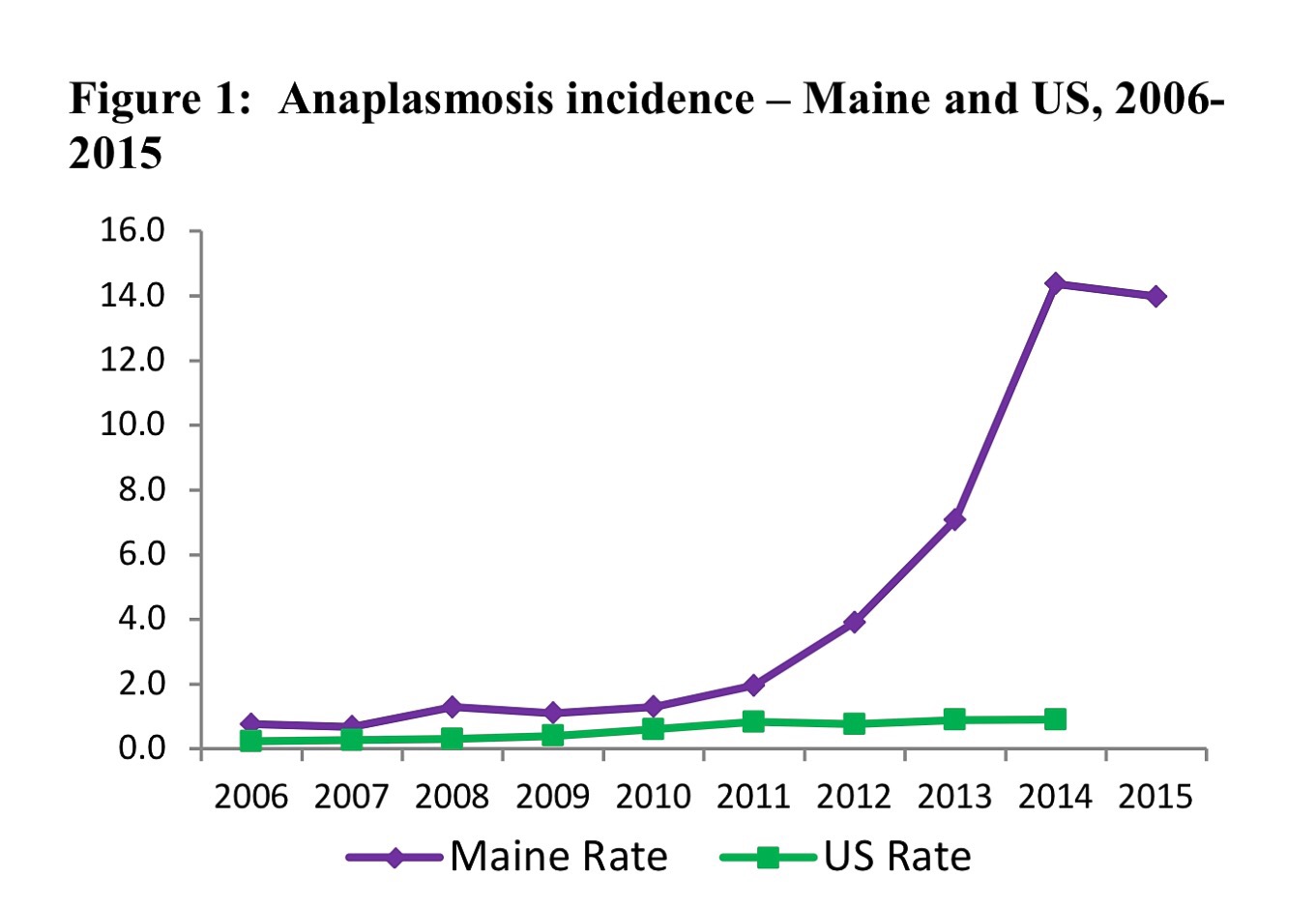
(Cases per 100,000. Source: Maine CDC,
http://www.maine.gov/dhhs/mecdc/infectious-disease/epi/vector-borne/anaplasmosis/documents/Anaplasma-2015.pdf)

P.S. This afternoon, Monica alerted me to a patient I will see in followup later this week, a middle aged man who had also been to Mountain View ER recently with flu-like symptoms and abnormal lab work. They had called it viral, but Monica had ordered a tick panel today and put him on doxycycline.

A Moving Target

He was a new patient. His medical records described him as severely hearing impaired and suffering from a rare movement disorder. He arrived with a caseworker for his 11:30 first appointment and I was running late.

“Why is a new patient or a minor surgery procedure ever scheduled at the end of the morning instead of at the beginning”, I asked Autumn, rhetorically.

The man seemed to be bouncing around in the small exam room. His head bobbed randomly and his body moved like waves in a wading pool full of three-year olds.

I introduced myself. His caseworker, clipboard in her left hand, shook my right hand. The man floated toward me, cocked his head suddenly and hollered while pointing to his right ear:

“I can’t hear!”

“For how long?” I asked.

He didn’t seem to hear me.

“At least a few years from what I know”, his caseworker answered, drowned out by the man’s repetition, “I can’t hear, I can’t hear!”

He seemed irritable, frustrated, and there was an air of desperation in the room. The caseworker looked helpless.

It was 12:35.

“Let me check your ears”, I said, gesturing with the wall mounted otoscope.

“I can’t hear!” the man shouted.

As I leaned toward him I could smell the odor of ear wax. I tried to gently grab and pull his right ear upward and back while I held the otoscope head between my right thumb and index finger and leaned the pinky-side of my hand against his cheek.

His head moved back and forth, up and down. Pushing my right hand firmly into his cheek, I moved with him, as if we were both bouncing on an underinflated air mattress.

All I saw was ear wax.

I repeated the procedure with his left ear. It, too was impacted with black, smelly cerumen.

“Let me flush your ears”, I said, loudly, into his right ear.

“I can’t hear!” he hollered back.

“I’ll be back”, I said and gestured with my index finger straight up as in “one minute”.

So followed an awkward dance with the man sitting in the exam room chair by the sink, Chux pad on his shoulder, the caseworker holding the cup under his ear and me flushing his right ear with lukewarm water from a large plastic syringe. All three of us moved in near-unison, again and again in what looked like multiple attempts to master a Tango step, sometimes rising at the end, sometimes sinking down or pausing mid-movement, all three of us.

The ear wax poured into the cup and large amounts of water saturated the Chux pad and the side of the man’s neck. Some of it landed on me.

As I eased myself away each time from our virtual embrace to empty the cup of clumpy wax soup into the sink, I watched through my splattered glasses for a reaction.

After the fifth or sixth serving, the man’s movements stopped suddenly. He shook his head like a wet dog. Slowly, he cocked his head and I could sense how he was trying to listen.

The aura in the room changed. Everything seemed quiet and peaceful. He was perfectly still for what seemed like half a minute. The caseworker picked up her clipboard and clicked her ballpoint pen. The ceiling air vents blew their gentle, artificial breeze. Someone walked down the hall outside the exam room.

“I can hear again. Thank you”, he said in a normal voice.

“Fantastic. Are you ready for the other ear?” I gestured with the otoscope. It was 12:49.

His head started to gently move again.

“Let’s roll!” he grinned.

Acts of Kindness

As I look back over the past work week I can’t immediately recall any great diagnostic coups or clinical victories. I vaguely remember having to reboot my EMR a lot because it seemed to freeze up, and I certainly remember being locked out of its iPad app for a day and a half.

What I remember best are my trips back to the waiting room pushing wheelchairs with elderly patients at the end of their visit, and I remember the gratitude of the arthritic man, no older than myself, whose toenails I cut as a “by-the-way” after I had excised a suspicious mole on his back.

Again this week I found myself, privately quiet and not much fun, living out my other persona, the secure, reassuring, jovial, gray-templed physician, fatherly to some, a peer to others, and a kind man of the (white) cloth to some.

Sure, it’s great to nail a difficult diagnosis, but we can’t expect to do that every day. What we can and should do every day is connect with and touch every human being we run across in our role as physicians. Otherwise, the new housekeeping tasks of healthcare today will wear us down.

—

That thought reminds me of a post I wrote nine years ago, six months after I started writing his blog, “A Day Without a Diagnosis”:

“Thursday I saw 29 patients*, but I didn’t make a single diagnosis. I did three physicals and saw several patients with diabetes, hypertension and high cholesterol. A migraineur came in for a shot, and we double booked a few sick people who already knew their diagnosis and what treatment they needed.

One of my physicals was a Registered Nurse, about my age, who left clinical nursing a few years ago and now does research for a group of surgeons at the hospital up the road. Her research focuses on quality of care.

That got me thinking about the differences in health care between my early days in this profession and today. The spectrum of diseases we deal with has changed, and lately also the notion of what constitutes quality in health care.

Physicians today spend more time managing chronic diseases, some of which weren’t even thought of as diseases twenty-five years ago. A cholesterol level we feel obligated to treat today was considered normal back then; Type 2 Diabetes was something our grandmothers developed in their late seventies, not a multisystem disease we looked for in children and young adults; Attention Deficit Disorder wasn’t something primary care physicians concerned themselves with. And who would ever have thought that Fibromyalgia, a term coined in 1976, would be such a common disease, along with Restless Leg Syndrome (Ekbom, 1944), obesity and toenail fungus?

My conversation with my R.N. patient moved toward the issue of what really constitutes quality in medicine. I worry that some things are measured mostly because they are easy to measure: What percentage of heart attack victims is currently taking beta-blockers? What is the average Hemoglobin A1c among a physician’s diabetic patients (as opposed to how is this value trending over time)? I never hear statistics on how often we as doctors make the right or wrong diagnosis, or how difficult it was to move a particular patient from one set of numbers to another.

The practice of medicine has become more a matter of housekeeping, if not downright bookkeeping. The days of brilliant medical mavericks that could ferret out the correct diagnosis and quickly move on to the next heroic act are history; today’s focus is on long-term management according to evidence-based guidelines (“evidence-based”, now there’s another topic for a post…).

There is no point in lamenting the shift over time in what our patients need from us; I am merely reflecting on what has happened during my years in practice. If we as doctors want to see more bad, untreated and undiagnosed diseases, we need to move to more remote places – my underserved corner of Rural America isn’t the place for that anymore.

Managing chronic illnesses can be very meaningful and satisfying, but it isn’t quite what I imagined I would be doing to this extent. But it is one of the reasons we need to hone our skills as physicians; it is no longer enough to be a good diagnostician when almost every patient we see in a given day already has a diagnosis established. Our challenge is to help them manage that diagnosis. That means we need to practice motivational interviewing for our patients with lifestyle-inflicted diseases, serve as our patients’ medical home in a fragmented health care system and be a voice of reason in an era of information overload.

In a brief moment of worry about what I would do if I didn’t get accepted to medical school I had considered teaching, and I worked as a substitute teacher for one semester between my military service and medical school. I don’t think that was a waste of time at all.

Once in a while as a physician, you’ll make a diagnosis. Most of the time you help patients manage a disease they already know they have.”

That, and dispensing a little kindness in the course of each day.

(*That was before EMR, Meaningful Use, PCMH, ACA and all that. Today, between the technology and all the mandated components of every office visit, I rarely see even 25 patients per day.)


I just realized none of the posts show on an iPad or a computer, but they do show on an iPhone. WordPress is working on this. In the meantime, please visit my Substack.


Osler said “Listen to your patient, he is telling you the diagnosis”. Duvefelt says “Listen to your patient, he is telling you what kind of doctor he needs you to be”.


BOOKS BY HANS DUVEFELT, MD

CONDITIONS, Chapter 1: An Old, New Diagnosis

Top 25 Doctor Blogs Award

Doctor Blogs

Enter your email address to subscribe to this blog and receive notifications of new posts by email.

Mailbox

contact @ acountrydoctorwrites.com
Bookmark and Share
© A Country Doctor Writes, LLC 2008-2022 Unauthorized use and/or duplication of this material without express and written permission is strictly prohibited. Excerpts and links may be used, provided that full and clear credit is given.


