Archive for the 'Progress Notes' Category


Friday’s Lessons

My colleague, Dr. L.T. Kim, was off this week and I covered for him.

Friday afternoon I dealt with two of his patients and learned, or relearned, two important lessons.

I saw a man with thoracolumbar back pain. He had fallen off a ladder a few years earlier and suffered from recurring bouts of back pain, sometimes with tingling in both legs. He had been to the emergency room after a particularly bad episode. Dr. Kim saw him in followup and ordered an MRI of his thoracic spine.

I saw him to review the results. The MRI showed more or less garden variety degenerative changes, but nothing that would explain all his symptoms.

“I’m feeling much better, but this very sore spot is still here”, he said and asked if he could point to the corresponding place on my back.

I asked him to remove his shirt and palpated my way down his spine.

“Right there. You got it”, he said.

I marked the spot with an X, using my green ink rollerball pen, sat down at the computer and ordered PA and lateral lumbar spine films. My tech taped a metallic marker over my X and a few minutes later I saw on the screen that his pain centered on his second lumbar vertebra, just below where his expensive MRI had ended.

A call to Cityside hospital’s MRI department verified that they couldn’t just go back and look a little lower on their images, which only included a small fraction of L2. Our patient needed a whole new, lumbar, MRI.

In case I had any temptation to feel a little smug that I had realized something Dr. Kim hadn’t, I learned another lesson at 4:55 pm.

“I’ve got a sodium of 123 on one of Dr. Kim’s patients”, our lab manager said as she entered my office with a lab printout in her hand. “If he saw this he’d probably have the patient go to the ER by ambulance”, she continued.

“Well I don’t usually worry quite that much about sodium levels”, I said. “I’ll take care of it.”

I saw that this older woman had been discharged from the hospital a week earlier and she did run low sodiums there, about 130.

Dr. Kim is an internist by training, and he spent most of his residency years in a tertiary acute care hospital, where only the sickest patients went. In that setting, even small changes in lab values could be harbingers of deterioration, disaster and death. I spent most of my training in small town hospitals and outpatient clinics, where most people got better more or less on their own, and where small laboratory abnormalities often didn’t matter much at all.

I dialed the number.

“Hello, is this Mrs. Weld? This is Dr. D. calling from the clinic with your lab results. Dr. Kim is away this week.

“No, this is her daughter.”

“Her sodium is low so I’m calling to see how she is doing.”

There were several voices in the background.

“Guys, I’ve got the doctor on the phone”, she said and the voices went silent. She continued: “The ambulance is here, I’ll put you on speakerphone so you can talk with them.”

“Hey, Doc, what’s up”, the familiar voice of one of our local EMTs greeted me.

“Mrs. Weld has a sodium of 123, it was 130 a week ago when she left the hospital”, I said.

“What are the symptoms of that?”

“Weakness, lethargy, confusion…” I started.

“That would be it, Doc.”

“So she needs to go back to the hospital. I’ll call the ER”, I said.

“Thanks a lot for calling, Doc. Good timing!”

Indeed. And I thought this would turn out to be just an insignificant laboratory abnormality.

Not On Call

“I am not on call”, Dr. Brian Stoltz said over a lot of background noise through what must have been the speakerphone in his car.

“I know”, I said. “Cityside ER said there is nobody on call for ophthalmology this weekend. I have a 54 year old woman with intense tearing, discomfort and only 20/70 vision in her right eye.”

“And she’s not a patient of our office?”

“No, she has only had to see an optometrist for glasses. I’ve called every hospital within 50 miles and there is no ophthalmologist on call over the long weekend. You helped me once before with a case of dendritic keratitis when you were on call.”

I also remembered Memorial Day weekend last year, I was in the same situation during my Saturday clinic. A young boy, whose mother had just joined the board of our health center, came in with eye irritation. He had a small rust ring very close to the center of his cornea. I had dug out plenty of them, with a special spatula or even with the tip of an 18 gauge needle, but this was a child, who might not have beeven fully cooperative, and the location was critical for his future near vision.

Cityside Hospital had no ophthalmologist on call for that long weekend either, and all my calls to ophthalmologists in the surrounding area were fruitless. He got in to see an eye doctor the Wednesday after the Monday holiday and it turned out that he actually also had a small metallic corneal foreign body. Everything turned out okay, but the wait was uncomfortable and at least a little risky.

A corneal rust ring, even a foreign body, can usually wait a few days, but if this woman had what I thought, acute angle closure glaucoma, I wouldn’t want her to wait that long to see an eye doctor.

“I think she’s got acute glaucoma”, I said.

He was silent. I continued:

“She’s got mixed injection, no foreign body, no fluorescein uptake and I can see her left fundus clearly but I can’t get a focus on her right fundus no matter what lens I dial in on the ophthalmoscope.”

He was silent again for what seemed a very long time. Then he said:

“I live an hour away, but I happen to be in town. If you have her walk out your door right now, I’ll meet her at my office in, what, 25 minutes?”

“She’ll be there. Thank you so much.”

I haven’t heard yet what he found, and I haven’t wanted to bug him, but I am anxious to hear what the final diagnosis was. I do know that an urgent slit lamp exam was necessary.

One postscript:

When I sent my emergency eye patient off with her office note and insurance information to see Dr. Stoltz, her husband said:

“You’ve done well by us. I came in and saw you once with a cauda equina syndrome.”

I didn’t remember him, but he must have had a critical enough pressure on his lower spinal nerves to also have warranted an urgent referral to a specialist.

Disease strikes at inopportune times.

Diagnoses Right Under My Nose

When I read a case report in a journal or whenever a patient comes in to see me about a new symptom, all my senses are tuned in and I know there is a diagnosis to be made.

But on regular clinic days with “routine” follow ups, I find myself not being as tuned in as I would like to be. I know my patients well; we are all growing older together. They change gradually over the years, just as I do. A couple of times last year I have found myself surprised and ashamed that someone else made a new diagnosis in a patient I was seeing on a regular basis.

Stella Sanders world had shrunk since her boisterous husband died a couple of years ago. She had never learned to drive, so without Roy to take her places, she had become virtually housebound. Her spinal stenosis had gone from moderate to severe, and she couldn’t take care of her home in the way she had always prided herself in. She admitted she was depressed, but didn’t want to take an antidepressant and wouldn’t hear of seeing a counselor. Her whole demeanor had changed. She never smiled, and she was less animated in all her facial expressions and body movements.

It was her neurosurgeon who saw it. He had nothing to offer for her spinal stenosis, but he suggested she talk to me about the possibility of her having Parkinson’s Disease.

I saw her again the other day, and on Sinemet she looks almost like her old self again.

Fred Nystrom’s health had been declining for years, and after going through both an operation for a fractured hip and emergency bowel surgery for perforated diverticulitis last year, he never recovered his old level of functioning. He came back from rehab the second time using a walker. Two months later he was still using it. His affect was flat and he couldn’t keep track of his medications the way he had a year earlier. His enlarged prostate seemed to bother him more and more, and he moved too slowly to always make it to the bathroom.

It was my partner, Dr. Wilford Brown, who made the observation that Fred had dementia, gait disturbance and urinary incontinence – the classic triad of normal pressure hydrocephalus. Fred is going in to have a shunt placed to drain his ventricles at the end of this month.

Our challenge is, in the hustle and bustle of everyday practice, to look beyond the issue at hand often enough to “see the big picture” in each patient, and at the same time keep a constant vigil for small changes that could mean a new disease is evolving.

Everything Goes Through Me

On an ordinary day last month, I saw patients for eight and a half hours. I addressed a dozen computer messages, took four or five calls from outside providers and held innumerable curbside conversations with medical assistants, case managers and colleagues.

I didn’t get to any of the 100+ lab results or 50+ documents in my electronic inboxes. Consequently, the care for several dozen of my patients didn’t move forward.

Many of them didn’t get the news that their blood tests, mammograms or CT scans were normal; some never got scheduled for follow up visits to discuss options based on their mildly abnormal studies; a few didn’t get their highly abnormal tests acted on. Others didn’t get their annual eye exams logged in their diabetic flow sheet.

This happened because I am the official bottleneck by virtue of the “work flow” dictated by our electronic medical record.

My last office note might say “Follow up to review results”, but if I am late getting through my inbox, the clerical task of scheduling that appointment doesn’t happen.

It’s a little bit like having me answer our clinic’s telephone, or, a presumptuous analogy, the President opening the Government’s mail and then forwarding each item to the proper cabinet secretary.

Because every piece of data in a medical office has an ordering provider or a provider of record, it seemed like an EMR no-brainer to send everything to that person. But I think someone forgot that the current primary care business model is based on each medical provider cranking out as many visits per day as is humanly possible. That makes desk work a money losing activity.

With all the talk about having everyone in the medical office work to the top of their license, I think it is high time we turn the virtual mail sorting work flow on its head:

Have non-providers check incoming reports and lab test against existing treatment plans with cut-offs for when to interrupt providers, and give the provides more time to provide care and make medical judgements. A lot of information comes in to the primary care office just so we can maintain a record of patients’ care. It isn’t necessarily imperative to have the physician read a seven page specialist report to find one relevant medication change that needs to be updated in a patient’s record. That is what we used to call secretarial work in the old days, but that word and concept, dear Health Care Industry Comrades, seems to be taboo these days.

So, back to my reality: Last night, after cleaning the horse stalls, I spent almost two hours going through my backlog of reports. At least I was able to do my work from home, in the company of my horses, but I keep feeling that on a daily basis I am making up for a system that isn’t all that well designed.

An Anniversary of Sorts

Theresa Miller is one of the hardest working women I know. She doesn’t come in to the office very often. She no longer needs my prescription for her heartburn medication, as it costs less for her to buy it over the counter these days.

Today I saw her for a preoperative clearance. She had decided to finally get her chronically sore shoulder operated on. She had injured it many years ago, and in spite of the heavy physical work she does, she has managed to live and work with her pain and limited range of motion until now. She never took a pain pill in all the years I’ve known her.

“I figured as things slow down for the winter, it’s time to deal with it. I’ve got ten more years before I’ll want to be done working, so it’s an investment”, she said as I opened up her record in our EMR.

I asked all the usual questions about chest pain, heart palpitations, shortness of breath on exertion and so on. Her answers were quick, to the point and full of her typical down to earth determination.

As I listened to her lungs, I remembered the first time I met her and her husband. They had moved to our area from Connecticut earlier the same year. He had become ill with cancer, and I had agreed to do a housecall one Saturday after my morning clinic. He died at home a few months later, and I saw Theresa only occasionally after that.

“You know”, she said after I removed my stethoscope from her chest, “sixteen years ago last weekend was the day you came to se Ron. It was Thanksgiving weekend.”

I hadn’t remembered that it was just this time of year.

“We talked about it this Thanksgiving, among the family, how unique that is, to have a doctor do housecalls like that”.

“Around here it isn’t”, I said. “Maybe Maine is a kinder, gentler place than Connecticut.”

“That’s what my sisters just said”, she answered.

Sixteen years ago, I thought to myself, I was a father of teenagers, the millennium was almost new, Y2K never really happened, the World Trade Center still towered over New York, and life seemed almost innocent that Thanksgiving. Except for the newly diagnosed cancer in the man who had so recently brought his wife to Maine for a better, gentler life, away from the hustle and bustle of the big city.

Life in medicine is never without sorrow. Today had a twinge of it, too.


I just realized none of the posts show on an iPad or a computer, but they do show on an iPhone. WordPress is working on this. In the meantime, please visit my Substack.


Osler said “Listen to your patient, he is telling you the diagnosis”. Duvefelt says “Listen to your patient, he is telling you what kind of doctor he needs you to be”.


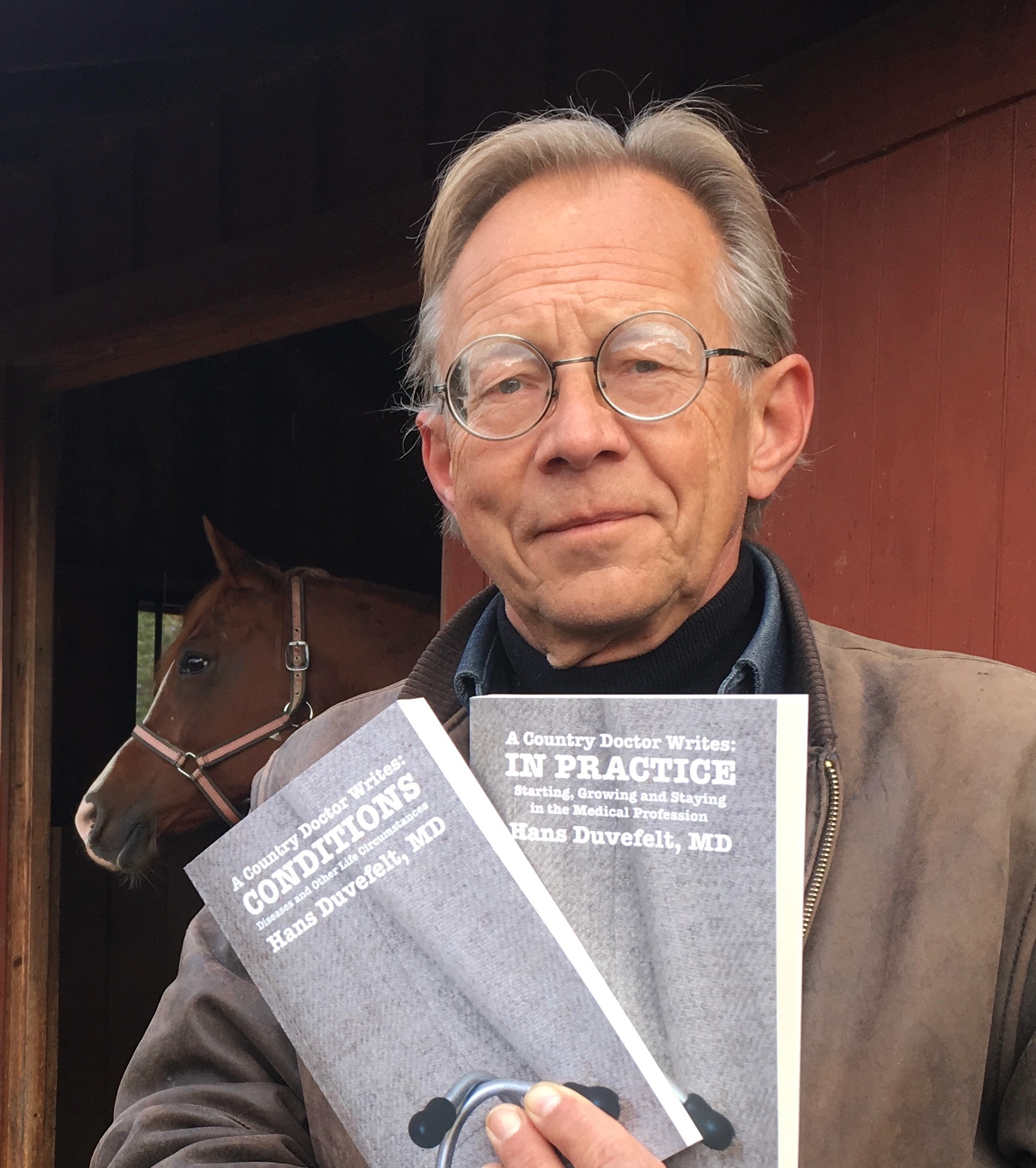
BOOKS BY HANS DUVEFELT, MD

CONDITIONS, Chapter 1: An Old, New Diagnosis

Top 25 Doctor Blogs Award

Doctor Blogs

Enter your email address to subscribe to this blog and receive notifications of new posts by email.

Mailbox

contact @ acountrydoctorwrites.com
Bookmark and Share
© A Country Doctor Writes, LLC 2008-2022 Unauthorized use and/or duplication of this material without express and written permission is strictly prohibited. Excerpts and links may be used, provided that full and clear credit is given.