Archive for the 'Progress Notes' Category


Acts of Kindness

As I look back over the past work week I can’t immediately recall any great diagnostic coups or clinical victories. I vaguely remember having to reboot my EMR a lot because it seemed to freeze up, and I certainly remember being locked out of its iPad app for a day and a half.

What I remember best are my trips back to the waiting room pushing wheelchairs with elderly patients at the end of their visit, and I remember the gratitude of the arthritic man, no older than myself, whose toenails I cut as a “by-the-way” after I had excised a suspicious mole on his back.

Again this week I found myself, privately quiet and not much fun, living out my other persona, the secure, reassuring, jovial, gray-templed physician, fatherly to some, a peer to others, and a kind man of the (white) cloth to some.

Sure, it’s great to nail a difficult diagnosis, but we can’t expect to do that every day. What we can and should do every day is connect with and touch every human being we run across in our role as physicians. Otherwise, the new housekeeping tasks of healthcare today will wear us down.

That thought reminds me of a post I wrote nine years ago, six months after I started writing his blog, “A Day Without a Diagnosis”:

“Thursday I saw 29 patients*, but I didn’t make a single diagnosis. I did three physicals and saw several patients with diabetes, hypertension and high cholesterol. A migraineur came in for a shot, and we double booked a few sick people who already knew their diagnosis and what treatment they needed.

One of my physicals was a Registered Nurse, about my age, who left clinical nursing a few years ago and now does research for a group of surgeons at the hospital up the road. Her research focuses on quality of care.

That got me thinking about the differences in health care between my early days in this profession and today. The spectrum of diseases we deal with has changed, and lately also the notion of what constitutes quality in health care.

Physicians today spend more time managing chronic diseases, some of which weren’t even thought of as diseases twenty-five years ago. A cholesterol level we feel obligated to treat today was considered normal back then; Type 2 Diabetes was something our grandmothers developed in their late seventies, not a multisystem disease we looked for in children and young adults; Attention Deficit Disorder wasn’t something primary care physicians concerned themselves with. And who would ever have thought that Fibromyalgia, a term coined in 1976, would be such a common disease, along with Restless Leg Syndrome (Ekbom, 1944), obesity and toenail fungus?

My conversation with my R.N. patient moved toward the issue of what really constitutes quality in medicine. I worry that some things are measured mostly because they are easy to measure: What percentage of heart attack victims is currently taking beta-blockers? What is the average Hemoglobin A1c among a physician’s diabetic patients (as opposed to how is this value trending over time)? I never hear statistics on how often we as doctors make the right or wrong diagnosis, or how difficult it was to move a particular patient from one set of numbers to another.

The practice of medicine has become more a matter of housekeeping, if not downright bookkeeping. The days of brilliant medical mavericks that could ferret out the correct diagnosis and quickly move on to the next heroic act are history; today’s focus is on long-term management according to evidence-based guidelines (“evidence-based”, now there’s another topic for a post…).

There is no point in lamenting the shift over time in what our patients need from us; I am merely reflecting on what has happened during my years in practice. If we as doctors want to see more bad, untreated and undiagnosed diseases, we need to move to more remote places – my underserved corner of Rural America isn’t the place for that anymore.

Managing chronic illnesses can be very meaningful and satisfying, but it isn’t quite what I imagined I would be doing to this extent. But it is one of the reasons we need to hone our skills as physicians; it is no longer enough to be a good diagnostician when almost every patient we see in a given day already has a diagnosis established. Our challenge is to help them manage that diagnosis. That means we need to practice motivational interviewing for our patients with lifestyle-inflicted diseases, serve as our patients’ medical home in a fragmented health care system and be a voice of reason in an era of information overload.

In a brief moment of worry about what I would do if I didn’t get accepted to medical school I had considered teaching, and I worked as a substitute teacher for one semester between my military service and medical school. I don’t think that was a waste of time at all.

Once in a while as a physician, you’ll make a diagnosis. Most of the time you help patients manage a disease they already know they have.”

That, and dispensing a little kindness in the course of each day.

(*That was before EMR, Meaningful Use, PCMH, ACA and all that. Today, between the technology and all the mandated components of every office visit, I rarely see even 25 patients per day.)

A Pearl From Medical School

In Sweden, back when I trained, three blood tests were the “routine labs” done at most doctor visits: Hemoglobin, White Bloood Cell Count and Erythrocyte Sedimentation Rate. I’m trying to remember, but I don’t think everyone waited an hour to see the doctor, so they must have used a modified rapid sedimentation rate.

The “Sed Rate”, or “sänkan” as we call it, was invented by Robin Fåhraeus, a relative of one of my High School teachers. Fåhraeus described the phenomenon in his doctoral dissertation in 1921 and was professor of anatomy and pathology at Uppsala University around the time I was born. He was nominated for the Nobel prize several times but was never awarded it. He collaborated with another Swede, Alf Westergren, on perfecting the technology. Blood in a vertical tube will separate into liquid on top and clumped together red blood cells on the bottom. The height of the fluid pillar after one hour is the “sedimentation rate”.

Anyway, in Sweden we were often faced with what to do when the sedimentation rate was abnormally high. In addition to the usual causes like infection, autoimmune disorders and multiple myeloma, it was drilled into my head to look for kidney cancer.

I’ve never heard any of my American colleagues talk about that, although there are several articles about the connection if you Google it.

A few weeks ago I saw a man who wasn’t feeling well. I ordered some lab tests, including a sed rate. It came back at 100 mm, five times the normal limit. I ordered a CT of his abdomen to look for kidney cancer. Before he ever got the test, he ended up in the emergency room with pneumonia. That could have explained the abnormal lab result. Because of the severity of his pneumonia, the hospital did a chest CT on him, so when he got the call about his appointment for the abdominal CT I had ordered, he told them he didn’t need it because he already had one. He thought one CT covered everything.

At his followup appointment, he was back to feeling nonspecifically unwell and his sed rate was now 118. I asked him to please reschedule his abdominal CT.

Today I got the result, a “Code Yellow, Unexpected Finding” fax in my office chair.

He has a one inch tumor in his right kidney, highly suspicious for cancer.

The Real Reason Behind EPCS?

As of July 1, pharmacies in Maine cannot honor paper or telephone prescriptions for controlled substances, from OxyContin down to Valium, Lyrica and Tylenol with Codeine.

EPCS, or electronic prescribing of controlled substances, is a double security step in the prescription process built into EMRs, electronic medical records. It involves another password entry and the use of onetime passwords from a small number generator issued to each prescriber.

It has been said that this will prevent fraudulent prescriptions via phone or on stolen prescription pads, as well as altering of legitimate prescriptions.

But there is another reason that doesn’t get much mention:

EPCS is going to prevent doctors from prescribing controlled substances for friends and relatives outside their regular office activity.

Now and then a physician is disciplined by the Board of Licensure in Medicine for writing pain medication prescriptions for friends, sometimes even getting pills back for their own use.

Not long ago a well respected older doctor gave up his license during a Board investigation of his career-long habit of prescribing a low dose tranquilizer for his wife. That was probably not an unusual thing to do for small town doctors in solo practice with no colleagues for miles around. It is not tolerated in today’s regulatory environment, where doctors are viewed as having no more integrity and judgment than anyone else.

The next step is probably what they did in Sweden many years ago: Pharmacies there were unable to submit prescription charges to the health insurer if scripts were not written on special forms, linked to each doctor’s place of employment. But in this case in tomorrow’s USA, the requirement will be electronic prescriptions linked to our EMRs.

That reminds me, I was too busy yesterday to answer a text message from Autumn, my nurse. She’s on vacation and came down with a bad cough. Should I prescribe her an antibiotic over the phone? She isn’t actually a patient in our office…

Horse Medicine

A HORSE DOSE

Each of my girls weighs less than 900 pounds (400 kg), but the amount of medicine they require when they are ill can be staggering.

My heartburn medicines, omeprazole (Prilosec/Losec) or esomeprazole (Nexium), are 20 mg pills that cost $25 for a box of 42. Humans take one or two of these per day.

When one of our girls was diagnosed with ulcers, which is something very common in horses after stressful events like trailering, she was prescribed 2000 mg per day of omeprazole at a cost of $1000 for a month’s worth of paste made especially for equine patients. While waiting for the mail order prescription, I crushed just twenty omeprazole tablets in a coffee grinder for each temporary daily dose of 400 mg. Without the protective coating, that medicine is extremely bitter. She hated it.

The paste, Gastrogard, at one hundred times the typical human dose, is truly a horse dose. It tastes sort of like cinnamon.

LONG IN THE TOOTH

I’ve heard the expression ever since I moved to America, but never truly knew its meaning. Now that I have horses, I know their teeth keep growing, and may need filing down. They even have a line in them, Galvayne’s Groove, which lengthens in a way that you can tell a horse’s age from within a five year range.

The white juvenile milk teeth stay in until a horse is five years old or so, and are then replaced with more yellow permanent teeth.

The angle between the top and bottom teeth also changes with age.

All of this contributes to the notion that you “shouldn’t look a gift horse in the mouth”, or be picky about any gifts you receive.

WHAT’S GOT YOUR GOAT?

In horse psychology, there is this thing about goats.

When we at one point had a single horse, we put three miniature goats in the empty stall for company in he barn. That worked very well, and gave some credence to the stories we’ve heard about how high strung race horses sometimes have a goat as a companion and stall mate in order to keep the horse calm. It is said that stealing the goat the night before a race can unsettle the horse and alter the outcome of the race.

So if a race horse seems edgy, the obvious question would be “What’s got your goat?”

HORSE AILMENTS

Equine medicine has its own terminology, which always makes me think of watching the Darrowby farmers speak in “All Creatures Great and Small” by James Herriot. The old English words for some diseases are strikingly graphic:

Strangles: A streptococcal infection with lymph node swelling that can cause facial swelling and suffocation.

Choke: Esophageal obstruction.

Shivers: A neurologic disease involving spasms of mostly the hind legs.

Cribbing: A compulsive wood biting behavior with neck tightening, laryngeal retraction and air sucking that is thought to release endorphins.

Founder: Also called laminitis, a hoof inflammation caused by overweight, rich diet or high blood sugar, causing the horse inability to bear weight on its feet.

Heaves: COPD in horses.

Roaring: Noisy breathing from vocal chord paralysis.

COLIC: TRIVIAL OR DEADLY?

As a father and primary care physician, I’ve always thought of (infant) colic as a harmless, even if challenging, annoyance. As caretaker of horses, I have the deepest respect for what we call colic in equine medicine. It would be as if abdominal pain in adults were to be called colic. Imagine appendicitis, pancreatitis, peritonitis, bowel obstruction or incarcerated hernia.

Horse colic is anything that looks like a bellyache. It can be anything from gas to constipation to impaction or obstruction, and as we can’t bring a downed horse anywhere for a CT scan, our diagnostic and management tools are crude and primitive to say the least. All we do in the field is treat pain, inflammation and spasm and see what happens.

I’m glad I’m just a Country Doctor and not a large animal veterinarian.

Where Does it Hurt?

“Noncardiac Chest Pain” was Laurie Black’s discharge diagnosis. Her chest CT Angiogram didn’t show a pulmonary embolus, her troponins were negative for a heart attack and her nuclear stress test was negative for coronary ischemia.

“So what do you think it was?”, she asked while I read through her hospital discharge summary.

“I don’t know…show me where the pain was”, I answered.

“It started in my back, on the left side, and then it went up and around to the front and then down my left arm and my hand felt kind of tingly.”

“Where in your back, upper or lower?”

“Upper.”

I palpated her left trapezius and put some pressure between her spine and her scapula.

“I assume the doctors at the hospital did all kinds of poking and prodding here”, I asked.

“No, I don’t think anybody really touched me”, Laurie answered.

“Can you move your shoulders around a bit”, I asked as I pushed my fingers in a little harder.

“That’s very sore”, she said, and I could feel the tightness in her muscle.

I moved to her front and asked her to show me the range of motion in her neck. It seemed close to normal.

“Try to go a little further”, I said.

“Ouch, I just felt something, in my arm”, she startled.

“Looks like it’s all coming from your neck. How about that…”

Just a few days earlier I had another “aha” moment, this one regarding a patient with abdominal pain.

Nora Friedman had seen one of my colleagues with a one month history of a painful lump in her right lower abdomen. She ended up with both a CT scan and an ultrasound, and the only abnormality they showed was a very large cyst in the lower portion of her right kidney. The radiologists suggested this cyst could be drained in order to relieve her pain. That’s where I came into the picture and as she is on blood thinners, I ended up fussing with the management of her anticoagulants before and after the procedure.

When I saw her after it was done, she told me that her pain hadn’t changed at all.

“Show me where it hurts”, I asked her.

“Here”, she said and laid her hand across her abdomen near McBurney’s point.

I asked her to lie down. She did and I felt nothing.

“I actually feel it more when I stand up”, she offered.

As she stood in front of me and I placed my hand where she directed me, I asked her to cough. Suddenly I felt a soft, almost squishy protrusion under my fingers.

I called the interventional radiologist who had aspirated her renal cyst through a long needle in her back.

He confirmed that her cyst wasn’t likely to have reaccumulated that quickly and I told him that both she and I thought we felt a hernia when she stood up and coughed.

“I’m looking at her CT right now…”

His voice trailed and there was a long silence.

“Actually, I can see a spigelian hernia now. That would explain everything. She needs to see a surgeon.”

So, in hindsight, a more carful examination of the patient at our end, and of the images at the radiology end, could have saved Nora an invasive procedure, just like Laurie could have been spared some of her fancy hospital tests for what turned out to be a simple neck problem instead of a cardiovascular emergency.


I just realized none of the posts show on an iPad or a computer, but they do show on an iPhone. WordPress is working on this. In the meantime, please visit my Substack.


Osler said “Listen to your patient, he is telling you the diagnosis”. Duvefelt says “Listen to your patient, he is telling you what kind of doctor he needs you to be”.


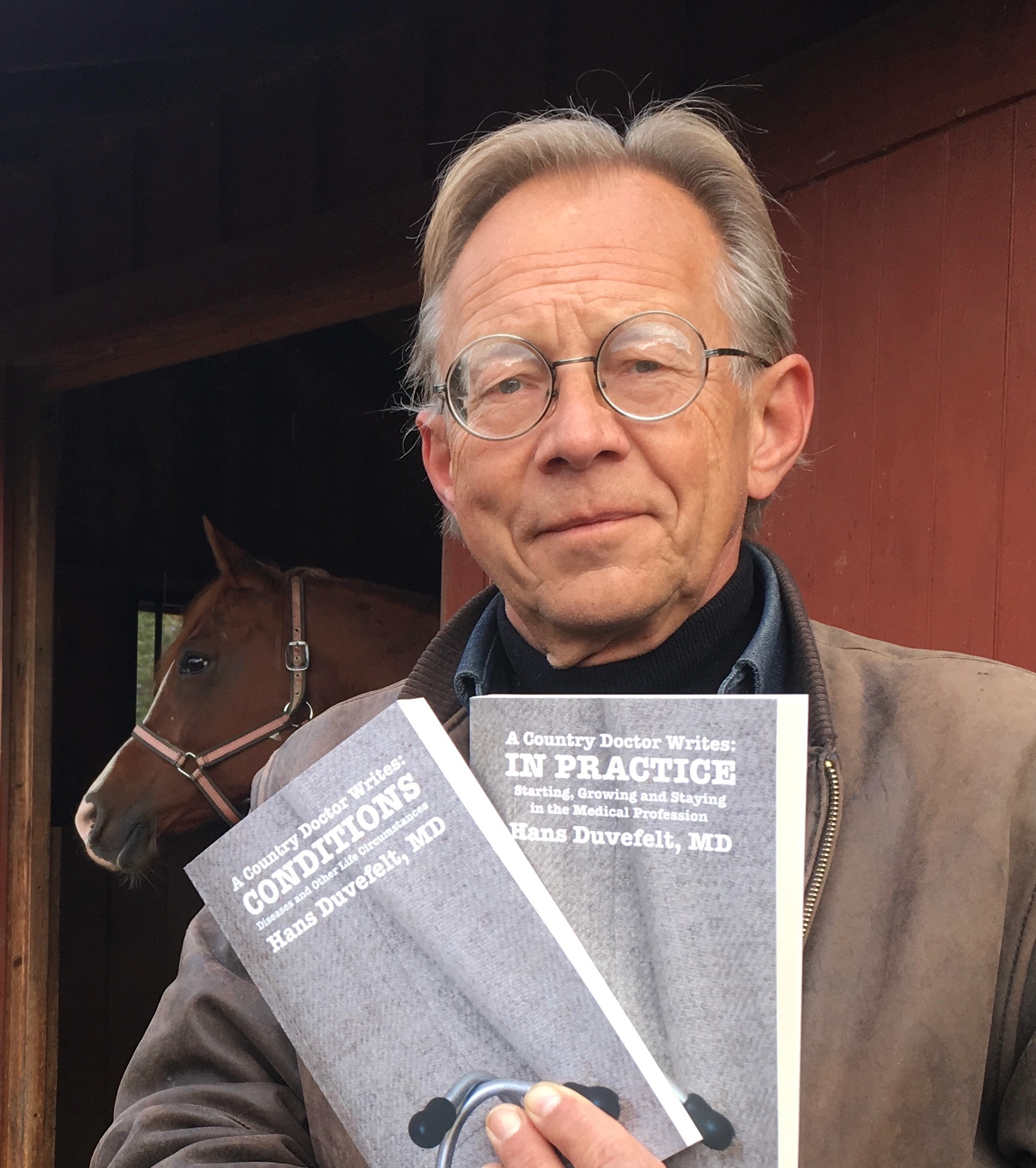
BOOKS BY HANS DUVEFELT, MD

CONDITIONS, Chapter 1: An Old, New Diagnosis

Top 25 Doctor Blogs Award

Doctor Blogs

Enter your email address to subscribe to this blog and receive notifications of new posts by email.

Mailbox

contact @ acountrydoctorwrites.com
Bookmark and Share
© A Country Doctor Writes, LLC 2008-2022 Unauthorized use and/or duplication of this material without express and written permission is strictly prohibited. Excerpts and links may be used, provided that full and clear credit is given.