Archive for the 'Progress Notes' Category


From Group Practice to Herding Cats

One cold winter night many years ago, someone dropped off a calico cat and her two kittens in our snowy driveway and we went from a two cat family to a five cat household. I learned a few things from that.

When I was a resident, two thirtysomething family docs had an office upstairs from the residency program. Ned and Peter precepted us and they sometimes ran downstairs to ask the director, Dr. Pete, for his input when they had a tough case themselves.

It was very clear to me that Ned and Peter had a shared vision of how a practice should run, even though I’m sure they weren’t clones of each other. They also seemed to be really in tune with the residency, and one of them later became its director.

My first job after graduation was with two middle aged doctors in a small Maine mill town. They covered seamlessly for each other, even though they seemed like very different people. I realized quickly that my comfort level with some of the things they tackled in the hospital was never going to catch up with theirs, so I moved on to where I am now the Medical Director. I did express my discomfort with handling patients in the Intensive Care Unit, for example, and they did tell me they were considering giving it up, but not right away. I was their employee, and although they offered me a partnership, they were the majority and the founding partners.

The clinic where I ended up spending most of my career is very different, and very typical for medical practices today. We are a nonprofit organization with a board and a Chief Executive Officer. I may be the Medical Director, but the physicians and nurse practitioners here really answer more to the CEO than to me.

The providers here are a little like my one time herd of five cats, gathered under one roof by circumstance rather than from a clear and particular desire to work with each other. Sure, Dr. Brown was my doctor when he worked in the city many years ago and he came here in part because he knew me, and Dr. Kim had practiced in the next town over and had been curious about us. He did call and talk to me before going very far in negotiations with our CEO, just to make sure he’d fit in, but others came here because of our location or some other reason besides knowing that we would all work well together or that we shared some deep practice philosophy.

We are not a group practice in the sense that group practices were formed when I started out. So my job as Medical Director is a lot more like herding cats than leading a group of likeminded visionaries in the early days of the new specialty of Family Practice. Also, because I care for a full compliment of patients alongside my colleagues and depend on their coverage and cooperation, I am in no position to be heavy handed in leading our medical staff. I may work to set an example in some cases, by building consensus in others, but I seldom lay down commandments on stone tablets.

That is a stark contrast to Elijah Lamb at Cityside Medical Group. At his hospital owned mega practice, he isn’t just the Medical Director, but a hospital Vice President of Medical Affairs. He is more clearly in the chain of command, and his medical staff knows it. He even fires people.

Right now, a newly hired provider at my clinic is asking that we not contradict her antibiotic stewardship when she sees another provider’s patient for a bronchitis. I did a “Practice style inventory” several months ago and we all said we didn’t prescribe antibiotics for a bronchitis of less than seven days’ duration. But Karen knows we often do, and she feels we undercut her by giving in to patients that call us the day after seeing her.

We have also had several exchanges and meetings about how we handle opioid prescriptions. When one of my colleagues reduced her hours in semiretirement, Dr. Kim inherited many of her patients, and started tapering some off their opiates. Much unrest followed. We had to sit down to find common ground about whether patients could switch from Dr. Kim to another provider just to see if they would reinstate their opioids. We decided, along with our CEO, not to allow internal transfers of that nature. Anything else would likely tear apart the fabric of our group, we reasoned. Interestingly, the retiring physician told us that the patients Dr. Kim had tapered off opioids were people she herself had contemplated doing the same with. She just hadn’t done it yet.

Do I wish my job was more like Dr. Lambs? Would I be happy seeing a few token patients and spending the rest of my time being a medical administrator? I don’t think so, no more than I would have preferred not to live with five cats of different disposition.

As a doctor, I never tell my patients what to do. I outline, explain and support my patients in choosing between options. That is how I act toward my colleagues, too. Just like with integrating five cats, it may not be the quickest way to get things done, but in the big scheme of things it is the only way that really works if you want peace in your house.
Patients from Away

Every year I get at least half a dozen new patients who are “from away”, as we say in Maine. Obviously, I’m “from away” myself. I chose to come here after once driving up from Massachusetts, where I had been an exchange student, and seeing the untouched vastness and the slower pace of life in rural Maine.

Until a few years ago, these new patients were all people who had fallen in love with Maine by vacationing here, or they had come here because of job opportunities.

Lately, I have puzzled over why some of my new patients have chosen to move here; many of them have serious health problems and disabilities, they have never visited Maine before (or seen a Maine winter) and they don’t know a soul here.

A few have hinted about the lower cost of living, and I didn’t really think very hard about that until I saw an article in the Wall Street Journal about a baby boomer in California who moved to an Iowa town of 700 just to be able to survive on the resources she had left to live out her life on.

Here, you can buy a modest house for a tenth of what a similar one costs in California or a third of the cost in Brockton, Massachusetts.

But Maine, as much as I love my adopted home state, offers some serious challenges for dislocated older patients with serious health problems. We have a shortage of physicians in most of the state, in both primary and specialty care. Dialysis centers and radiation oncology clinics are few and far apart. We have few options for public transportation, and small towns rarely have taxi services.

Winters can indeed be hard, heating costs are high, and the town I live in regularly loses power during snowstorms, sometimes longer than 24 hours at a time.

I have many patients who are “snowbirds”, and as they get older, they often decide to give up their second homes in Florida and stay year round in Maine. But they know what it’s like here, and most of them have most of their family right here.

I wonder if those of my patients who have moved here alone in their sixties or early seventies have thought of how their journey will end – not where they wanted to be, but where they ended up.

I worry about them.

.

A Week with no Lab Coat

Something very interesting happened to my patient visits when I changed my office attire.

My clean long cotton lab coats, hanging on the back of my office door, suddenly all seemed dingy when I set out to change lab coat about a week ago. I decided to pretend it was Saturday.

On Saturdays I usually wear a pocketed button-down shirt instead of one of my usual Jermyn Street ones. I skip the lab coat, hang my stethoscope around my neck, put some pens in my breast pocket and attach my magnetic name tag. I still wear a tie, but sometimes with a doctor motif or Snoopy (I miss my beagles).

On Saturdays I seldom have very serious visits. Most are physicals for working people and sick visits, sore throats, earaches and such. Nobody from the administration, lab or X-ray is in, there are fewer messages, no faxes and no meetings. It’s just me, a medical assistant and the patients. It’s all very basic.

So there I was, deciding to go coatless. I put the magnet inside my pocketless English shirt and the name tag lined up outside, draped the stethoscope around my neck, clipped a pen inside my pants pocket and entered the exam room to greet my first patient of the day.

“Nice shirt”, said the sixty-something man. He was chattier than usual, I noted quietly. I had two more similar compliments that day and I started to feel something was different about the dynamic in the exam room.

Since then, I have had the distinct impression that my visits are more laid back, more intimate and less demanding. It’s as if my patients are relating to me in a more personal way, even though I’ve always felt very close to my patients. I have also not had a single patient try to cram in a long shopping list of concerns I couldn’t possibly address in one single visit. I feel as if everyone is viewing me as more human, just as competent, but not a healthcare robot or action hero.

I still delivered good and bad news, I still explained the inner workings of the body in plain English and I still typed away with only two fingers on the computer or my iPad. But I felt as if a veil had been lifted and my patients saw me as more than just their doctor, or dared to treat me that way.

A Lesson Learned

It was late afternoon. The woman who had seen my colleague, Dr. Wilford Brown, a few days earlier was sitting in my exam room. Her chart note read like a typical unnameable virus: Headache, bodyaches, fatigue, low grade fever. She had always seemed like a level-headed resolute woman, but she had called three days in a row for medical advice because she felt so poorly. And it all sounded like a simple virus that a few more days of rest would take care of.

She did have a good sized boil in the middle of her back, but that wouldn’t make her feel that sick. The rest of her exam was perfectly normal.

“Let’s check your blood count to see if this looks viral”, I suggested.

“Anything”, she answered.

I moved on to the next patient. A few minutes later I was handed a printout of her CBC. Her white blood cell count was 1.88, almost critically low and without the “right shift” that often accompanies a low WBC in certain viral illnesses. Her platelet count was 68, not far above where spontaneous bleeding might occur.

“I need to send you to the hospital for more testing. I don’t know what’s going on. It could still be a virus, but you need to be checked for blood poisoning”, I explained.

She felt well enough to drive herself to Cityside. For a split second I agonized about that decision. If she was going septic, could she suddenly drop her blood pressure on the way? But I agreed to have her drive.

I called the ER and spoke wih one of their regulars about her case.

“Ok, we’ll be looking for her”, the seasoned but still young physician answered after my thumbnail description of her.

Fifteen minutes later I got another printout. Her ALP, ALT and AST were all about three times the upper normal limit. What wold cause that kind of liver irritation, I thought to myself.

“Fax it to Cityside ER”, I told Autumn, and I called back and left a message for Dr. Waterman about the new information.

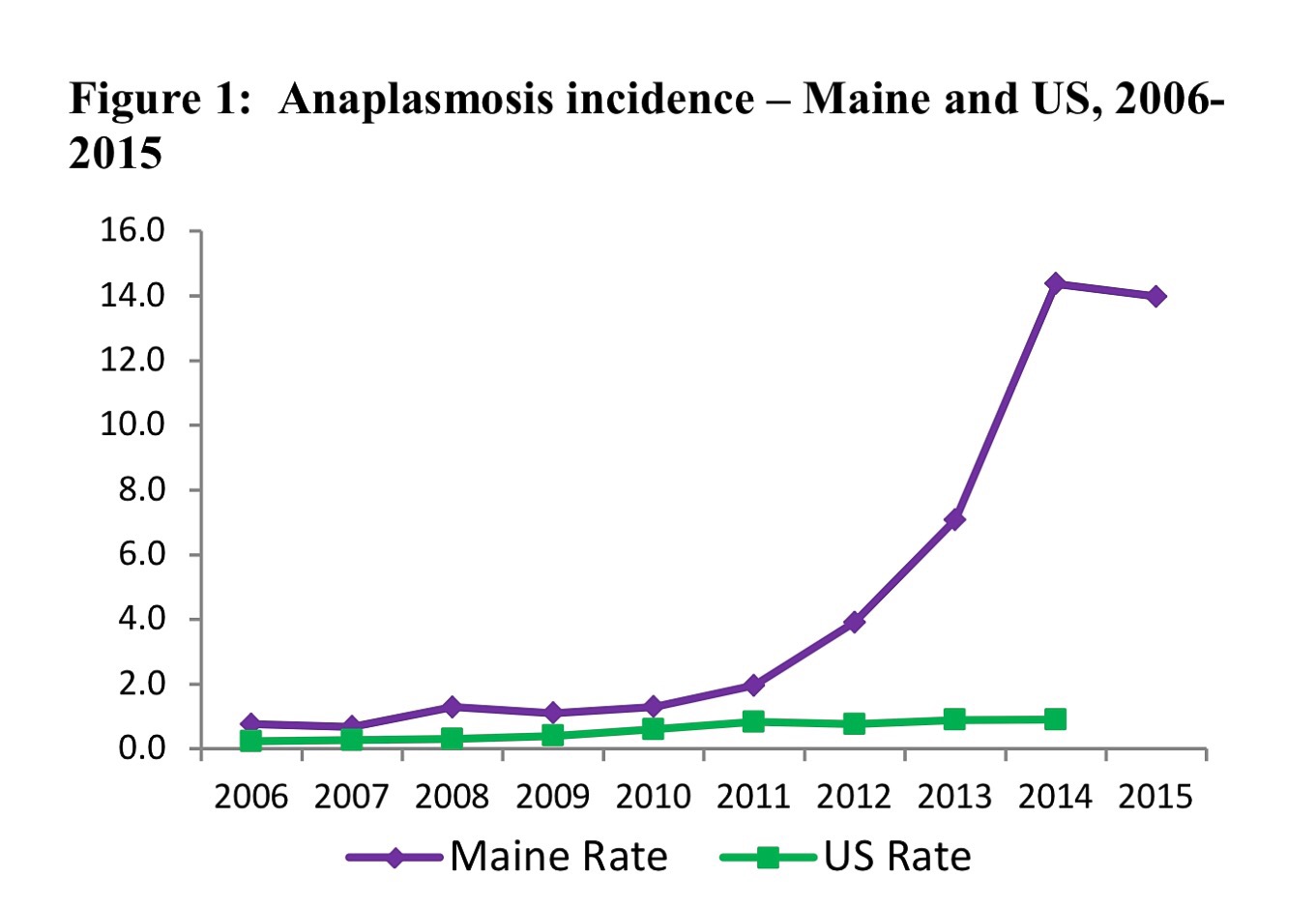
I told Dr. Kim about her and, without hesitation, he said “I’ll bet she has anaplasmosis”.

I’ve seen plenty of Lyme Disease. I grew up with ticks in the country where Erythema Chronicum Migrans was first described. But I hadn’t had any experience with anaplasmosis, another tick borne disease, also treatable with doxycycline. I had thought of that as a near tropical disease.

I checked UptoDate and a few other sources, and certainly all the symptoms matched, as well as the low white count and platelets and the elevated liver enzymes. A rash can occur but not usually. The description “summer flu” stuck in my mind from my brief reading.

The next morning I got the admission history and physical. The hospitalists at Cityside suspected a tick borne illness but worked my patient up for sepsis to be safe.

Two hours later, Monica, our new nurse practitioner, asked me to look at a rash. The patient was a woman in her late sixties. The rash consisted of several blanching maculae, each measuring 4-5 inches. None of them were itchy. She was feeling fairly well, but when I asked her about recent illnesses, she said she had been to the ER at Mountain View Hospital the week before with a headache, fever and body aches.

Monica got called away for a telephone call. I sat down by the computer and pulled up the woman’s ER report. The labs they had done showed a low white count, a low platelet count and liver enzymes twice the normal limit. I printed up the report.

“I know what this is”, I said to Monica when she came back, and handed her the ER note. “It looks like a tick borne illness, possibly anaplasmosis. Why don’t you get a tick panel and put her on doxycycline.”

(Thanks, Dr. Kim.)

IMG_0304.JPG

(Cases per 100,000. Source: Maine CDC,
http://www.maine.gov/dhhs/mecdc/infectious-disease/epi/vector-borne/anaplasmosis/documents/Anaplasma-2015.pdf)

P.S. This afternoon, Monica alerted me to a patient I will see in followup later this week, a middle aged man who had also been to Mountain View ER recently with flu-like symptoms and abnormal lab work. They had called it viral, but Monica had ordered a tick panel today and put him on doxycycline.

A Moving Target

He was a new patient. His medical records described him as severely hearing impaired and suffering from a rare movement disorder. He arrived with a caseworker for his 11:30 first appointment and I was running late.

“Why is a new patient or a minor surgery procedure ever scheduled at the end of the morning instead of at the beginning”, I asked Autumn, rhetorically.

The man seemed to be bouncing around in the small exam room. His head bobbed randomly and his body moved like waves in a wading pool full of three-year olds.

I introduced myself. His caseworker, clipboard in her left hand, shook my right hand. The man floated toward me, cocked his head suddenly and hollered while pointing to his right ear:

“I can’t hear!”

“For how long?” I asked.

He didn’t seem to hear me.

“At least a few years from what I know”, his caseworker answered, drowned out by the man’s repetition, “I can’t hear, I can’t hear!”

He seemed irritable, frustrated, and there was an air of desperation in the room. The caseworker looked helpless.

It was 12:35.

“Let me check your ears”, I said, gesturing with the wall mounted otoscope.

“I can’t hear!” the man shouted.

As I leaned toward him I could smell the odor of ear wax. I tried to gently grab and pull his right ear upward and back while I held the otoscope head between my right thumb and index finger and leaned the pinky-side of my hand against his cheek.

His head moved back and forth, up and down. Pushing my right hand firmly into his cheek, I moved with him, as if we were both bouncing on an underinflated air mattress.

All I saw was ear wax.

I repeated the procedure with his left ear. It, too was impacted with black, smelly cerumen.

“Let me flush your ears”, I said, loudly, into his right ear.

“I can’t hear!” he hollered back.

“I’ll be back”, I said and gestured with my index finger straight up as in “one minute”.

So followed an awkward dance with the man sitting in the exam room chair by the sink, Chux pad on his shoulder, the caseworker holding the cup under his ear and me flushing his right ear with lukewarm water from a large plastic syringe. All three of us moved in near-unison, again and again in what looked like multiple attempts to master a Tango step, sometimes rising at the end, sometimes sinking down or pausing mid-movement, all three of us.

The ear wax poured into the cup and large amounts of water saturated the Chux pad and the side of the man’s neck. Some of it landed on me.

As I eased myself away each time from our virtual embrace to empty the cup of clumpy wax soup into the sink, I watched through my splattered glasses for a reaction.

After the fifth or sixth serving, the man’s movements stopped suddenly. He shook his head like a wet dog. Slowly, he cocked his head and I could sense how he was trying to listen.

The aura in the room changed. Everything seemed quiet and peaceful. He was perfectly still for what seemed like half a minute. The caseworker picked up her clipboard and clicked her ballpoint pen. The ceiling air vents blew their gentle, artificial breeze. Someone walked down the hall outside the exam room.

“I can hear again. Thank you”, he said in a normal voice.

“Fantastic. Are you ready for the other ear?” I gestured with the otoscope. It was 12:49.

His head started to gently move again.

“Let’s roll!” he grinned.


I just realized none of the posts show on an iPad or a computer, but they do show on an iPhone. WordPress is working on this. In the meantime, please visit my Substack.


Osler said “Listen to your patient, he is telling you the diagnosis”. Duvefelt says “Listen to your patient, he is telling you what kind of doctor he needs you to be”.


BOOKS BY HANS DUVEFELT, MD

CONDITIONS, Chapter 1: An Old, New Diagnosis

Top 25 Doctor Blogs Award

Doctor Blogs

Enter your email address to subscribe to this blog and receive notifications of new posts by email.

Mailbox

contact @ acountrydoctorwrites.com
Bookmark and Share
© A Country Doctor Writes, LLC 2008-2022 Unauthorized use and/or duplication of this material without express and written permission is strictly prohibited. Excerpts and links may be used, provided that full and clear credit is given.


