Archive for the 'Progress Notes' Category


A Flex Fuel Man

I met Andrew Dearborn about a year ago. He was an overweight diabetic with high blood pressure, high cholesterol and triglycerides treated with maximum doses of a statin medication, and a prior history of a heart attack.

We seemed to connect, maybe because he is a car collector. Not that I collect them, but I have had cars on my mind since my grandfather walked down Stockholm Street in my home town and pointed out all the postwar American cars that were parked near his antiques store.

I decided to try my car analogy on Andrew:

“Your body isn’t running well on regular gas anymore. But if you read the manual, it is actually a flex fuel body. It isn’t metabolizing carbs properly, but it can still run on fat and protein, and believe it or not, we now know that diets that are low in carbs and higher in protein and at least what we call good fats, are good for weight loss, diabetes control, lipid lowering and heart risk reduction.”

I waited.

His eyes slowly lit up.

“I can do that. So what do you recommend I eat?”

I asked him to walk me through what he was eating now and then made suggestions. I told him what I eat, hard boiled eggs and ham for breakfast, a roll up with lots of cheese and turkey ham with an apple for lunch and for dinner a salad with avocado, feta cheese, some kind of bean like garbanzos or lentils and grilled chicken, salmon or tuna. And as a snack if I need one, roasted almonds or one more apple.

“How about beef?”

“If you like.”

“I can definitely do that.”

And he did. Here are the numbers (notice his Hb A1c is now normal):

IMG_0341.PNG

Driving my Mini (iPad)

I’ve finally found my groove with our EMR. Maybe I’m even starting to like it.

A few weeks ago I got a new iPad, this time a mini, which lets me type with two thumbs the way some people text on a smartphone, and the voice transcription is good enough as long as you avoid fancy jargon and unusual generic drug names. Yesterday as I sat next to a patient and dictated her history, she added to it and her words transcribed perfectly into my office note, unintended but very elegantly.

Even the size difference from my personal iPad which I had been using, horse barn scented leather cover and all, made a difference because on the mini I can type faster with only my thumbs. Years ago I had a pen tablet computer that wasn’t bad, but I find that the smaller my device gets, the more unobtrusive it seems.

The iPad version of my EMR is growing on me. Its interface was obviously designed from the ground up, so while it looks different from the desktop version, once you’ve worked with it for a while, it is twice as fast.

The software can graph, instantly, any historical lab values and vital signs, which is extremely helpful when I sit next to a patient and want to show them their improving hemoglobin A1c or variable blood pressures. When I first started using the iPad, I saw a couple of patients who had subtly but steadily falling hematocrits and turned out to have erosive gastritis in one case and colon cancer in another. Without seeing the trend in a graph it would have been harder to spot.

Reading reports, I can enlarge them by spreading two fingers and I can move around by dragging them left to right, whereas on the desktop I have to enlarge the window, click “view”, then choose a percentage enlargement and then use the scroll bar to move left to right in order to to see each line completely, which is ridiculously cumbersome.

During today’s 7 hour Saturday clinic I saw 27 patients, one of them brand new to the practice, and I did 90% of my documentation on my mini in the room with each patient. Twenty minutes after closing, I walked out the door and drove home in the sparkling afternoon light, down winding roads flanked by the peaking fall foliage and the royal blue waters.

I felt like I hadn’t even worked today, that’s how easy my day was with my user friendly app and my new mini.

An Old, New Diagnosis

The middle aged woman started to pull down her jeans as she explained:

“I want you to look at this rash on my leg. I’ve had it for a month now.”

What I saw got my mind churning. On top of her left thigh was a brown discoloration about the size of the palm of my hand. It had a reticular pattern, like a coarse lace doily or irregular fish net. It was light brown, smooth to the touch and didn’t blanch when I pressed on it.

I knew I had read something about rashes that looked like that, but I couldn’t remember any details. So I did what I often do, I googled the description:

(Images) Brown reticular erythema.

Almost instantly I saw a perfect picture of the woman’s rash. The caption read “Erythema ab igne”.

Yes, that was it, but what was it again?

My trusted Wikipedia had a tidy little entry that echoed with memories in the recesses of my mind. I printed it out for her. It described the rash as often occurring in older patients who used hot water bottles or, in the old days, stood too close to the fire to keep warm.

I didn’t think my patient slept with a hot water bottle only on her left thigh.

“Is anything warm often touching that spot?” I asked.

“Yeah, my laptop”, she answered instantly.

“Try putting a folded towel or something between your leg and your laptop”, I said as we wrapped up her visit.

What an odd symmetry, I thought to myself: A diagnosis of historical interest, brought back by the use of modern technology and identified by the very device that causes it.

A Dream Job

“Jag ska bli doktor”, a four year old boy announced to his family sixty years ago.

Somehow, everything he did after that moment seemed to move him in that direction, even when, on the surface, his path through life seemed to be meandering.

As a student, he was just as interested in literature and philosophy as he was in scientific subjects. He even failed his first quiz in organic chemistry just after receiving the Berzelius scholarship for achievements in inorganic chemistry.

As a Boy Scout, he learned to find his way with or without map and compass, mastered the building of lean-tos and rope bridges, and came to travel the world, even following Baden Powell’s steps in the Swiss Alps. He edited the troop newsletter and, years later, he became a troop leader.

He spent a summer with a rural pastor, helped decorate his small church for midnight masses, read Scripture in the dark, played guitar from behind the altar, and watched the aging man of the cloth look up to the sky in tears and ask God for stronger faith and divine help in managing his own shortcomings and weaknesses.

He spent a year as an exchange student in Massachusetts, and although he was homesick for Sweden at first, he left the U.S. just as homesick for it as he had been for his native country when he first arrived.

He marched, stopped and turned in musty uniforms and sore army boots to the relentless commands of his drill sergeant and crawled in the mud under low-slung barbed wire. He conquered his fears and held on to the rope that pulled thirty soldiers on bicycles behind a military vehicle down Swedish gravel roads.

He worked as a substitute teacher with wide eyed, eagerly listening fifth graders and bored-to-death teenagers.

And at age 21 he entered the only medical school he thought of applying to; he just knew he wanted to go to Uppsala University. Only after the application deadline did it occur to him that perhaps he could have put down the Karolinska Institute as a backup plan.

As a medical student, he didn’t party and he didn’t study all that much. He took tidy notes with a fountain pen and spent much of his time on his second hand couch, listening to James Taylor, Simon and Garfunkel and cassette tapes of American FM radio he recorded on visits to the place he was longing for.

Today, he has lived much longer in America than in Sweden. He is part teacher, part pastor, part Boy Scout and still a student of literature and philosophy. He finds solace and inspiration in writing about his personal journey and that of the patients who put their lives in his hands.

And he is starting to feel a little bit like the doctor he set out to be.

Thank Goodness(?) for Technology

Friday night:

I had a good day. I was typing in the exam rooms with both thumbs, and sometimes dictating, on my new iPad mini and getting most of my notes done in real time. The phones were ringing off the hook, as we say in America. My 3-5 pm administrative time, earmarked for working with our IT and EMR manager, was up for grabs since she was away at a conference. We opened it up to take care of the patients that were calling in. I saw 25 patients and the last one left at 5:06.

I sat down at my desktop computer to respond to messages, check some of the 50+ documents and 100+ lab reports in my electronic inbox. I was out the door by 5:45 and as I drove home I enjoyed the fall foliage illuminated by the warm red glow of the early sunset.

After dinner, as I was preparing the horses’ mash, the answering service called. Cityside ER wanted lab results on a patient I had referrred up almost six hours earlier.

“Didn’t you receive my fax with two office notes, an EKG and all the bloodwork?” I asked.

The answer was no.

“I can fax it from our EMR through my iPhone app”, I told her. “Call me on my cellphone if you don’t get it.” Within minutes I had sent everything and they didn’t call, so I felt pretty comfortable that they got it. A couple of months ago I had sent records to Mountainview hospital the same way and that time I had called them to make sure the system worked.

Moments later, I got another call from the answering service. Rural Hospice needed more morphine concentrate for a patient of Dr. Kim’s. They wanted me to send it to the nearest pharmacy instead of the regular Hospice outfit, so they could be sure to have it on hand by Saturday morning. They offered me the phone and fax numbers of the pharmacy.

“I don’t need that, I can send it straight from my iPad”, I said, confidently. The Hospice nurse sounded impressed.

I have sent controlled substances from the iPad many times during office visits. This was the first time I tried to do it from a phone message I just created for myself. It didn’t work. Normally, I get a pop-up screed where I have to type in my EMR password and a number from a miniature number generator, or Hard Token, as the lingo now goes. I just didn’t get to that screen. I tried my iPhone app, and it just said the prescription went, but there was no popup, so I knew that script wouldn’t be honored.

I hardly ever bring my company laptop home with me, and we have only Apple products in the house. So I dusted off my MacBook and logged on via the web browser version of our EMR, which no one in our office uses, and I have only looked at it briefly.

I started another telephone encounter and picked morphine sulfate concentrate from the pick list. The directions listed there were not the same that Dr. Kim’s patient needed, so I double clicked on the drug name to get to the “edit” screen. A big red box popped up, telling me I was not authorized to change dosages and needed permission from my Administrator. So much for that.

I sent the phone message with the failed script to myself, opened it up on my iPad and fiddled with it again. I tried several times to change the pharmacy from the default one to he new one that the patient had never used before. I realized I didn’t know how to enter an brand new pharmacy. It took several tries before that part worked. So, again, I tried to send the script. This time, suddenly, and without me knowingly doing anything different from before, I was able to not only change the morphine dose, but I also got the pop up screen for prescribing controlled substances.

I still had a nagging doubt, so I called the pharmacy and left a message that if they didn’t get an electronic prescription for this patient to please call my office Saturday morning.

After all, I thought to myself, this new technology is pretty handy.

After feeding the horses their belated supper, I sat down in my little den next to the stalls and wrote the first draft of this post. I hesitated a bit about the question mark in the title, but I figured I’d sleep on that one.

Saturday morning:

An hour into my seven hour Saturday clinic, Autumn told me the pharmacy was on hold on line 1. They were calling about my message. They had not received any morphine script overnight from me.

Oh well, I guess he question mark stays.


I just realized none of the posts show on an iPad or a computer, but they do show on an iPhone. WordPress is working on this. In the meantime, please visit my Substack.


Osler said “Listen to your patient, he is telling you the diagnosis”. Duvefelt says “Listen to your patient, he is telling you what kind of doctor he needs you to be”.


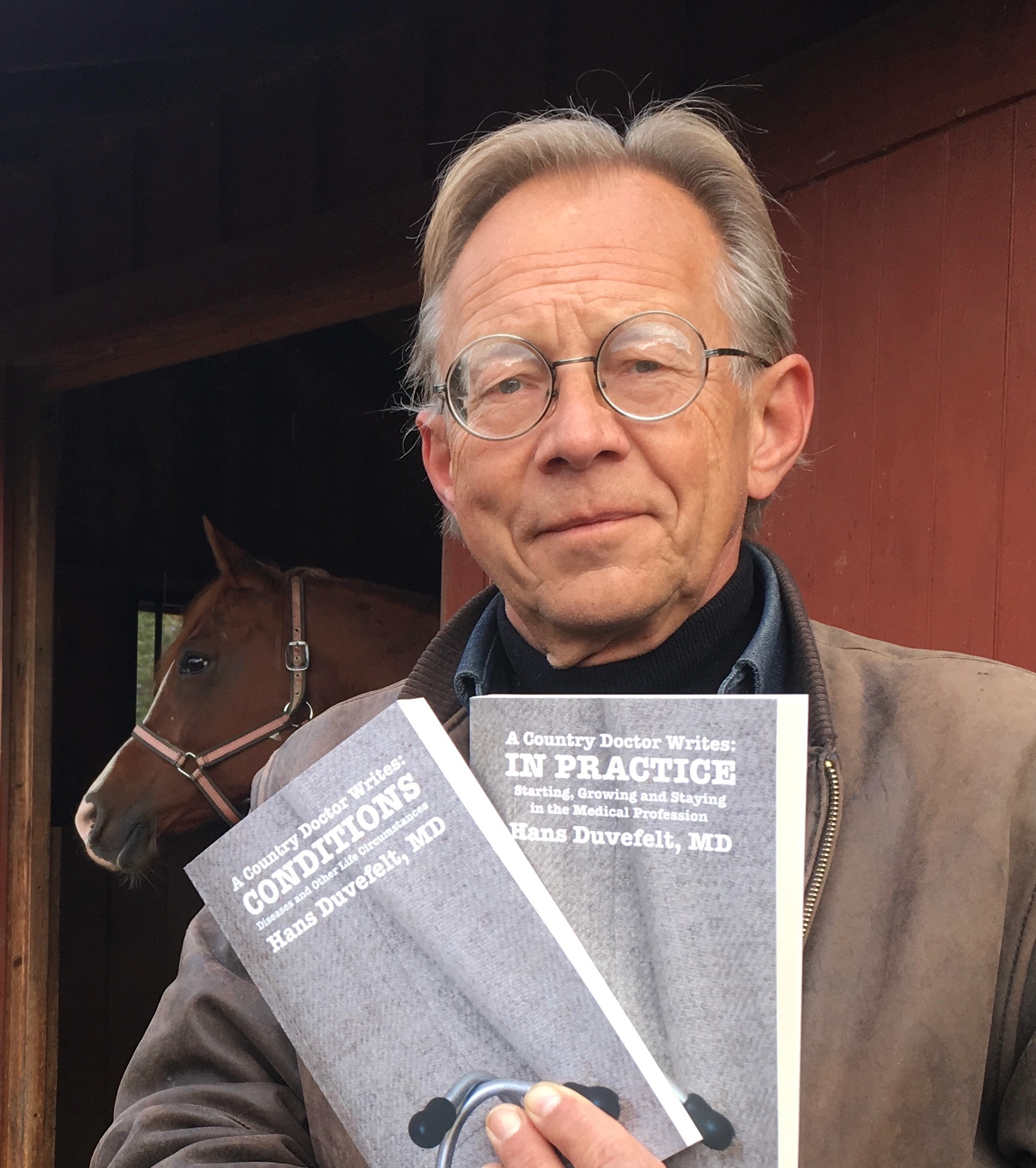
BOOKS BY HANS DUVEFELT, MD

CONDITIONS, Chapter 1: An Old, New Diagnosis

Top 25 Doctor Blogs Award

Doctor Blogs

Enter your email address to subscribe to this blog and receive notifications of new posts by email.

Mailbox

contact @ acountrydoctorwrites.com
Bookmark and Share
© A Country Doctor Writes, LLC 2008-2022 Unauthorized use and/or duplication of this material without express and written permission is strictly prohibited. Excerpts and links may be used, provided that full and clear credit is given.