Archive for the 'Progress Notes' Category


Progress in Weekly Increments

I’m prescribing Suboxone again, not in a half empty strip mall in town, where I filled in for a number of years, but in my own office.

My clinic received a grant that helped us hire an additional social worker, a part time medical assistant with recovery experience and a part time substance abuse counselor.

For a couple of months now I have met once a week with each one of a dozen patients with widely different stories and circumstances. Unlike the last time I worked with opioid addicted patients, I am not just one of several prescribers rotating through the clinic. I am the only doctor for this, our first group.

I have followed this group of a dozen fellow human beings every single week through the cold of winter and the snowstorms outside and through the outer and inner tumult of their own lives. Our encounters are brief, pulling each member out from a group session to review how the Suboxone is changing their bodies and their lives, check the rapid drug screen results and send the electronic prescriptions to the pharmacy.

In those brief encounters, I get deep glimpses into the many lives that are starting to move away from the brink: A young woman has moved out of an abusive relationship. A young man has made a plea bargain with the District Attorney. A heroin addict is enjoying her children without the Department of Health and Human Services watching her every move. A depressed young man smiled at me for the first time two weeks ago, and someone else has stopped drinking.

Other participants have transferred in from other clinics. One was already my patient, but I couldn’t prescribe Suboxone for him without the full structure of a substance abuse program. He has a visible career in our community, and he is like a mentor or older brother to those that have just started on their own road to recovery.

My last tour of duty in substance abuse care was all individual appointments; this time, I hear everyone saying that the group is more effective in bringing out honesty and accountability in its members than one or two clinicians have been able to do before.

In my previous setting, I had to be careful not to assume the role of primary care provider and give detailed advice or prescriptions for general medical matters. Here, in my own office, I can adjust antidepressants, prescribe for insomnia and restless legs as I would any time filling in for one of my colleagues. In the same way, the staff counselor who attends the group can give advice and refer seamlessly to clients’ individual therapists here.

This time for me, the care for opioid addiction is integrated with both the provision of primary care and behavioral health. This is as it should be. It requires a certain structure and a certain level of expertise, but it is by now a basic kind of care for a very common chronic condition with, if untreated, potentially devastating consequences.

Last time I wrote about treating opioid addiction, “I don’t hate coming here”. This time, I feel good about having helped bring this service home, under our own roof, in our own community.

On a Personal Note

In the ten years since I first clicked “Publish” and posted my first piece on “A Country Doctor Writes”, I have published roughly the quantitative equivalent of Moby Dick and War and Peace combined. Not that I claim to be quite in their league, but have written quite a lot.

During this decade I have recertified twice as a Family Physician. I have buried both of my parents and several cats, dogs and horses. I have grayed significantly at the temples and I have gained and lost two pants sizes.

This week I received news that I passed my Board examination, 34 years after my first one, and I got an email that “A Country Doctor Writes” is one of the top 25 doctor blogs in the country.

On the day of my ten year anniversary I will be in Boston at a Harvard course for medical writers. Such a coincidental symbol of my milestone as a writer.

Listening to Audio Digest’s Family Medicine Review course on my way to and from work gave me a sense of renewal, and the other events this month make me feel that I am preparing for a professional growth spurt at an age when some of my contemporaries are retiring.

One of my purposes when I started this blog was to inspire the next generation of doctors and counterbalance some of the negativity I see among my colleagues today. I have seen that my writing has been republished and commented on in student doctor circles, and I have had some of them comment here, first as students and later as new doctors.

I have also tried to paint a picture of how rural medicine today is a soulful endeavor, allowing you intimate access into the lives of people in a way that is not very different from how doctoring was a generation ago.

I have created a fictional version of my community, its citizens, my colleagues, the nearby hospitals and the specialists in the city. But the essence of all of what I have written is pure truth. “Only the names have been changed”, as they say.

Thanks very much for reading.

(P.S. Because my senior colleague did retire, and because one of my contemporaries is planning to do so, I’m looking for one or two new partners. My email is in the sidebar on the right.)

From EMR to Paper to EMR

I can’t help myself from telling patients how things really work in health care. But I feel they have a right to know.

When I see new patients their jaw usually drops when I sit down with them next to the computer with a stack of papers held together with a rubber band or a gigantic clamp and with yellow sticky notes protruding here and there with words like LAB, ER and X-RAY.

Patients always assume that medical records transfer seamlessly between practices. They don’t, even between clinics that use the same EMR vendor. The stack of papers gets scanned in, as images or PDFs, but they don’t appear in searchable, tabular or report-compatible form. Often, they don’t each get labeled, but are clumped together under headings like “Radiology 2010-2017”.

In one of the clinics I work in, a Registered Nurse enters patients’ medical history in the EMR before each new patient’s first appointment. In the other, it is my job.

In both cases, only a fraction of he information is usually carried over from one EMR to the other, and the patient’s life story risks getting diluted, even distorted.

It doesn’t take much imagination to understand why things work this way:

Once upon a time, the Rulers of a great country handed out money to all the medicine men so they could start using computers to document what they did (and what they charged for, which was the real reason the Rulers handed out money the way they did).

This was a gift, not only to the medicine men but also to a lot of computer companies, who quickly geared up and made EMRs that the medicine men needed to buy before the deadline the Rulers had imposed.

Soon the medicine men gave all their newfound money to the computer makers. One of the things they thought they remembered hearing about was “interoperability”, but the computer makers were no fools. By making it just about impossible to transfer data between EMRs, the computer companies figured they could keep their respective customers hostage, because no matter how much they hated the slapped-together systems, it would be too costly to start over with another system.

Eventually, each vendor secretly hoped they would end up with the most users and thereby becoming the industry standard when the medicine men and the Rulers caught on to the lack of interoperability.

That, I explain to those of my patients who were around for it, is like the early days of VCRs – Betamax or VHS – more than 100 times over or, think about it, 100 times worse.

(I wrote this on April 1, but I’m not fooling…)

Triage at the Front Desk

It happened again the other morning.

As I left the conference area and crossed the main lobby I saw a young woman approaching the front desk, leaning on an older woman. I didn’t think much of it, and unlocked the clinic door. I did what I had to do, and as I returned to the lobby, I heard an overhead page “Triage at the front desk”. As I reentered the lobby, the young woman was on the floor and a lab tech was just leaning down over her. A medical assistant almost pushed her way through the door with me, emergency box in hand.

“What’s happening with you?” I asked the woman, who is my patient and has several chronic health problems.

“I need my blood pressure checked”, she answered.

“We’ll do that”, I said as we opened the box. “Why do you need your blood pressure checked?”

“I just need my blood pressure checked.”

“She passed out in the kitchen”, the older woman said.

“She’s a diabetic, check her blood sugar”, I said to the medical assistant as I placed the blood pressure cuff on the woman’s arm.

“Your blood pressure is fine”, I said. “Now, did you just pass out again?”

“160”, the medical assistant announced. Normal for a diabetic. Her pulse rate and oxygen saturation were also normal.

“I don’t think I passed out.”

“Do you hurt anywhere?”

“My behind is sore and my chest hurts.”

“She had chest pain this morning when she walked across the kitchen and fell to the floor”, said the older woman, who turned out to be her mother.

“Call the ambulance”, I called out.

“No, I want to go home”, the young woman mumbled.

“Listen, we don’t know why you passed out, and we don’t know yet what this chest pain is from. You need more testing.” I held my hand on her pulse for a while to make sure it was regular.

As the ambulance crew entered the lobby with their stretcher, she sat up and protested. The crew listened to my rapid fire description of her medical background and today’s events.

“You need to be checked out further”, one of the attendants pronounced.

They were in charge now, and I returned to my office and called the hospital to let them know what was coming.

Over the years I have seen countless patients who in a medical emergency have a specific idea of just what they need and whose medical care is delayed because of that.

When I first started practicing in this area, we didn’t have advanced EMTs on our volunteer ambulance corps. It was the on-call doctor’s duty to fill that role, which meant I would sometimes get paged after hours to meet the ambulance at somebody’s house or at one of the local motels.

Later, even when the ambulance service was upgraded, I would get calls from patients in the middle of the night, demanding that I open up the office, singlehanded, and do an EKG because the person figured that was the full extent of a medical assessment for chest pain. A few times my refusal to do so caused complaints to the management and the board of directors.

Ten years ago, we ended our longstanding free blood pressure checks. Until then, when we were titrating blood pressure medications, we would simply tell patients to drop in and have their blood pressure documented. We would then look over the numbers to make sure we got the medications right. But what started to happen more and more was that people who felt poorly and couldn’t get an appointment soon enough or were offered a time that was inconvenient for them would simply show up for a “free blood pressure check”.

Once in a room with the medical assistant, they would say, “I’m having chest pain”, or “I think I’m going to faint”, forcing the doctors to interrupt their schedules. Some patients event went so far as to threatening on the phone “if you can’t give me an appointment this morning, I’ll just come in for a blood pressure check and then you’ll have to see me”.

We are not the only practice that has to balance access with medical appropriateness. Most clinics and pharmacies, even Cityside Cardiology start their automated telephone attendant system with “If this is a medical emergency, please hang up and call 911…”

I’m grateful I’m not expected to meet the ambulance in the middle of the night or open up the office alone for someone who could collapse in front of me. I’m not complaining that people think we can do more than we are equipped to do. I am only puzzling about why, in this era of ever increasing sophistication in emergency care, so many people think they know exactly what they need.

Like the woman in the lobby – she had passed out and had chest pain, but her blood pressure was okay, so she wanted to go home.

One More Question

“Any recent antibiotics? Steroids?” I asked my last patient of the day, a healthy looking young woman with what she described as a yeast infection that was driving her crazy. She’d had many of them, and they were always coming back, but she had only used over the counter topicals.

I knew she needed oral medication, but I asked one more question:

“Any trouble with high blood sugars?”

Her answer eliminated any late day drowsiness or fatigue I might have harbored.

“No, my sugars have always been fine, even during my pregnancies, but I always have sugar in my urine.”

“That’s why you get all these yeast infections. Has anyone ever looked into why you have sugar in your urine?”

“No.”

We got a fingerstick blood sugar, which was low normal, and a urinalysis which showed 4+ glucose, no protein, a pH of 5 and normal specific gravity.

I took a deep breath.

“When the blood is filtered in the kidney, a lot of valuable stuff ends up in the urine, but then we reabsorb things like sugar, because the body is thrifty. You have a kidney disease that keeps you from reabsorbing the sugar. I’m not smart enough to know exactly which variety of disease you have but I’d like to get some more labs tomorrow and refer you to a nephrologist.”

She asked for some information about the kinds of kidney disease she might have and added, “well, you’re smart enough to know what my basic problem is. I’ve had it all my life and nobody has said anything about any of this, they were just happy that my blood sugar was okay.”

A seemingly ordinary symptom, one additional piece of history and distant memories from medical school, never touched since then…

How can you not be fascinated by this job?


I just realized none of the posts show on an iPad or a computer, but they do show on an iPhone. WordPress is working on this. In the meantime, please visit my Substack.


Osler said “Listen to your patient, he is telling you the diagnosis”. Duvefelt says “Listen to your patient, he is telling you what kind of doctor he needs you to be”.


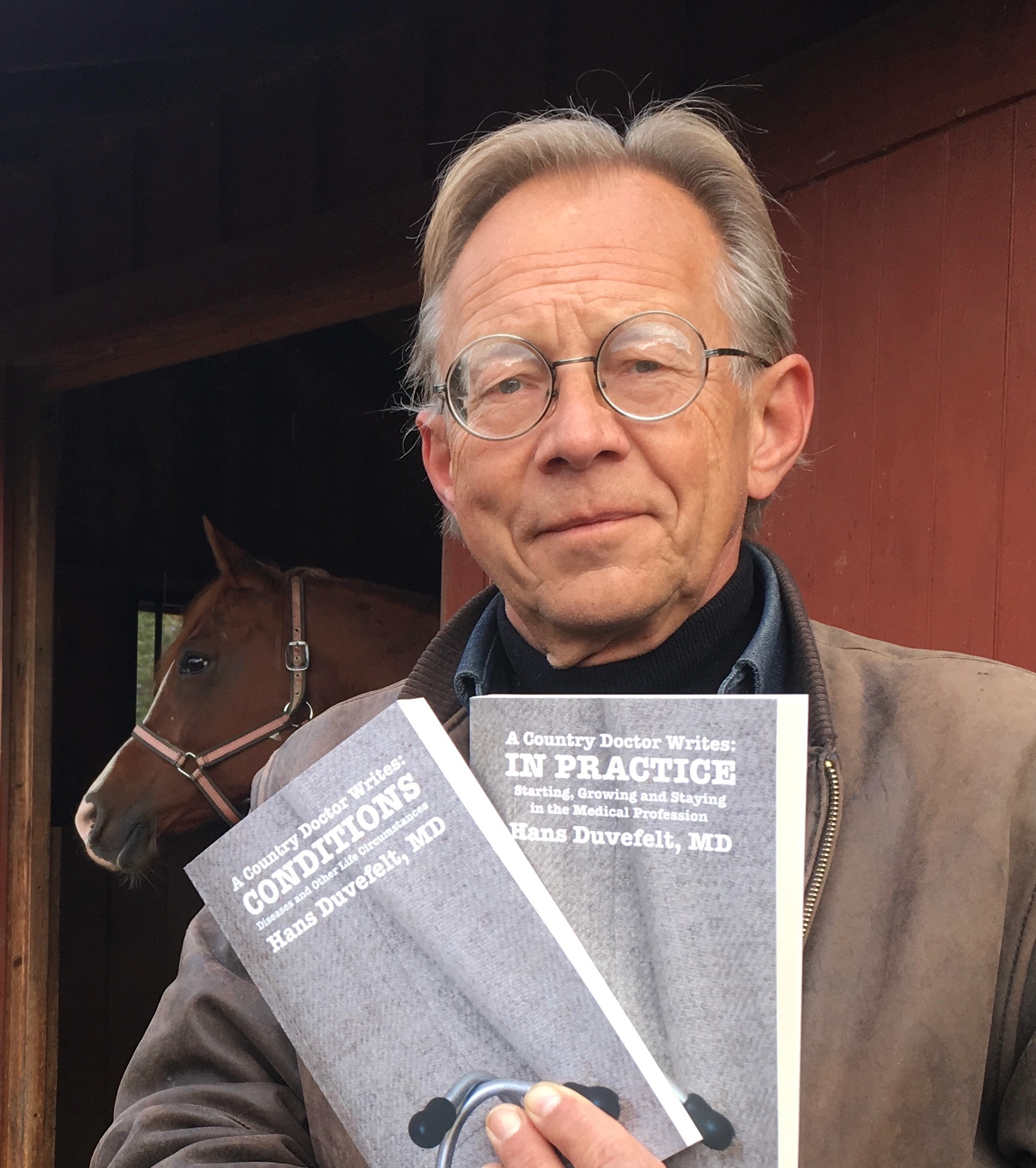
BOOKS BY HANS DUVEFELT, MD

CONDITIONS, Chapter 1: An Old, New Diagnosis

Top 25 Doctor Blogs Award

Doctor Blogs

Enter your email address to subscribe to this blog and receive notifications of new posts by email.

Mailbox

contact @ acountrydoctorwrites.com
Bookmark and Share
© A Country Doctor Writes, LLC 2008-2022 Unauthorized use and/or duplication of this material without express and written permission is strictly prohibited. Excerpts and links may be used, provided that full and clear credit is given.