Archive for the 'Progress Notes' Category


Lists of Three: Unforgettable Lessons from Medical School

A few weeks ago, I saw a patient with shortness of breath during my Saturday clinic. He had been short of breath for a few of weeks, and on a couple of occasions he had also experienced mild chest pain. He has known aortic stenosis, moderate according to his last echocardiogram two years ago.

My brain kicked into autopilot and I asked “have you fainted or passed out recently?” It was a flashback to medical school, where it seemed we were inundated with lists of threes.

For aortic stenosis, the triad of surgical indications for critical degrees was: Angina, synkope (remember I’m Swedish) and svikt, which is Swedish for failure, specifically congestive heart failure.

I’ve already written about a diagnosis right under my nose that I missed because the onset was so gradual: Dementia, urinary incontinence and gait disturbance, the diagnostic triad of normal pressure hydrocephalus.

A few months ago a crackerjack nurse practitioner came to me with the question: “What’s the syndrome with a droopy eyelid and a small pupil?”

“And a sunken-in eyeball?” I added.

“Yes!” She exclaimed.

“Horner’s Syndrome”, I proclaimed. “I still remember it from medical school and from a patient and my first Persian cat who both had sinus cancer.”

I don’t know why there are all these diagnostic triads out there, is it by some divine design or just because medical students can only retain short lists because of the multitude of diagnoses we have to memorize?

Where would we be without memorization? Sure, we could use computers to sift through endless lists of symptoms, most of which are red herrings, but there’s nothing quite as satisfying as knowing, in an instant, what the diagnosis is.

Wikipedia has a list of fifty clinical triads:

https://en.m.wikipedia.org/wiki/List_of_medical_triads_and_pentads
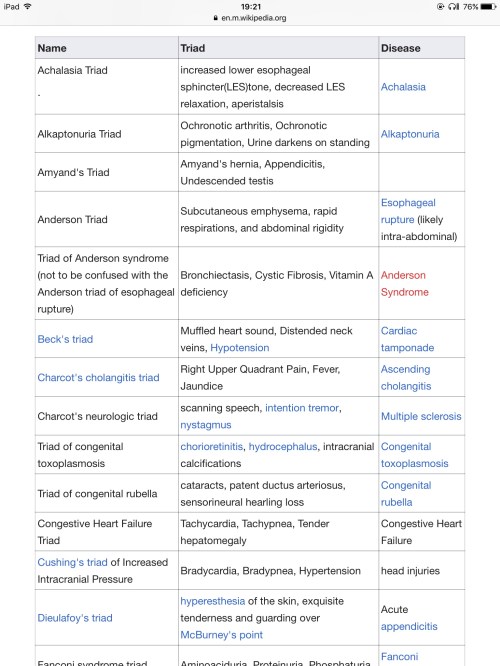
And, I almost forgot, last week I saw a patient with Reiter’s Syndrome, now called Reactive Arthritis: Persistent conjunctivitis, frequent urination and migrating arthritis that all began after a bout of severe diarrhea. She had already seen one other primary care clinician and her optometrist and both knew there was a bigger, overarching diagnosis behind her eye irritation. I was the one who nailed it.

If Not a Doctor, Then What?

One of the questions I was asked recently in an interview was something along the lines of could I say something about myself that few people know about.

The answer came to me fairly quickly.

After my military service, I applied to medical school. I had decided I wanted to go to Uppsala University. The Karolinska Institute was more famous, not the least because they pick the Nobel Prize winners in Medicine. But Uppsala is the second oldest university in the world, and the history behind it impressed me as the most classical medical education I could get.

In what now seems like a reckless thing to do, I only applied to Uppsala. It never occurred to me until after the deadline that it might have been wise to make a second and maybe even a third choice.

That fall semester I worked as a substitute teacher in my home town. I found myself one week in front of a room full of wide eyed second graders and the next facing one with bored and sullen fourteen year olds.

During those months I knew what I could do if Uppsala wouldn’t have me: I might become a teacher. I loved explaining things plainly and simply. I enjoyed presenting the hard to engage teenagers with an opening hook to gain their interest, or at least some degree of curiosity.

Today, again and again, day in and day out, I explain, challenge and engage patients in similar ways. As I often find myself pointing out, the word doctor is derived from “docere”, to teach.

So I got both jobs – a doctor, educated at the school of my choice, and a teacher for all ages, having to adapt my style and approach for a wide variety of patients, toddlers to centenarians.

It’s all the same, in a way. And I love it.

A Rare Form of Deafness or a Trivial Case of Congestion?

I chose doxycycline to treat Norman Starks Lyme disease. A week later he went to a walk-in clinic with sudden loss of hearing in his right ear. The PA who saw him suspected that the doxycycline had caused it and told him to stop the medication. Meanwhile, he needed at least one or two more weeks of antibiotics. He got amoxicillin.

When I saw Norman I asked what kind of exam they had done on him, he said “they just looked in my ears”.

“Did they do any kind of hearing test?” I asked.

He shook his head.

“Did they put a tuning fork on your head?”

“No”, he said quizzically.

I pulled my tuning fork from a plastic basket on the counter. I have one in every room.

“So how is your hearing now?” I asked.

“I think it’s a little better.”

“OK, tell me, if I put this tuning fork in the middle of your head like this, where do you hear it the loudest?”

Norman looked like he concentrated hard. He seemed confused.

“It’s louder in my right ear.”

“And which of these is louder, on the bone behind your ear or in the air in front of it?”

“Behind.”

I put the tuning fork away and sat down next to him.

“Your hearing is going to be fine. You can hurry it along by using some cortisone nose spray for a while. This is not nerve deafness, you’re just congested. And the doxycycline had nothing to do with it.”

I love low tech medicine.

And just the other day I saw a new diabetic who complained of blurry vision. After a split second of worry, I excused myself and got several sheets of dark paper, stapled them together and pierced a small hole in the center.

“Come with me, let’s check your vision”, I said.

We went down the hall and I asked him to look at the eye chart through the pinhole, one eye at a time.

“What’s the smallest line you can read?”

“D,E,F,P,O,T,E,C”, he read.

“Perfect. The lenses inside your eyes are just swollen from your high blood sugars. Hold off a little before seeing the eye doctor, and don’t order glasses until your blood sugars have settled down.”

Another early lesson all the way back from medical school.

Myopic Versus Hyperopic Views on Physicians’ Work

There is a constant tension in medicine between the details and the big picture. Many factors magnify this tension, and they make our work as clinicians harder. We really need to find our own balance between tending to the details and grasping the big picture, or, in optical terms, a myopic or hyperopic view of our work.

A jeweler working on a delicate mechanical watch, with a loupe pinched over his dominant eye, is not well equipped to also watch the front door of his store for shoplifters.

The more pressured I feel from the number and complexity of patient visits in my schedule, and the further behind that schedule I fall, I know that I become increasingly hyper-focused. It is definitely my survival mechanism for days that threaten to spin out of control. I revert to a razor sharp focus on THAT patient in order to make decisions, sometimes in a triage sort of way: What is the WORST thing this could be? What is the NEXT step for this patient? What would make the BIGGEST difference in this situation? If I instead tried to think of how to get the next two or three patient visits to go smoothly, I don’t think I would be much help to the person I am with RIGHT NOW.

I don’t verbalize or claim this nearly enough: If my team wants me to handle THIS MANY patients in THIS LITTLE time, they need to watch the flow for me; there is no way I can do both. I can’t get enough from them of things like:

“I put out the instruments you might need if you decide to lance this.”

“I got a urinalysis/EKG and a copy of the last culture/tracing…”

“You need to look at this ankle ahead of your next patient, because x-ray is leaving in twenty minutes…”

My other persona, the Medical Director, zooms effortlessly between the two focal distances. Unfettered by a near-superhero clinic schedule, I can zero in when consulted by a new nurse practitioner on a clinical case, and the next minute I can watch the clinic flow and sense the energy of a dozen coworkers as they go about their day, or I can glance at lists of data and get the “big picture” or spot incongruences.

The difference is that pressure, which is so insidious that you can’t really understand it until it is gone: When the last patient has left, the phones are off, most people have left the clinic and the sounds of air conditioners and office equipment have eased off, you realize there had been a pressure on your mind and even your body, coming from every angle as if you were a deep sea diver far below the surface.

Suddenly, the air feels lighter, I am aware of my surroundings and not just striving to tune them out. I didn’t feel the pressure building, but when it eases off this suddenly, it is a very physical sensation.

I throw the word “pressure cooker” around now and then. My mother had one back in the early sixties. Long before microwaves and convection ovens, we cooked things faster by using airtight lids on heavy pots. Without that extra pressure, dinner would be late. Without that extra pressure, clinic would run longer and overtime costs would mushroom. Without that extra pressure, revenue would drop. But like kitchen technology, aren’t there more elegant ways of doing this? The heavy iron lids and the steam escaping through their rattling top vents evoke yet more images – steam locomotives of a bygone early industrial era.

Oh well, I’m just letting off some steam…

Too Many Chest Pains

There are at least 50 words in the Eskimo languages for snow, 25 in mainstream Swedish, and supposedly 180 or so in the Sami language of the nomadic inhabitants of the northernmost parts of Norway, Sweden and Finland.

But there are even more words than that for “chest pain” among my patients, many of whom do not consistently or fully comprehend the English phrase “If you have chest pain, call 911 or go to the nearest emergency room”.

This Saturday I had three serious cases of chest pain, but of course they all used different words, like “empty feeling”, “tightness” and “pressure”.

“The medical term is PAIN”, I patiently explained to all three. They all had normal EKGs. “Thirty years ago that would have been more reassuring than it is today”, I told each one of them. “But today we have blood tests that can show heart muscle damage that doesn’t ever show up on an EKG. So today’s standard of care is that you get to the emergency room where they can do these blood tests.”

One patient got pain free after a “GI cocktail”, which numbed his irritated esophagus, so I agreed to leave it at that, with a caution that new pains might require urgent reevaluation. Another agreed to go to he ER, declined the ambulance and seemed to understand my concern that his wife could find herself transporting a medical emergency patient singlehandedly on a winding road with sketchy cell phone reception. His wife also understood. The third patient accepted the ambulance, and left the building accompanied by the attendants, only to part company with them in the parking lot.

My compliance officer, after I told her we’ve got to figure out how to discourage Walk-in chest pains with our Saturday skeleton crew, asked about legal risk when the two most recent cases declined the ambulance. I wasn’t worried; the first one I counseled thoroughly, and the second one left the building in the company of EMS. Once EMS takes over, my responsibility ends, that’s well established, no matter what qualifications the doctor in the field has.

We have posters, pamphlets, mailings and all kinds of communications that encourage coming to see us for nonemergent medical problems like coughs, sparing, earaches, rashes and the like but to quickly get ER care for chest pain, severe shortness of breath and the like.

Every month at our Quality Assurance meeting we look at how many ER visits in our patient population could likely have been handled in the office instead. I don’t have statistics on how many people delay care for a serious cardiopulmonary condition by insisting to be seen by us first, but it sure happens.

We definitely need to do more training with front desk staff about this, but I know many patients will not admit to the receptionist that what they have is chest pain; they will try some of the other words instead.

So before Saturday, I think I’ll have to come up with some new, catchier posters about the fact that they all mean the same thing: PAIN.

And that in turn means: NOT HERE.


I just realized none of the posts show on an iPad or a computer, but they do show on an iPhone. WordPress is working on this. In the meantime, please visit my Substack.


Osler said “Listen to your patient, he is telling you the diagnosis”. Duvefelt says “Listen to your patient, he is telling you what kind of doctor he needs you to be”.


BOOKS BY HANS DUVEFELT, MD

CONDITIONS, Chapter 1: An Old, New Diagnosis

Top 25 Doctor Blogs Award

Doctor Blogs

Enter your email address to subscribe to this blog and receive notifications of new posts by email.

Mailbox

contact @ acountrydoctorwrites.com
Bookmark and Share
© A Country Doctor Writes, LLC 2008-2022 Unauthorized use and/or duplication of this material without express and written permission is strictly prohibited. Excerpts and links may be used, provided that full and clear credit is given.


