Archive Page 97


How Much Should Physicians Touch?

Touch is a sensitive thing. No pun is intended here, but whether and how we touch our patients deserves our careful thought and deliberation.

So much interpersonal contact these days is virtual, with emojis, abbreviations and whole words thrown around as substitutes for human contact. Think :-), 💕, 😏, XOXO and “Hugs and kisses”. And when people do touch in our healthcare environment it is often with gloves, even for simple fingerstick blood sugars, immunizations or routine ambulance transports.

Shaking hands when you meet a patient for the first time is not standard procedure by any means. I wonder if it shouldn’t be in this country. There’s a lot of cultural history behind such a simple gesture.

When I examine a patient I often start by listening to their heart. I do this sitting and I almost always do this through their shirt or blouse. For my purposes, I’m able to hear what I need to hear through one thin layer of clothing; these days we tend to get an echocardiogram anyway if we hear or suspect that a murmur is present.

Listening to the heart is something so expected that almost no one is surprised, intimidated or offended by it. As I do this, I often put my left hand on the patient’s back as I press my stethoscope a little firmer against the patient’s chest with my right hand. This does give me a better chance to hear and it prevents the patient from moving away subconsciously from my stethoscope. It also creates a sort of clinical embrace as I, still fairly lightly and very clinically and professionally put their body between my two hands.

Listening to someone’s lungs, whether I do it through a thin layer of clothing, which I sometimes do, or after asking permission to pull a shirt or blouse up on the back, I don’t also touch the back with my hands while I listen to the lungs.

If, in doing a review of systems, the topic of leg swelling comes up, I often start my exam checking there by first lightly touching and then pressing with my finger for pitting edema. This is a non threatening place to start touching a patient and it feels natural as part of the history taking.

After either of those two initial exam points, I do what everyone does, although I will point out that I don’t wear gloves unless I am doing a genital or rectal exam or perhaps examining an Ebola suspect or something else that might be dreadfully contagious. I have known doctors who wear gloves for every patient visit and I think that does not help in gaining anybody’s trust or confidence in you.

Social touching I don’t do much of. I often shake hands at the end of a visit, and I only occasionally put my hand on somebody’s leg, arm or shoulder. The reason is that I’m not a very gregarious person and I wouldn’t feel that being socially touched by me would seem natural in most cases. I do make a point of “touching” people in spirit, by talking about their personal concerns and sometimes sharing my interests, joys or experiences.

The more I feel that we have a personal connection, the more likely I would be to place my hand on an arm or shoulder, and the less we connect in words or “energy”, the less likely I am to touch someone in a social way.

I find that by being “open” as a person, patients are likely to initiate social physical contact with me, and that’s easier to navigate.

But I do feel awkward if during a visit with a patient there isn’t even a brief clinical physical contact, and I have heard so many patients speak of other doctors with the words “he didn’t even touch me”. I feel strongly that even a small amount of physical contact can cement the therapeutic alliance between doctor and patient.

As I renewed my Maine medical license the other day, I had to answer questions about what is proper and improper physical contact between doctor and patient. I answered correctly the multiple choice questions about kissing and about having affairs when the patient initiates them.

It’s sad to think that someone would have to formulate questions like that for licensing adults who are supposed to be among the most trusted professionals in our society.
“Thanks for Your Time”: Einstein’s Relativity in the Clinical Encounter

In business literature I have seen the phrase “getting paid for who you are instead of what you do”. This implies that some people bring value because of the depth of their knowledge and their appreciation of all the nuances in their field, the authority with which they render their opinion or because of their ability to influence others.

This is the antithesis of commoditization. Many industries have become less commoditized in this postindustrial era, but not medicine. Who in our culture would say that a car is a car is a car, or that a meal is a meal is a meal?

The differences between services with the same CPT code for the same ICD-10 code aren’t, hopefully, quite that vast. But they’re also not always the same or of the same value. There is a huge difference between “I don’t know what that spot is, but it looks harmless” and “It’s a dermatofibroma, a harmless clump of scar tissue that, even though it’s not cancerous, sometimes grows back if you remove it, so we leave them alone if they don’t get in your way”.

I always feel a twinge of dissatisfaction when, after a visit, a patient says “Thanks for your time”. It always makes me wonder, on some level, “did my patient not get anything out of this other than the passage of time, did we not accomplish anything”?

It reminds me of a phrase from an ancient Swedish language course on cassette my first American girlfriend played over and over (she eventually became fluent, but only by living in Sweden): “Vad kostar tre minuter?” (”How much is three minutes”, referring to operator connected long distance phone calls.)

Three minutes of static on a phone line or three minutes with a dear one can never seem like the same three minutes, so thanking a doctor for his or her time only makes me think of an almost wasted encounter, almost like “thanks anyway”.

Now, one thing about charging for time that isn’t completely ridiculous is the fact that you can charge even if you don’t do a physical exam if “greater than 50%” of the visit was spent on “counseling and education“, which is pretty much the majority of what we do in primary care.

We are all familiar with Einstein’s formula E=mc2. He showed that energy equals mass times the speed of light squared.

Einstein’s formula, if you allow speed to be variable, also applies to calculating the impact of head-on motor vehicle collisions or the stopping distance of a freight train.

In medicine, just like in physics, the energy (impact) of a visit and the mass of its actual, meaningful medical content are really just different manifestations of the same thing. Their conversion factor is time.

When calculating the stopping distance of a train or impact of a head on vehicle collision, the speed means a whole lot more than the weight (mass) of the moving object. In our business, energy and mass are presumed constants and therefore time is thought of as the variable, especially when it comes to provider scheduling.

All of us intuitively know that a ping pong ball traveling at many times the speed of a slow moving freight train would still never cause similar damage on impact.

Similarly “Mass” in medicine (or “amount of clinical information considered or conveyed”) can vary enormously and isn’t always what it appears to be. Let’s say an unknown, untrusted clinician speaks at length, using many big words and all the patient hears is the “static” of one of my three minute phone call examples above.

What if “Mass” in these sample formulas is not what the provider THINKS (and documents) is delivered, but actually what the patient receives or “HEARS”?

It seems as if the staticky three minute phone call is like an office visit with a provider with lower credibility due to less relationship or shared history, resulting in less therapeutic weight and impact.

To quote myself:

“Medicine, at least in the non-procedural specialties, is a relationship based business. If a hostile stranger spends fifteen minutes trying to change your behavior, is that more effective or more valuable than if a trusted doctor, friend or admired mentor mentions the same thing almost in passing?”

So, instead of thinking of TIME as the variable, as in 15, 20 or 30 minute visits, we need to look harder at the “Mass”, or what might be called effective content of a visit.

Let’s think of time as a constant and accept that during their career, clinicians have the same number of hours available to them every week.

Let’s think more about the two things that are the value laden variables in Einstein’s theory:

E (Energy, or therapeutic impact) = M (Mass, or ACTUAL effect of our attempted clinical interventions).

If we counsel smokers at a rate of a hundred every month and none of them actually quit, does anybody really believe that is that better than succeeding a dozen times a month with fewer patients?

Health care should not be a speed contest. That would be like saying we could increase cardiac output in heart failure patients by increasing their heart rate. We all know from medical school that this isn’t true if their heart rate was normal to begin with. Like I explain to my patients: if you try to flush your toilet too frequently, each flush will become less effective.

So, while speed in medical encounters may not be a absolute constant, its variability is definitely limited, and as we approach that limit, we risk becoming less and less effective.

I believe it is easier and more effective to work on increasing the value and weight of each of our clinical encounters. Then, and only then, might it be possible to improve our speed. This is where the idea of being paid for who you are instead of what you do comes in. One sentence of advice from a professor, judge, priest, guru, most trusted friend or personal physician could be worth much more than fifteen minutes with a generic health care provider.

A Country Doctor Reads: July 21, 2019 – Big Data

Big Data and the Patient in Front of Us

In recent weeks I’ve come across some articles in the “lay press” about Big Data that contained a couple of eminently quotable statements about BIG DATA.

First, let me present a brief patient vignette:

This physician in his 60’s was taking low dose aspirin because that, the data showed, would decrease his heart attack risk. He was in compliance with current recommendations, at least one of them.

After several nosebleeds, this physician stopped the aspirin. He was now out of compliance but free from his inconvenient apparent complication of treatment.

During the past year, the ASPREE study showed that aspirin would only benefit our hero if he had heart disease, which he doesn’t appear to have. He is now in compliance, doing what the Big Data is suggesting he ought to do.

Now, the two newspaper quotes that started me down this road of thinking:

1) “Data that doesn’t yield insight is just trivia.”
2) “Stories move data from the head to the heart.”

DATA WITH OR WITHOUT INSIGHT

An article in The Wall Street Journal describes how employers mine data from their employees activities, on their computers (sites visited, emails answered and so on), in their vehicles (speed, routes etc.) and on the phone (with whom, length of call etc.), but as one UPS representative pointed out, all that data isn’t worth anything if it doesn’t help you understand what’s going on:

“UPS confirmed it uses advanced analytics to sift through data in ways that help it better serve customers and drive efficiency. “Data that doesn’t yield insight is just trivia,” a spokesman says.”

https://www.wsj.com/articles/three-hours-of-work-a-day-youre-not-fooling-anyone-11563528611

STORIES MAKE DATA MEANINGFUL

The New York Times ran an article about “mystery shoppers” in healthcare facilities and how their work, which includes personal observations gathered while posing as patients and subsequent interviews with real patients in hospitals and clinics can make sense of otherwise confusing data:

Hospital leaders pore over reams of data. They review financial spreadsheets, patient satisfaction surveys and clinical outcome data. Secret shopper studies don’t replace that information. Rather, they attempt to give the data context.

“Stories move data from the head to the heart,” said Kristin Baird, president and chief executive of the Baird Group, a Wisconsin-based company that performs secret shopper and other consulting services for health care organizations. She has seen how patient stories that exemplify otherwise confusing trends in the data can influence health care executives powerfully.”

https://www.nytimes.com/2019/07/16/well/live/secret-shopper-hospital.html?smprod=nytcore-ipad&smid=nytcore-ipad-share

This reading made me curious. As a simple country doctor, I wanted to know what we really understand about Data in Medicine.

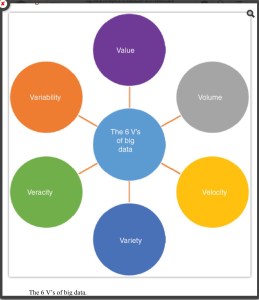
THE 6 V’S OF BIG DATA: Volume, Velocity, Variety, Veracity, Variability and Value

I found a 2018 article by Ristevski and Chen in the Journal of Integrative Bioinformatics that nicely illustrates the many facets of what people lump together as Big Data.

Seeing the succinct summary of the meaning of these six V-words immediately helped me feel I have a better grasp and comfort level thinking about how to approach the data that is constantly bombarding me as a physician.

“The volume of health and medical data is expected to raise intensely in the years ahead, usually measured in terabytes, petabytes even yottabytes. Volume refers to the amount of data, while velocity refers to data in motion as well as and to the speed and frequency of data creation, processing and analysis. Complexity and heterogeneity of multiple datasets, which can be structured, semi-structured and unstructured, refer to the variety. Veracity referrers to the data quality, relevance, uncertainty, reliability and predictive value, while variability regards about consistency of the data over time. The value of the big data refers to their coherent analysis, which should be valuable to the patients and clinicians.”

https://www.ncbi.nlm.nih.gov/pmc/articles/PMC6340124/

I will repeat and italicize the last sentence in this article:

“The value of the big data refers to their coherent analysis, which should be valuable to the patients and clinicians.”

So, how do we know how to apply all this Big Data, how do we make it relevant for the patient in front of us?

Harvard T.H. Chan School of Public Health posted this piece by Lisa D. Ellis on their website, describing a program called Measurement, Design, and Analysis Methods for Health Outcomes Research.

“Since diabetes patients act and respond differently to treatment due to many reasons, health care providers often cannot advise patients as to how they might respond given their personal characteristics simply because they do not have the required information,” Simonson points out.

The reason this crucial information is lacking is that “typically, no one clinical study can separate out the results by all the patient characteristics that might affect treatment,” Testa offers. “In addition, clinical drug trials do not typically measure how patients feel or how satisfied they are with their assigned treatment,” she says, adding, “In most clinical trials, the ‘true voice’ of the patient is usually silent.” To better capture this important component, Testa, Simonson, and their colleagues are pooling existing databases of diabetes patients with information gathered online and through social media.

https://www.hsph.harvard.edu/ecpe/value-of-health-outcomes-research/

Here, again, I will repeat and italicize the most salient sentence of my search result:

“In most clinical trials, the ‘true voice’ of the patient is usually silent.”

Not to get too heavily Jungian, but referring back to my recent writings about the Grail Legend and “Whom does the Grail Serve”, the obvious question here is “Whom does the Big Data serve?”

Primary care providers are perhaps the Parsifals of medical mythology.

“Central to the legend is that a simple man, a fool, needs to ask the simple question “whom does the Grail serve” in order for the wounded Fisher King to be healed. But Parsifal, who is such a person, heeded his mother’s advise “don’t ask too many questions” and missed his opportunity.”

https://acountrydoctorwrites.blog/2019/07/08/the-stages-of-a-mans-life/

Everybody Seems to be an Expert, Except Your Family Doctor?

It’s a funny world we live in. Lots of people make a handsome living, defining their work and setting their own fees and hours with little or no formal education or certification

There are personal and executive coaches, wealth advisers, marketing experts, closet organizers and all kinds of people offering to help us run our lives.

In each of these fields, the expectation is that the provider of such services has his or her own “take” or perspective and offers advice that is individual, unique and as far removed from cookie cutter dogma as possible. Why pay for something generic that lots of people offer everywhere you turn?

So why is it, in this day of paying lip service to “personalized medicine”, genetic mapping, the human biome and psychoneuroimmunology that we expect our healthcare to be standardized and utterly predictable?

And why is it that we are so willing to fragment our care, using convenient care clinics, health apps, specialists who don’t communicate with each other and so on? Does anybody believe it makes sense to have your life coach tell you to have a latte if you feel like it because it makes you happy and your financial adviser scorn you for wasting money, never mind your health coach talking about all those unnecessary calories?

In today’s world, almost all knowledge and information is available, for free, instantly and from anywhere on the planet. But this has not eliminated our need for “experts”. It used to be that we paid experts for knowing the facts, but now we pay them for sorting and making sense of them, because there are too many facts and too much data out there to make anything self explanatory.

The information explosion of our era has brought with it an implosion and a near extinction of common sense.

The facts contradict each other:

Eggs are good for you and bad for you. Almost everybody should take aspirin and most people don’t need it. The bread of life is the bread of death. Low LDL is desirable, low LDL confers risk of disease.

I think there are way too many non-medical providers giving medical advice and way too few medical providers daring and taking the time to do it.

Our nation’s doctors are busily checking virtual boxes trying to randomly cover way too much ground instead of meeting their patients “where they are at”.

Kenny Lin, a fellow medical blogger, has a perfect name for his blog, “Common Sense Family Doctor”.

We don’t need more “Experts”. We need well trained, experienced professionals with common sense. Like Family Doctors.

A Patient in the Lobby Refuses to Leave: Medical Emergency, Unhappy Customer or Active Shooter?

The receptionist interrupted me in the middle of my dictation.

“There’s a woman and her husband at the front desk. She’s already been seen by Dr. Kim for chest pain, but refuses to leave and her husband seems really agitated. They’re demanding to speak with you.”

I didn’t take the time to look up the woman’s chart. This could be a medical emergency, I figured. Something may have developed in just the last few minutes.

I hurried down the hall and unlocked the door to the lobby. I had already noticed the man and the woman standing at the glassed-in reception desk.

“I’m Dr. Duvefelt, can I help you?” I began, one hand on the still partway open door behind me.

The husband did the talking.

“My wife just saw Dr. Kim for chest pain and he thought it was nothing. He didn’t have any of her old records, so how could he know?”

While I quickly considered my response, knowing that Dr. Kim is a very thorough and conscientious physician, the man continued:

“Can we get out of here, and step inside for some privacy?”

My mind raced. This was either a medical emergency or an unhappy customer situation. We had the door locks installed not long ago on the advice of the police and many other sources of guidance for clinics like ours. It was a decision made by our Board of Directors. In this age of school, workplace and church shootings, everyone is preparing for such scenarios. We are always reminded not to bring people inside the “secure” areas of our clinics who don’t have an appointment or a true medical emergency.

I figured I had to find out more about this woman’s chest pain in order to make my decision whether to let her inside again; after all, she had just been evaluated.

“Ma’am, are you having chest pain right now?” I asked.

“A little”, she answered.

“How long have you had it?” I probed.

“A couple of years now.”

“And you just saw Dr. Kim?”

“Yes, and he said my EKG looked okay, but he didn’t bother to ask me about you heart valve operation three years ago in, Boston. He just said ’we’ll get those records’, and he told me I was okay today.”

The husband broke in, “It’s the same everywhere we go, everybody just says it’s not a heart attack, but we need more answers than that. we know what it isn’t, but we need to know what it is!” He added, again, “can’t we go inside for some privacy?”

“Have you been seen elsewhere for the same thing?” I said without answering the request.

“Yes, at the emergency room in Concord, New Hampshire when we lived there…”

“Did Dr. Kim have you sign a records release form so we can get the records from Boston and New Hampshire?” I asked.

“Yes”, the woman answered.

“Then that’s all we can do today,” I said. “I hear you telling me this is an ongoing problem, you’ve already been assessed today and Dr. Kim told you that you’re safe today and we’ve requested your old records. That’s what needs to happen.”

“You mean you’re not going to help us today?”

“You’ve seen Dr.Kim, your records will get here, I don’t know what more we can do for you today.”

“You’ll hear about this”, the husband said as they stormed out. Another man in the lobby introduced himself to them and said “I’ll be your witness.”

I closed the self-locking door and wished I had somehow been more skilled and more diplomatic, and I wished the world wasn’t the way it has become in just a few years, with more concern for bolted doors, gun violence and mass shootings than simple customer relations.


I just realized none of the posts show on an iPad or a computer, but they do show on an iPhone. WordPress is working on this. In the meantime, please visit my Substack.


Osler said “Listen to your patient, he is telling you the diagnosis”. Duvefelt says “Listen to your patient, he is telling you what kind of doctor he needs you to be”.


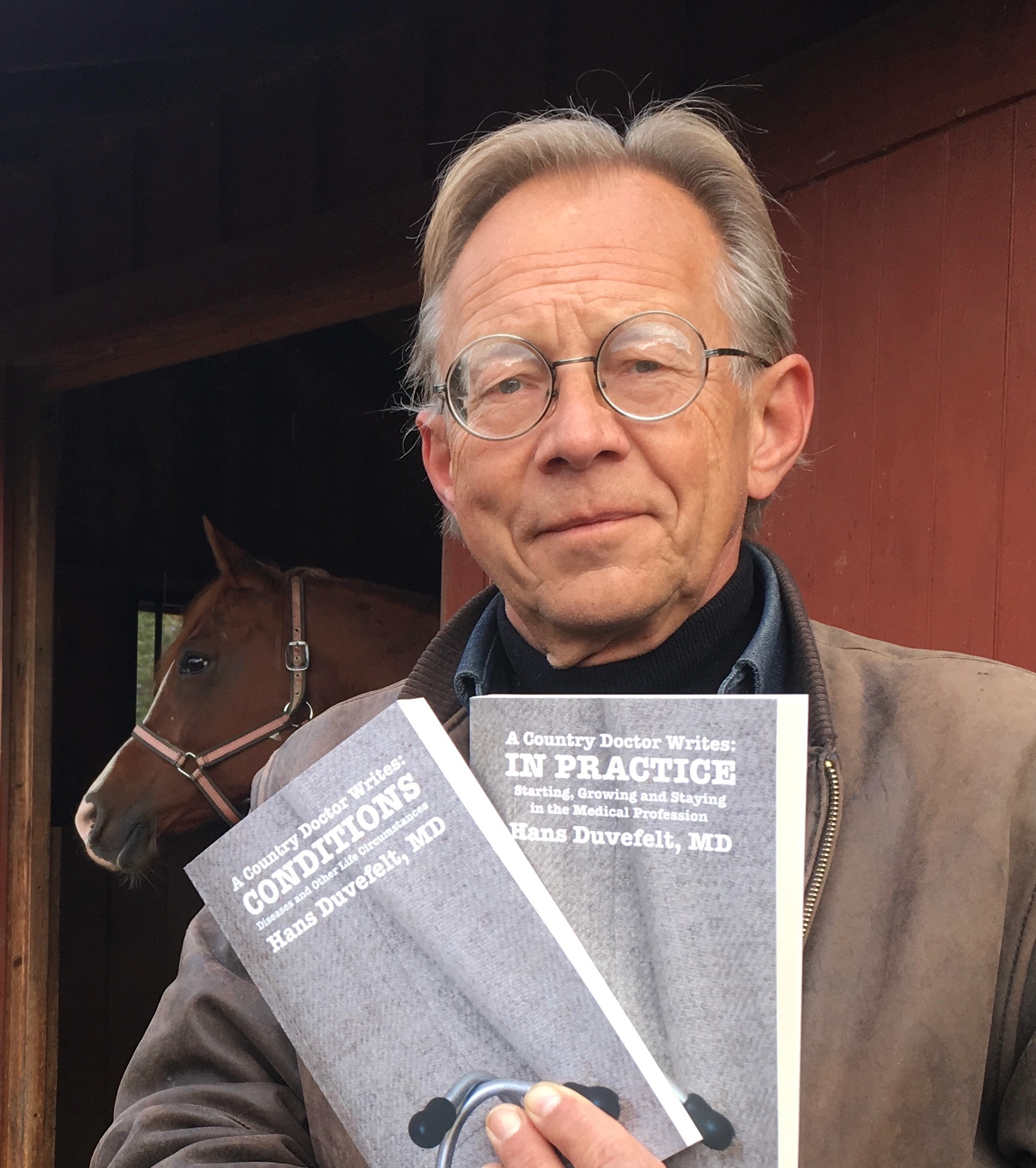
BOOKS BY HANS DUVEFELT, MD

CONDITIONS, Chapter 1: An Old, New Diagnosis

Top 25 Doctor Blogs Award

Doctor Blogs

Enter your email address to subscribe to this blog and receive notifications of new posts by email.

Mailbox

contact @ acountrydoctorwrites.com
Bookmark and Share
Š A Country Doctor Writes, LLC 2008-2022 Unauthorized use and/or duplication of this material without express and written permission is strictly prohibited. Excerpts and links may be used, provided that full and clear credit is given.