Archive Page 94


Despair and Happiness in America and in Medicine

Earlier this month Ross Douthat wrote a piece in The New York Times titled “The Age of American Despair” where he posed the question “Are deaths from drugs and alcohol and suicide a political, economic or spiritual crisis?”

Douthat writes:

“The working shorthand for this crisis is “deaths of despair,” a resonant phrase conjured by the economists Anne Case and Angus Deaton to describe the sudden rise in deaths from suicide, alcohol and drug abuse since the turn of the millennium.

Now a new report from the Senate’s Joint Economic Committee charts the scale of this increase — a doubling from 22.7 deaths of despair per 100,000 American in 2000 to 45.8 per 100,000 in 2017, easily eclipsing all prior 20th-century highs.

But had deaths of despair remained at 2000-era levels, approximately 70,000 fewer Americans would have died this year alone.”

He imagines what the presidential candidates would say about the cause for this epidemic:

“The Technocrat (voice of Pete Buttigieg): “This is primarily a drug abuse and mental-health crisis, and the only way to solve it is with more and better drug treatment programs, more and better psychiatric care. We’ll save these lives one patient, one addict, one treatment center at a time.”

The Socialist (voice of Bernie Sanders): “This is obviously an economic crisis! People are despairing because their jobs have been outsourced, their wages are stagnant, the rich have hijacked the economy. Tax the plutocrats, raise the minimum wage, give everybody health insurance, and you’ll see this trend reverse.”

The Cultural Healer (voice of Marianne Williamson): “You can’t just medicate this away or solve the problem with wonkery alone. There’s a spiritual void in America, a loss of meaning and metaphysical horizon. The problem is cultural, spiritual, holistic; the solution has to be all three as well.”

Somehow, somewhere I came across a psychiatrist and public speaker named Gordon Livingston, who wrote a lot about grief and happiness. He said this about drug abuse, a year before he died in 2016, but it applies to a lot of things Americans do today:

We can try to turn drug abuse into a disease, but we are just dealing with the larger paradox: the mindless pursuit of pleasure brings pain.

Now, I think drug abuse amounts to a disease because it involves changes in brain function and chemistry, but I do believe his generalization that the harder you pursue pleasure the more elusive it becomes.

Happiness, Livingston said, requires three things: Something to do, someone to love and something to look forward to.
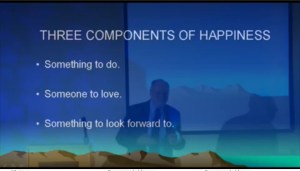
Looking at my own life and career, with the major changes of recent months, I took these three fundamentals to heart – they actually stopped me in my tracks when I first saw this slide on YouTube. These three things are actually so simple and don’t have to cost much, or anything at all, but they are so undeniably necessary for every human being. But how many people can honestly say they have all three, or give much thought to what they are.

This is exactly what I’ve been thinking and doing. I gave up administrative work and focused on the one-on-one work of seeing patients while I also moved back into my little farmhouse that calls out for me to catch up with some “deferred maintenance” (I love American euphemisms). I also carved out the time to do a substantial amount of horse and farm chores.

So I have several things to do that are meaningful to me. And this would be my addition to Dr. Livingston’s list – we have to see meaning in what we do, even if it is a job we don’t love (although I love mine) but we do it because it makes us feel valuable in some way, to society or our family.

And, speaking of family, and of love, I am deepening my relationships with my adult children and their families after years of working too hard with blinders on much of the time. And not everyone can understand this, but I love my Arabian horses and view them as family. Caring for these noble creatures and being in their presence is almost like a higher purpose.

And what I look forward to now is so different from earlier in my life. I wasted so much mental energy making long term plans before. Now at this age, with the biggest long term plan of all (growing old with my wife) suddenly evaporated, my perspective is shorter, allowing me to take in the present, appreciate the moment, in a way that has profoundly grounded me emotionally.

Back to the three fundamentals of happiness:

How many people in today’s society have defined for themselves what these three things are in their own life?

And, for me as a physician, how many patients do I see who suffer from depression, anxiety, addiction, maladjustment or dysfunctional relationships? How can I better, with whatever influence I have in my role as healer or guide, help them see how simple it can actually be to move closer to being happy?

I wrote this in 2012, in a post titled “The Secret of Life“:

Observing which of my patients live well and handle age, illness and adversity the best, I see the power of this every day.

Jungian therapist Robert A. Johnson describes in his book, “Transformation: Understanding the three levels of masculine consciousness”, how the male psyche evolves from simple man (exemplified by Don Quixote), who asks “What’s for dinner?” to complicated man (Hamlet), who asks “What does it all mean?” to enlightened man (Faust), who asks “What’s for dinner?”

(Here I am again, seven years later, realizing how one has to work at this being grounded kind of thing because modern life pulls us in so many distracting directions…)

With everything published these days about physician burnout, I also think Livingston’s three principles of finding happiness can be useful professionally for doctors. Aside from the love we need in our personal lives, I think doctors today have become distracted from the fundamental need to feel love for humankind, empathy with people, who now are increasingly cast as consumers or “populations” in the scripting of our work lives.

(I also, obviously perhaps, think that what we do has become separated from what we were trained to do, hope to do and need to do. The agendas for healthcare today are to a great degree neither our patients’ nor our own and that spells burnout for us and frustration for our patients.)

Our society is a selfish one. Happiness has become a selfish pursuit. The harder we strive for it, the more elusive it becomes and the more despair we feel.

Happiness is like floaters in our eyes: Try to focus on them and they move out of your field of vision. Keep your eyes on what you’re doing and they’ll remain visible slightly in the periphery as long as you don’t think too hard about them.

P.S.

So here is my happiness recipe for this September Sunday:

I finished my stall cleaning. Soon I’ll make breakfast and if the sun stays around I’ll eat it outside by the horse barn.

My short term goals in life are to catch up on some filing and vacuum the downstairs. And, coming back to me trying to be enlightened man instead of complicated man – what’s for dinner? Grilled salmon and asparagus, my favorite.

I’m not planning tomorrow too hard. Today is today.

…..

A Country Doctor Reads: September 14, 2019 – Life Forms Inside Us are Controlling Our Behavior

Several news media (I first saw it on BBC’s website) recently published the picture of an insect, invaded by a fungus, compelled to climb high, then killed off only to become a means for airborne spread of fungal spores.

I had also read in The New York Times about how massospora live inside cicadas and spread between them like an STD and stimulate mating behaviors to promote its spread, even though the cicadas become grotesquely altered by the fungus (see the yellow fungal “plug” in its rear). This behavior is caused by the release of Psilocybin, a mind altering controlled substance that eases depression and anxiety in cancer patients, and cathinone, a powerful stimulant.

Interesting that one life form can alter another’s behavior, but does anything like this apply to mammals, or humans? Certainly – maybe not for fungi, but definitely other parasitic (or symbiotic) organisms and viruses. Just consider the behaviors caused by rabies infection:

This seemingly improbable concept that specific microbes influence the behavior and neurological function of their hosts had, in fact, already been established. One prime example of “microbial mind control” is the development of aggression and hydrophobia in mammals infected with the rabies virus (Driver, 2014). Another well-known example of behavior modification occurs by Toxoplasma gondii, which alters the host rodents’ fear response. Infected rodents lose their defensive behavior in the presence of feline predators, and instead actually become sexually attracted to feline odors (House et al., 2011). This results in infected rodents being preyed upon more readily by cats, and allows Toxoplasma to continue its lifecycle in the feline host (House et al., 2011). Further, a variety of parasitic microbes are capable of altering the locomotive behavior and environmental preferences of their hosts to the benefit of the microbe. For instance, the Spinochordodes tellinii parasite causes infected grasshopper hosts to not only jump more frequently, but also seek an aquatic environment where the parasite emerges to mate and produce eggs (Biron et al., 2005). Temperature preference of the host can even be altered, such as observed during infection of stickleback fish by Schistocephalus solidus, which changes the hosts’ preference from cooler waters to warmer waters where the parasite can grow more readily (Macnab and Barber, 2012). Other microbes can even alter host behavior to seek higher elevations, believed to allow the infected host to be noticed more easily by predators or to eventually fall and disperse onto susceptible hosts below (Maitland, 1994). More coercively still, microbes can influence the social behavior of their hosts, causing insects, such as ants, to become more or less social to the benefit of the parasite (Hughes, 2005). In fact, the sexually transmitted virus IIV-6/CrIV causes its cricket host (Gryllus texensis) to increase its desire to mate, causing its rate of mating to be significantly elevated and allowing for transmission between individual hosts (Adamo et al., 2014).
— Read on www.ncbi.nlm.nih.gov/pmc/articles/PMC4442490/

There is, of course, now more and more interest in the role our microbiome plays in seemingly every aspect of our lives – from mood to metabolism to immunity. The more I read about this, the more humblingly (is that a word?) fascinated I become.

The well referenced review article quoted above illustrates several already known ways our microbiome affects us, and I highly recommend reading it. I’ll zero in on how our behaviors are influenced, leaving cancer, allergies and other aspects of their influence for another post. Here are some highlights:

Germ Feee (GF) mice tend to be anxious and socially impaired. These behaviors normalize when normal gut flora is introduced.

GF mice have an increased permeability of the blood brain barrier both during fetal development and in adulthood. Some strains of clostridium and bacteroides and also the short chain fatty acid butyrate can restore normal blood brain barrier function.

Probiotics (L. Helveticus and B.longum) caused decreased self reported anxiety and decreased urine cortisol levels in humans.

Microbiota metabolize fermentable complex carbohydrate/fiber into short chain fatty acids (SCFAs) such as acetate, butyrate and propionate, which cross the blood brain barrier. Acetate influences the hypothalamus’ regulation of glutamate, glutamine and GABA. It also increases anorectic neuropeptide, which suppresses appetite.

Probiotics from fermented dairy do not alter the composition of gut microbiome, but they alter the transcriptional state and metabolic activity of the microbiota.

Autism spectrum disorder (ASD) patients have an increased incidence of constipation, increased intestinal permeability and altered intestinal microbiome. Mice with ASD like behaviors have a similar overrepresentation of gastrointestinal abnormalities. Introduction of B. fragilis has normalized intestinal permeability and reduced stereotypical behaviors, communication deficits and anxiety behaviors.

“It is becoming increasingly recognized that other psychiatric and neurological illnesses are also often co-morbid with gastrointestinal (GI) pathology (Vandvik et al., 2004), including schizophrenia, neurodegenerative diseases and depression.

“The enteric nervous system (ENS) is directly connected to the central nervous system (CNS) through the vagus nerve, providing a direct neurochemical pathway for microbial-promoted signaling in the GI tract to be propagated to the brain on mood and behavior, including depression, anxiety, social behavior, and mate choice.

Bifidiobacterium infantis can normalize depression-like behavior in mice to a degree similar to the antidepressant citalopram.

Finally, I got the impression in medical school that the vagus nerve was unidirectional. Now I understand that it is very much bidirectional, as quoted above. Here is a quote from another article I ran into about that:

The bidirectional communication between the brain and the gastrointestinal tract, the so-called “brain–gut axis,” is based on a complex system, including the vagus nerve, but also sympathetic (e.g., via the prevertebral ganglia), endocrine, immune, and humoral links as well as the influence of gut microbiota in order to regulate gastrointestinal homeostasis and to connect emotional and cognitive areas of the brain with gut functions (1). The ENS produces more than 30 neurotransmitters and has more neurons than the spine. Hormones and peptides that the ENS releases into the blood circulation cross the blood–brain barrier (e.g., ghrelin) and can act synergistically with the vagus nerve, for example to regulate food intake and appetite (2). The brain–gut axis is becoming increasingly important as a therapeutic target for gastrointestinal and psychiatric disorders, such as inflammatory bowel disease (IBD) (3), depression (4), and posttraumatic stress disorder (PTSD) (5). The gut is an important control center of the immune system and the vagus nerve has immunomodulatory properties (6). As a result, this nerve plays important roles in the relationship between the gut, the brain, and inflammation. There are new treatment options for modulating the brain–gut axis, for example, vagus nerve stimulation (VNS) and meditation techniques. These treatments have been shown to be beneficial in mood and anxiety disorders (7–9), but also in other conditions associated with increased inflammation (10). In particular, gut-directed hypnotherapy was shown to be effective in both, irritable bowel syndrome and IBD (11, 12). Finally, the vagus nerve also represents an important link between nutrition and psychiatric, neurological and inflammatory diseases.
— Read on www.frontiersin.org/articles/10.3389/fpsyt.2018.00044/full

I Have a Strong Relationship with my Bank but I Almost Never Go There. How Could this Translate to Primary Care?

Imagine if your bank handled all your online transactions for free but charged you only when you visited your local branch – and then kept pestering you to come in, pay money and chat with them every three months or at least once a year if you wanted to keep your accounts active.

Of course that’s not how banks operate. There are small ongoing charges (or margins off the interest they pay you) for keeping your money and for making it possible to do almost everything from your iPhone these days. Yes, there may be additional charges for things that can’t be done without the bank’s personalized assistance, but those things happen at your request, not by the bank’s insistence.

Compare that with primary care. The bulk of our income is “patient revenue”, what patients and their insurance companies pay us for services we provide “face to face”. We may also have grants if we are Federally Qualified Health Centers, mostly meant to cover sliding fee discounts and what we call “enabling services” – care coordination, loosely speaking.

Only a small fraction of our income comes from meeting quality or compliance “targets”, and those monies only come to us after we have reached those goals – they don’t help us create the needed infrastructure to get there.

Then look at how medical providers are scheduled and paid. We all have productivity targets, RVUs (Relative Value Units – number and complexity of visits combined) if our employer is paid that way and usually just straight visit counts in FQHCs (because all visits are reimbursed at the same rate there). Sometimes we have quality bonuses or incentives, which truthfully may be the combined result of both our own AND other staff members’ efforts.

As we are now starting to think of how to make the transition to a system that pays medical offices not for the number of visits but for the overall health of our patients (as defined by our quality metrics), we should ideally free up doctors’ time to review and act on health data that comes to us in more ways than face to face visits – but there’s a catch: We don’t think we can afford to have our docs see fewer face to face visits, because right now there is no money in what in the future will compare to the bank’s cash flow that their customers generate when they use online banking, ATMs and so on.

If a patient sends me a list of blood pressures or blood sugars, there is a cost for us to review and act on them – lost lunch breaks, unreimbursed overtime (”provider pajama time”) OR lowered productivity targets (for face to face work in an organizational leap of faith that these efforts will actually result in incentive payments some time down the road).

Most medical offices are quaintly or hopelessly old fashioned in our approach to the changing demands and desires of our payers and our patients. It is hard to make the transition to something new: We are being asked to start working differently and potentially making less or spending more without knowing for sure if it will pay off.

(The Banking business analogy can only go so far. After all, healthcare is still a humanitarian endeavor: More and more payers want us to “take risk”. I bet. Your patients cost more to care for, not just in the office but in hospitals you have no control over. Result: You lose money. But when the bank takes risk, they charge accordingly and if you’re a terrible credit risk, they’ll turn you down. Doctors can’t turn away patients because they are too sick and a bad financial risk. We can only view what we do as a business up to a point. Banks and insurance companies have actuaries and people like that whose entire careers involve projecting costs and calculating risk. Even big medical practices don’t have that. So while I think we can emulate banks in our interactions with patients, I don’t think it’s fair to ask us to behave like banks in every aspect of what we do.)

A Country Doctor Reads: September 7, 2019 – Workarounds in Healthcare, Empathy in he Age of the EMR, US vs Swedish Postoperative Pain Management

The American Medical System is One Giant Workaround – NYT

The nurses were hiding drugs above a ceiling tile in the hospital — not because they were secreting away narcotics, but because the hospital pharmacy was slow, and they didn’t want patients to have to wait.

So begins an article in Friday’s New York Times. How many times have I used or thought of the word “workaround” recently? Lots, certainly in my personal life, with an older house, an older car, in far northern Maine. But as a descriptor of our country’s entire healthcare system? Well, to be honest, there’s a lot to that notion…

The United States spends more per person on health care than any other industrialized country, yet our health outcomes, including overall life expectancy, are worse. And interventions like bar code scanning are a drop in the bucket when it comes to preventable medical mistakes, which are now the third-leading cause of death in the country. Our health care nonsystem is literally killing us.

As the workarounds accumulate, they reveal how fully dysfunctional American health care is. Scribes are workarounds for electronic medical records, and bar code scanning is a workaround for our failure to put patient safety anywhere near the top of the health care priority list.

www.nytimes.com/2019/09/05/opinion/hospital-workaround-health-care.html

____________________________________________________________________

Empathy in the Age of the EMR – Danielle Ofri, MD

Danielle Ofri has another article on the plights of today’s physician, this time in The Lancet. I had offered some feedback on her article “The Business of Healthcare Depends on exploiting Doctors and Nurses” in The New York Times some months ago, and I ended up joining her mailing list. This just arrived in my inbox and it certainly resonates:

Many of us physicians muddle through our clinical encounters in this manner. We’re half-listening, half-typing, half-processing what tests we’ll need to order, half-chiding ourselves about an oversight from our last patient, half-ignoring the red-flag alerts that keep cropping up, half-thinking about the next three patients in the waiting room, and half-pondering whether one of the EMR buttons could do something practical like conjure up a cup of coffee and a sandwich.

 The only thing that’s not diminished by half is the feeling that we’re cutting corners on every front and scraping by with mediocre medical care. 
— Read on danielleofri.com/empathy-in-the-age-of-the-emr/

_____________________________________________________________________

US, Canadian and Swedish Postoperative Opioid Prescribing – JAMA

I had an open appendectomy in Sweden back in 1972, weeks after returning from my year as an exchange student in Massachusetts. I remember distinctly that I was in relative agony but never asked about my pain level or offered anything for pain while I was recovering in the hospital. I remember spending a few days there. Then, as now, the Swedish healthcare system is lean on interventions and generous with bed-days, so by the time I was discharged I didn’t hurt much at all.

I was aware that Swedish patients to this day don’t receive as much pain medication as Americans, but I had no idea of the magnitude. This week I read an article that pegs the numbers – a seven fold difference:

This cohort study determines whether there are differences in the frequency, amount, and type of opioids dispensed after surgery among the United States, Canada and Sweden.

In summary, we observed differences in opioid prescribing after low-risk surgical procedures across 3 countries in North America and Europe. Patients treated in the United States and Canada received opioids after surgery more often and in higher doses compared with patients treated in Sweden. These findings highlight opportunities to encourage judicious use of opioids in the perioperative period in both the United States and Canada. Understanding the societal and cultural factors that influence these prescribing patterns could inform areas of further research and identify targets for future interventions.
— Read on jamanetwork.com/journals/jamanetworkopen/fullarticle/2749239

When Was the Last Time You Saved Somebody’s Life?

I got an email Saturday from Laurence Bauer of the Family Medicine Education Consortium. 

Larry said that when he talks to doctors and residents about saving lives they usually think of their preventive medicine efforts and few people have stories about the short term impact they have on people’s lives. Larry asked me if I had anything to say or write about that.

The first thing that comes to my mind is my work with substance abuse, our medication assisted treatment, which I still do for Bucksport via telemedicine even though I live and otherwise work 200 miles north of there. Statistics show that immediately upon entering a Suboxone program participants risk of dying from an opioid overdose is reduced by 50%. So it’s possible I’ve saved a life or two there. At the annual staff appreciation day in August patients from the Suboxone program had written greetings to me on the whiteboard and a couple of them had written that I saved their lives.

The other thing I think of is the triage type of decisions we make. Somebody comes in with chest pain and we have to decide whether or not to send them to the emergency room or order tests for heart disease or blood clots in their lungs. We’re supposed to make the right decision and when we do we don’t necessarily get a thank you card or anything. Perhaps if we don’t, there would be all kinds of repercussions. Very often in our line of work our reward is the absence of negative feedback.

In less dramatic cases, we make choices all the time that could be life altering or life saving. When we order an x-ray or CT scan rather than say, “let me know if it doesn’t get better”, we could be in a lifesaving situation, but once you have been practicing for a few years you don’t reflect on that as much as when you first start out. 

In my post “Primary Care is Messy” I wrote about this five years ago, although I didn’t even remember the incident until I searched my own blog for “saved my life”. For non-physicians it may seem incredible that one might not remember a story like this one, but when you see sixteen to thirty patients day in and day out for forty years, you can only make so many personal notes and still keep up the pace. 

“Knowing what constitutes success in frontline medicine is not easy. Let me illustrate:

A middle aged smoker comes in for a follow up on his blood pressure treatment and mentions that he would like to try Chantix (varenicline) to help him quit. My nurse has already secured our practice credit for documenting his smoking status. I can use certain billing codes to document my counseling on the subject, and I can get credit for printing out the drug information, even though the pharmacy also provides a printout. This is a successful visit, it might seem.

But I also ask, “Ron, what makes you want to quit at this particular point in time?”

“Well, I’ve had this funny cough, like a dry hack, for the last two weeks whenever I take a deep breath”, he answers. 

Ron turns out to have a very small, resectable lung cancer. My question about the reason for his request probably saved his life, and catapulted us from shallow administrative success to probable or at least possible clinical victory, without making any further difference in my own quality metrics.”

So, Larry, I think there is a lot of focus on doctors supporting each other when they feel burned out or inadequate, but I’m not hearing much about taking notice and stopping to celebrate the small and large clinical and relationship progress or downright victories we have in our everyday work. With no doctors lounge to visit anymore (another blogpost of mine from just four months ago), how do we do that?


I just realized none of the posts show on an iPad or a computer, but they do show on an iPhone. WordPress is working on this. In the meantime, please visit my Substack.


Osler said “Listen to your patient, he is telling you the diagnosis”. Duvefelt says “Listen to your patient, he is telling you what kind of doctor he needs you to be”.


BOOKS BY HANS DUVEFELT, MD

CONDITIONS, Chapter 1: An Old, New Diagnosis

Top 25 Doctor Blogs Award

Doctor Blogs

Enter your email address to subscribe to this blog and receive notifications of new posts by email.

Mailbox

contact @ acountrydoctorwrites.com
Bookmark and Share
© A Country Doctor Writes, LLC 2008-2022 Unauthorized use and/or duplication of this material without express and written permission is strictly prohibited. Excerpts and links may be used, provided that full and clear credit is given.