Archive Page 91


The Polyvagal Theory: The Science Behind Therapeutic Relationships, Stress Related Illness and Long Term Effects of Trauma

The vagus nerve runs from our brain to our gut and along the way it connects with our heart. We used to think of it as a one-way signaling, but 80% of the activity in the vagus nerve travels the other way – from our gut to our brain.

As many times before, I read an article in The New York Times that made me dig deeper into a medical subject, this time the vagus nerve, and the term “Polyvagal Theory” got me going.

We now understand that there are three levels of activity in this system, and that each one of them can influence our bodily functions, our emotions and even our perception of reality.

This deeper understanding of the vagus nerve has been named the Polyvagal Theory.

The three functions of the vagus nerve represent three different stages in evolution and the newest one, involving our conscious mind, can’t necessarily override the older two.

The oldest part of the system regulates our intestinal functions and has the ability to decrease our heart rate to the point of unconsciousness and our brain function to the point of shutdown or, in psychological terms, dissociation – playing dead, if you will.

The middle aged system can raise pulse and blood pressure and is the carrier of our famous flight or fight responses.

The newest vagus function is involved with social connections and whatever conscious regulation of the influences of the other two systems we are capable of.

Dr. Stephen Porges explains this in his books, articles and videos:

The fight or flight response is well studied and well accepted and I think most of us understand fairly well how it works. What I find the most fascinating aspects of the vagal system are the other two.

The shutdown ability of the oldest part of the system appears to explain a lot of the late effects of trauma, including dissociation and some cases of irritable bowel syndrome, for example. These conditions are associated with heart rate variability differences resulting from altered vagus nerve signaling by this system.

The younger system of social regulation was one I hadn’t really heard of and it suddenly made me understand therapeutic relationships not only in a social context like mother and child, friends or loved ones but also clinical ones, in a way that I had only intuited up until this point. This part of the vagal system is involved with control of our facial expressions, intonation of voice, gestures and all kinds of emotions involved in human contact.

Our ability to interpret things like facial expressions and intonation is dependent on whether we feel threatened in any way, and the polyvagal theory includes something called neuroception. Dr. Porges writes:

“Neuroception is proposed as a ‘reflexive’ mechanism capable of instantaneously shifting physiological state. Neuroception is a plausible mechanism mediating both the expression and the disruption of positive social behavior, emotion regulation, and visceral homeostasis.”

Neuroception can make us misread facial expressions and impair our ability for social engagement, both aspects of the newer vagal system. It can trigger panic attacks with heart palpitations and impulses to flee when the middle aged system is activated. It can also make us faint or mess our pants if we are paralyzed with fear due to activation of the oldest vagal pathways.

Our social regulation happens on many levels, and has its foundation in mother-child bonding. The so-called social neuropeptides, oxytocin and vasopressin are present in the same anatomical areas that are involved in vagal stimulation. The vagus nerve also regulates cytokine activity, involved in immune reactions.

Dr. Porges points out that humans have an inherent but limited ability for self regulation of emotions and their bodily correlates, although we can learn more of that even as adults through yoga or meditation and by exposing ourselves to soothing music for example. The foundation of human emotional regulation however is interpersonal relationships.

He writes:

“In order to co-regulate with another person, we need certain social engagement behaviors to feel safe with that person. Engagement turns off defenses. There are 3 behaviors: Facial expressions, gestures and prosodic vocalizations (intonation of voice the higher more soothing the voice the more safer perceived). Eye gaze can be seen as a threat at times for some trauma clients but prosody of voice is more of a stronger behavior for eliciting safety. Therapists can be mindful of all three behaviors in their therapy sessions with clients. Humans need others because regulators of physiology are embedded in relationships.”

This brings me back to what I wrote earlier this month in a post titled “Ten Building Blocks of Therapeutic Relationships”:

“It is well known by now that a physician’s demeanor influences the clinical response patients have to any prescribed treatment. We also know that even when nothing is prescribed, a physician’s careful listening, examination and reassurance about the normalcy of common symptoms and experiences can decrease patients’ suffering in the broadest sense of the word.”

Sounds positively vagal, now that I know a little more…

Changing EMR – Seamless Continuation, Dreaded Chore or Fresh Start?

At the end of the year my patients and I will start over. That is what changing EMRs does to us. I have mixed feelings about data migration, if it even happens.

I will move into a new virtual environment and my patients will take on slightly different appearances, maybe even alter their medical histories. Some will perhaps be asking me to edit diagnoses that have haunted them since we went from paper to computer records almost a decade ago.

With our first EMR, we scanned in a few things from patients’ paper records – sometimes only a few pages from years or decades of first handwritten and later typed notes. Much got lost, because we were doing something we never really had thought through, and we had to do it with a clock ticking: “Hurry, before the Federal incentives go away”. The Feds wanted EMRs because the vision was that more data would help research and population health and also reduce medical errors.

This time, another factor is pushing us forward: The EMR we have will no longer be supported after a certain date, and for an EMR that requires continuous tinkering in order to do basic tasks consistently, that is an untenable scenario. Only yesterday, I was suddenly unable to send prescriptions electronically and it took the national headquarter’s involvement to get me up and running again.

Our old EMR will become “read-only”, and who knows how much structured data will “migrate” from the old to the new system. And some information that should have been structured isn’t, because the old system’s search function was clunky enough that if we couldn’t find the exact word for a rare diagnosis in someone’s medical history, we would give up and choose the generic “neurologic disorder” and then free text the thing we might not even be spelling correctly. That still displayed intelligibly enough while the system was live, but will that migrate to the new system – who knows? Of course, there will be opportunities to correct old mistakes and omissions, as long as there is time…

The only way to view this inevitable transition is as an opportunity to undo old beginner mistakes, bad habits and workarounds. Having worked with two systems in my two clinics, I feel this is a bit like learning a new language or instrument; I know better what functionality I am looking for and will recognize it when I see it – just like a Spanish word I don’t know might look similar to a French word I do know for the same thing.

Wise from my positive experiences of screen sharing, I will bring patients along on this journey. I will be sitting next to each one with my laptop in front of us. I will invite them to update their history and increase the transparency of how I work, because there isn’t enough time in the day to keep the EMR invisible from my patient and then do all that work outside the appointment. Also, this is an era of increasing patient centeredness and I want to embrace that as much as I can.

I am determined to become as expert as possible with the new system so that I can document everything in real time in the visit and use more of my non-patient time in front of the screen to build templates and things like that.

In a way I feel a bit like many, many years ago when, as a student or budding writer, I opened a brand new notebook and put my pen to it for the first time. I loved fountain pens, crisp paper, leather bindings and the potential of all that clean, empty space.

Instead of feeling this EMR change will be a chore, I feel like a new school year or a new writing project is just about to begin.

Ten Building Blocks of Therapeutic Relationships

It is well known by now that a physician’s demeanor influences the clinical response patients have to any prescribed treatment. We also know that even when nothing is prescribed, a physician’s careful listening, examination and reassurance about the normalcy of common symptoms and experiences can decrease patients’ suffering in the broadest sense of the word.

This has been the bread and butter of counselors for years. People will faithfully attend and pay for weeks, months and even years of therapy visits just to have an attentive and active listener and to feel like they have an ally.

We also have data that shows that adherence to treatment plans is dependent on how patients feel about their provider. One problem solved can build an ally for life

Primary care medicine is a relationship based business. I don’t know how often that basic fact is overlooked or denied. Whether you are trying to get another person to alter their lifestyle, take expensive medicines according to inconvenient schedules or even just trust and accept your diagnosis, you have to “earn” the right to do those things. Our titles and medical accoutrements give us a foot in the door, but they don’t usually get us all the way into peoples inner circles of trusted advisers.

In this age of corporate medicine, there is a belief that patients attach themselves to institutions and networks because of their trust in the organizations, and that therefore the connection with their individual providers is secondary.

I think that is a factor mostly when someone is looking for sophisticated specialty interventions, often one-time-only, like “where’s the best place to go for high risk cardiac surgery”.

When looking for primary care, people still tend to ask, “who’s a good doctor”, rather than “which is the better primary care group, Uptown Medical Associates or Statewide Primary Care”.

How do you as a clinician in today’s restless and mobile society earn trust and build therapeutic relationships in fifteen minute visits with several visible and invisible intruders in the room – the computer and the insurance company, for starters.

I have previously reflected on how to prepare yourself for beginning a clinical encounter. My ABCs are Attention, Behavior and Connection.

But where do you go from there, how do you continue, grow and nurture a therapeutic relationship over time in the kind of environment most of us work within?

Here are a few lessons I have learned myself:

1) Listen and respond. How many times do we hear that patients don’t get to speak for even a minute before we interrupt them? If you hear something that immediately requires clarification, do what you would do in a social situation. Say that what the other person just said is important or interesting, reflect back what you think you understood and then be careful not to give them too many yes or no options, but invite them to continue their story. Imagine that you’re meeting an interesting person at a dinner party, not leading a legal interrogation.

2) Set an agenda. Almost every time I ignore this little rule, I get burned. Patients may not reveal their real concern when making an appointment and their priorities may have changers since then. Going all-in with what you think is their main issue and saving “do you have any other concerns” until the end of the visit is a recipe for disaster. That agenda-setting may need to be addressed right away or after hearing a little about the main concern. If you don’t ask what people need from you, how can you ever hope to fill your role as their provider?

3) Budget time. Don’t act frustrated about the reality that time is at a premium, and don’t declare that you have too little of it until you know how serious or urgent your patient’s concern is. The person with a seemingly trivial concern may need you to help them with the biggest or worst problem of their life, so invest your time and attention on listening and understanding early on in the visit. By acting unhurried at first, you are more likely to create an atmosphere of trust and caring; once you know your patient’s concern and their diagnosis or differential diagnosis, if they feel heard, you can move more quickly to wrap up the visit if you need to.

4) Manage the perception of time. If I am running late, I often enter the exam room and demonstrably sit down, take a deep breath and relax my posture as if I am finally arriving at the most important appointment I have all day. That slowing down gesture helps me to undo my patient’s fear that I’m going to be rushing them along. If they think I’m not going to meet their needs, their memory of the visit will likely be just that, even if I do a pretty good job technically for them.

5) Don’t be a hero. My 2018 post “Be the Guide, Not the Hero” points out the fact that everyone is on heir own journey in life and we are at best guides in our patients’ pursuits. If we try to be the hero in their stories, we create unhealthy, dependent relationships that often lead to patient disappointment or even resentment. As guides instead of heroes, we also remind ourselves that we are not the ultimate experts on what is best for our patients. Since our patients are the heroes of their own stories, they must ultimately decide which piece of advice from which guide they will choose to follow.

6) Be true to yourself. On the one hand, I believe we must adapt our demeanor to the situation – reassuring, motivating, inquisitive or sometimes decisive – but we must stay within the range of our real selves. I can be jovial only to a point or I will seem and feel like I am pretending, for example. People can usually sense falsehood a mile away.

7) Balance disclosure. We can not build therapeutic relationships as only technicians; we must engage as real people and you can’t be real without showing emotion, genuine interest, engagement and a good amount of humility. We have to be careful to show that we are fallible like everybody else but also that we ultimately have our act together. Nobody wants a self absorbed, overconfident guide, but nobody wants a weak and insecure one either. If we say we never had tough choices to make or regrets we carry with us, how can we expect patients to allow us to be close enough to build trust?

I tell people things they could relate to that I don’t think would come back to haunt me. I tell them how many miles I have on my car, but not how much money I spent on repairs. I tell them about my life lessons from being a Boy Scout or going through basic training in the Swedish army, the antics of the beagles I’ve had in my life or the way my one-time vegetarian diet made me put on weight. I tell them I was homesick at my first scout camp, but I don’t talk about things that could distance patients from me; not that I am a golfer or a sailor, but pictures and magazines of such things will alienate as many patients as it might build relationship with. My Arabian horses didn’t cost much money, they were adopted from a horse rescue and simply needed a home. Our relationship with animals, I believe, is more likely to show that we have the capacity for relationship building with humans, too.

8) Build continuity. From one visit to the next, find a thread to follow. For some patients, it is their chronic disease, for others their family or their hobby. Reconnecting about what you talked about last time is a powerful and quick way to reestablish the fact that you know each other and that you care about your patient. It brings you straight into a space where you are ready to do the work you do. Even if you have to pull up their last visit in the EMR (maybe even looking at the screen together), that quick reconnection that begins every visit helps make you seem better prepared; maybe you don’t remember the details of the last visit but you do remember your patient very well.

9) Solicit participation. When it’s time to formulate a treatment plan, don’t be too quick to lay it out as if there is only one way to do things.

10) Plan when and how to reconnect. “Followup PRN” isn’t usually the best way to conclude a visit in your mind or the EMR. Friends don’t usually leave each other saying “I’ll see you around”, that’s more for casual acquaintances. It’s important to agree on what to do after the test results come in, when the antibiotic runs out, if the rash doesn’t go away or when to meet up if everything is going well. Not making such plans devalues the relationship and makes you look as if you don’t care about your patient.

Everything on this list is about how we interact with the people we engage with frequently or infrequently. We must always look beyond the diagnosis and the Chief Complaint (which should be Chief Concern – where did “complaint” come from?). Remember Osler:

The good physician treats the disease; the great physician treats the patient who has the disease.

Screen Sharing With Patients

I ran late the other morning. My first patient, an internal transfer, was already waiting. Booting up my laptop seemed to take forever.

Usually I try to poke around at least a little in the EMR before I enter the exam room, even when I know the patient well in order to remind myself of what we are supposed to do in today’s visit.

I decided to walk in cold because I was so late. All I did before unplugging my laptop was open the encounter note of the man I had never seen before.

I knocked on the door and introduced myself – first and last name, I only call myself “doctor” with children or if I walk into a crisis-type situation where being a doctor allows or requires you to take charge.

I pulled up the little computer stand and sat down in the second chair right next to my new patient.

I did everything with him as in a guided tour of the electronic medical record, moving the cursor over things I oriented myself to.

“So, you’re 66, and it says here you’ve got high blood pressure, cholesterol and a history of GERD. Let’s check your medication list…are you still taking Prilosec. It hasn’t been renewed since 2017….or are you just buying it over the counter?”

I pulled up lists of blood pressure readings, commented on how the numbers seemed to have dropped at the same time he started losing weight last spring.

We looked at his immunization record together and I cracked about both of us needing the “Big Boy Flu Shot” because of our age.

As we sat there, side by side, I renewed prescriptions and ordered his flu shot and a couple of blood tests, explaining exactly what I was doing.

He interrupted me:

“You know, my old doctor never showed me the computer screen. It’s like it was secret somehow. I like the way you do this.”

I learned something in that visit. I show the screen all the time like this, but I have always tried to prepare myself for a new patient visit by looking through the chart before I walk into the room.

It was actually more powerful to start from scratch together, me exploring my new patient’s medical history and him seeing an EMR, his own story on the screen, for the first time.

If Nothing Else Works, Try a Horse

Equine assisted therapy keeps coming up for me. I hear about people who provide it and I know people who are curious about it. Last weekend I read a piece in The Wall Street Journal about it that had some quotable things in it.

After reading it, I did some more research, and found a few interesting connections. For example, Hippocrates, the father of medicine, whose name (I never reflected on it) literally means Horse Power(!) described the health benefits of horseback riding two millennia ago in a work called “Natural Exercise”.

Horse therapy today encompasses both riding and being in the presence of horses, including grooming them, without necessarily riding them. Riders with physical disabilities can sometimes do as well or better than most other riders, for example the Danish dressage rider Lis Hartel, who won a silver medal in the 1952 Helsinki Olympic Games in spite of partial leg paralysis from polio, which prevented her from mounting her horse unassisted. Since then there have been many studies on the benefits of horseback riding on balance, coordination and muscle control for patients with neuromuscular diseases.

There is also more and more research published on what being with or riding horses can do for psychiatric conditions, from veterans with PTSD to depression to substance abuse.

Meggan Hill-McQueeney, featured in the WSJ article, runs an Equine Assisted Therapy program. She had a profound first experience with therapeutic riding:

M, a life­long eques­trian, first wit­nessed the heal­ing power of horses while work­ing af­ter col­lege on a ranch in Col­orado, where she was teach­ing peo­ple to ride. A fam­ily had brought their 4-year-old son, a boy with Down syn­drome who was un­com­mu­nica­tive. Some­thing about the horse cap­ti­vated him. Sit­ting in the sad­dle, he signed “horse”—the first word he had ever com­mu­ni­cated. His mother started cry­ing, which prompted his first spo­ken word too: “Mama.”

Horses, being prey animals, are exquisitely sensitive to their environment and their survival depends on fleeing from predators. They can sense the intentions of animals and humans around them. They are said to be able to smell adrenaline and they can “read” the intentions of predator animals and save their energy if such animals are only passing through without intentions of attack. They can synchronize their heart rates with the humans who care for them.

I know from my own experience with rescued Arabians, who as a breed have a reputation of being easily excited, that they help me be calm and unhurried around them. It is almost as if they provide me with biofeedback and reflect back to me what my own degree of tension might be. And not just because an edgy 1000 lb animal could inadvertently hurt me, but because I so much enjoy their unfrightened peacefulness and kindness, I automatically correct my own frame of mind in their presence.

As Meggan Hill-McQueeney puts it:

“When you’re near a horse, you have to prac­tice the art of keep­ing your en­ergy in a good spot. To trust them, they have to trust you. Help­ing the horse rec­i­p­ro­cates to help­ing the per­son. It’s just so nat­ural, but it ends up chang­ing you.”

Her focus is helping veterans and her mission is to prevent suicides. The article concludes:

This year, BraveHearts will see more than 1,000 veterans, and Ms. Hill-McQueeney longs to reach even more. “Is it unconventional? Innovative? Does it help?” she asks. Her answer to all those questions is “yes.” “We’ve got an epidemic of veteran suicide in this country,” she says. “If nothing else works, try a horse.”


I just realized none of the posts show on an iPad or a computer, but they do show on an iPhone. WordPress is working on this. In the meantime, please visit my Substack.


Osler said “Listen to your patient, he is telling you the diagnosis”. Duvefelt says “Listen to your patient, he is telling you what kind of doctor he needs you to be”.


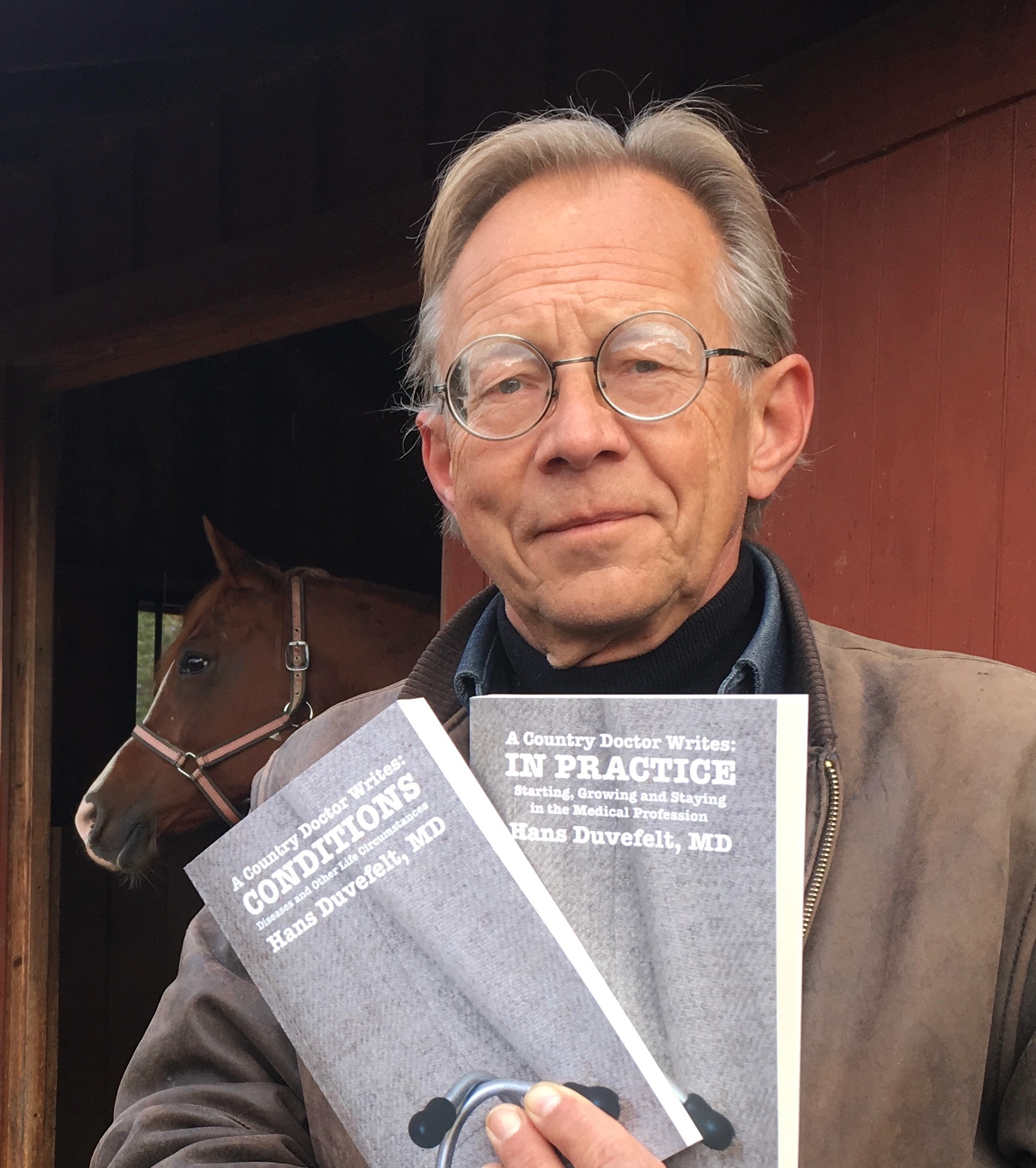
BOOKS BY HANS DUVEFELT, MD

CONDITIONS, Chapter 1: An Old, New Diagnosis

Top 25 Doctor Blogs Award

Doctor Blogs

Enter your email address to subscribe to this blog and receive notifications of new posts by email.

Mailbox

contact @ acountrydoctorwrites.com
Bookmark and Share
© A Country Doctor Writes, LLC 2008-2022 Unauthorized use and/or duplication of this material without express and written permission is strictly prohibited. Excerpts and links may be used, provided that full and clear credit is given.