Archive Page 6


“Practice at the Top of Your License?”

In my first 30 days on Substack, I published a post that got eight new subscribers and broke my record of how many views it had, 195, more than twice what my budding Substack had accomplished before.

It was a call to reimagine, reinvent and reinvigorate primary care. I re-blogged this post on my original, much older WordPress blog and it got 14 comments, many more than usual. So this was a hot topic and two years later it’s still hot. In fact, personally, six months later, I started transitioning to a different job, the one I now work full-time in, doing housecalls and virtual visits for older and disabled patients.

Many of the comments were saying that Direct Primary Care is the solution to today’s primary care crisis. It’s a great alternative, for sure, but it doesn’t work for everybody. Medicare patients on a fixed income need to use their insurance if they still want to eat and heat their homes. Same thing for most people on Medicaid.

There are a few problems with primary care today. One is that our nation’s lack of a public health system has defaulted most of those tasks to the primary care practices, where we are hard wired (and usually reimbursed) for seeing patients one by one. It is hugely inefficient to do mass education and mass screenings with large populations on a one-on-one basis. This is obviously leaving less time to treat sick people one by one.

Another problem with primary care today is that managers and EMR programmers have basically no idea of what we do, the cognitive aspect of doctoring. They only see the superficial aspects of our work and they create “workflows” (a word that makes me cringe) that emphasize the scutwork aspects of our day instead of creating systems that liberate us from tasks that non-providers could do and free us up to diagnose and treat. This is a dramatic example of what it used to be like to dose the blood thinner warfarin before and after computers (note that the top image is for 4 months’ worth of test values and the bottom “workflow” is for ONE SINGLE test value).

Dosing Warfarin: From Flowsheet to Workflow. Is This Progress?

So this is my early “blockbuster” post:

Practicing at the Top of Your License is Not an Option for Primary Care Physicians

Can Diabetics Get UTIs Because of Insulin?

I was covering for Dr. Kim the other day. A 60-something diabetic who had started taking insulin a few months ago had left a message that she wanted to change from Novolog (insulin aspart) to Humalog (insulin lispro) because she had just had her second UTI (urinary tract infection). And she had just read that UTI is listed as a side effect of Novolog but not of Humalog.

I’d never heard of insulin causing UTIs, but if that were the case, wouldn’t all insulin do the same thing, I thought. I opened epocrates, the drug app 60% of doctors use (created by the CEO of Galileo, where I work). Sure enough, UTI is listed as number 5 of common side effects for Novolog, but it is not on the list for Humalog, where URI (upper respiratory infection) is included as number 8.

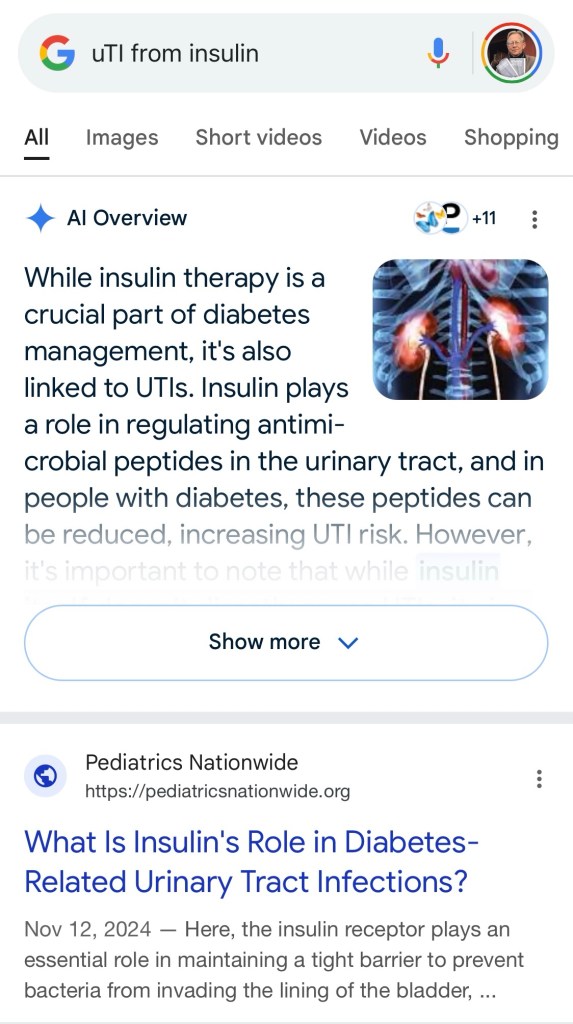
My trusted, much younger colleague, Dr. Google, quickly produced the most interesting answer to my query “UTI from insulin”.

Here are two quotes from the article Google delivered to me:

What Is Insulin’s Role in Diabetes-Related Urinary Tract Infections?

“…reduced insulin receptor activity….led to a weakened response to bacterial infections, lower antimicrobial peptide production, and compromised immunity.”

“suppressed insulin receptor signaling lowered antimicrobial peptide production and increased susceptibility to “leaky bladders” and infections caused by….Escherichia coli.”

I’ll say it again, just as I did in my story about the woman with precipitous drop in albumin:

You can’t know everything and you’re never too old to learn.

The Case of the Dropping Albumin

Zen and the Art of Doctoring

I had this idea to write a post about quality, linking to the characterization of quality in the classic book Zen and the art of motorcycle maintenance. On a whim, I gave ChatGPT the task, formulated like this:

Write a 500 word essay with the title Zen and the art of doctoring, borrowing the major concept of the book Zen and the art of motorcycle maintenance, applying the principles to the practice of medicine

The post below appeared within seconds. Let me know in the comments what you think of it.

In Zen and the Art of Motorcycle Maintenance, Robert M. Pirsig explores the philosophical concept of “Quality,” a state of harmony that transcends dualities—subjective and objective, rational and romantic. This Quality, though elusive, serves as a guiding principle in life and work, merging the precision of rational thought with the richness of emotional experience. When applied to the practice of medicine, this philosophy encourages a more holistic, mindful, and compassionate form of care—a way of doctoring that goes beyond technical expertise to embrace presence, empathy, and moral responsibility.

Modern medicine, much like motorcycle maintenance in Pirsig’s narrative, often emphasizes technical accuracy, protocols, and measurable outcomes. Doctors are trained to diagnose, prescribe, and perform with efficiency and precision. However, as Pirsig argues in his book, focusing solely on the mechanical aspects of any practice—be it fixing a motorcycle or treating a patient—risks losing sight of the human element that gives the work its meaning. The true art of doctoring, therefore, lies in integrating the scientific with the philosophical, the measurable with the immeasurable.

“Quality” in medicine is not merely reflected in lab values or surgical success rates but also in the subtle, often unquantifiable connection between doctor and patient. When a physician sits quietly, listening to a patient’s fears, or takes time to explain a diagnosis with care, they are practicing medicine with a Zen-like awareness—fully present, attentive to detail, yet attuned to the broader context of human suffering and resilience. This presence transforms routine care into something meaningful for both patient and practitioner.

Pirsig’s idea of “the knife that cuts too fine” is especially relevant here. In modern clinical environments, the fragmentation of care into ever-smaller specialties can lead to loss of coherence. A patient becomes a collection of organs rather than a whole person. Zen and the art of doctoring would urge us to resist this fragmentation and instead cultivate an integrated view, where physical health, mental well-being, and social context are interwoven threads in the diagnostic process.

Moreover, Pirsig emphasizes the importance of caring about one’s work. A mechanic who cares about his motorcycle treats it with respect and patience, and through this care, finds peace and purpose. Similarly, a doctor who views each patient encounter not as a transaction but as a sacred opportunity to heal, learns to derive meaning from the practice itself. In this way, doctoring becomes not just a profession but a discipline of the spirit—an ongoing meditation on suffering, healing, and the mystery of life.

Ultimately, Zen and the Art of Doctoring invites us to approach medicine not merely as a science, but as a craft rooted in attention, compassion, and humility. It is a call to rediscover the joy of presence in an age of protocols, to honor the artistry in healing, and to recognize that in the quiet space between diagnosis and cure lies something ineffable—a fleeting but profound glimpse of Quality.

The Case of the Dropping Albumin

Glenda Cyr has been my patient for many years. She also follows with an endocrinologist in the city because of hypoparathyroid disease. She’s on varying doses of calcitrol and vitamin D and he follows her bloodwork regularly, even though he last saw her about two years ago. He works at the Catholic hospital across the city from the rival, bigger, Cityside hospital.

Back in March, Glenda became very ill very quickly and was first admitted to our local hospital and within 24 hours they transferred her to Cityside. She turned out to have abscesses threatening several of her vital organs. Some were drained and some were inaccessible so she was on complicated regimens of intravenous antibiotics over several weeks at the big hospital and then at a rehab facility closer to home.

Shortly after her admission, it was time for her regular blood draw, which Autumn usually does. But because she was at Cityside, we called the endocrinologist and left a message that she was there.

Maine has a health information exchange where most hospital systems upload their clinic notes, imaging and laboratory results. In our system, telephone notes, patient letters and office messages are not posted on the information exchange. Because the endocrinologist has treated her over the phone since he last saw her two years ago, I don’t know exactly what is going on with her care there.

Sometime in April, I got a message that he wanted me to evaluate Glenda, but the message didn’t say for what. I called the endocrinology office to ask what the issue was that they wanted me to look into but the office staff were unable to locate any such information. There were no notes in the health information exchange from the Catholic hospital system, but plenty of notes from Cityside and the rehabilitation hospital.

Finally, I got word that he wanted me to look into why her albumin was dropping so drastically. This is a big issue when you have a calcium level problem, because calcium is bound to albumin and you can ballpark the ratio, but it is often very helpful to check an ionized calcium. He was basically hoping that I could tease out why her albumin was dropping as this would make it more straightforward for him to control her calcium levels.

She has been home for two weeks now and I have seen her once in a hospital followup visit when I didn’t have the information about what I was supposed to look into. We had scheduled an appointment for today now that we know our assignment. Before I headed out, I logged into the health information exchange to see what her latest albumin level was. Lo and behold, it is now normal.

My instinct told me that the albumin must have dropped when she was so desperately ill and now normalized when she is relatively well. I googled albumin, infection, illness, and there it was: It often drops during infection or inflammation, and during the pandemic that was thought to be a marker for poor outcomes.

When I saw her today, she showed me a letter dated two weeks ago, describing his concern. He must have seen the chemistry profiles done at Cityside Hospital on the health information exchange so he must have known how desperately ill she had been. I did not know until today that hypoalbuminemia can be caused by illnesses such as severe infections and I suspect neither did the endocrinologist or he would not have asked me to look into this.

You can’t know everything and you’re never too old to learn.

The Power of Words, 16 Years Later

One failed and one successful Primary Care/Behavioral Health integration

16 years ago I was a newcomer, at age 56, in the northernmost part of Maine. In one way I was starting over, but in another way, I was continuing what I had done in my previous job near Bangor. There, as medical director, I had a friend and ally in the behavioral health director, and both our departments underwent years of rapid growth. This was in part because we shared patients and patient experiences between our departments and had a bidirectional way of making warm handoffs. If a primary care patient was going through a difficult time with their social life or mental health, we would walk them down the hall to meet a therapist right then and there. Similarly, if a behavioral health patient looked like they had pneumonia, the warm handoff would go in the opposite direction.

The kickoff to my new employer’s effort to integrate primary care and behavioral health led to many more meetings and eventually to embedding one LCSW into each of our relatively small primary care offices. Six years later, about 10 years ago, none of them remained. The organization now employs a single psychiatric nurse practitioner for medication management. No counseling is offered.

My theory is that the behavioral health staff members felt isolated and not integrated with the primary care providers. And I think Bucksport’s success is that there are several behavioral health staff members and a bigger medical staff in the same clinic and they have meetings together, share a lunch room and have easy access to curbside conversations with each other.

The piece quoted below blends the importance of choosing the right, nonjudgmental, words to describe our patients’ symptoms and personalities with the idea that we cannot treat their seemingly physical symptoms without trying to understand the context they arose from.

The Power of Words

Yesterday afternoon I sat in a dark room with a couple of doctors and several mental health professionals and participated in a video conference about integration of primary care and behavioral health. Outside, the late summer sun shone brightly just like it did September 11 eight years ago.

The case for integration is obvious; 85% of the time the ten most common symptoms brought to the attention of primary care doctors (chest pain, dizziness, fatigue, back pain and so on) have no known somatic explanation – the cause for the symptom appears to be psychological.

Yet, the words we use to interview patients, to document the history and physical examination findings, and to present our thoughts to our patients and to our behavioral health consultants are often extremely unhelpful and sometimes downright insulting to the patient.

It seems the place to start integrating primary care and behavioral health is with our everyday choices of words we use to describe the patients we see in our offices.

The days are essentially gone when doctors spoke in technical terms to each other and other medical professionals with the purpose of keeping the patient in the dark. For example, very few of the old prescription-related Latin phrases are still being understood and used by doctors and pharmacists, and most preprinted prescription pads no longer feature the optional “label” box, which in a bygone era gave the prescribing physician the option of not revealing the name of the drug to the patient.

We are nowadays cautioned to clear our vocabulary of words which we as physicians have used and understood to mean something perfectly neutral in clinical language, yet can be offensive to patients, who increasingly often end up reading their own medical records.

In my years as a physician I have read many chart entries that read something like this:

“This pathetic 57 year-old woman returns with a litany of complaints, and seems to completely lack insight into the real cause of her misery…”

Those are words that, perhaps, may insulate a doctor from bad feelings about his/her inability to help such a patient, but they aren’t likely to help the patient manage their symptoms or psychological issues, and they ultimately don’t belong in a therapeutic relationship.

This is not Orwellian Newspeak; our words can heal, and they can hurt. These are some examples of conventional doctorspeak and suggested alternatives from the video presentation we watched by Alexander Blount, Ed. D.:

Chief Complaint = Main Concern

Suffers from = Struggles with

Refused to take = Decided against

Was noncompliant with = Didn’t see the value of

Didn’t keep appointment = Wasn’t able to be here

Arrived late = Was determined not to miss

There is a lot of talk these days in the U.S. about the Patient-Centered Medical Home. It begins here; with the way we see our patients as the center of the clinical work we do, indeed the justification for our own existence as doctors in our communities.

(I see now that I need to write about what happened with the noble idea of a patient centered primary care practice and the stilted, bureaucratic way we had to qualify for certification. Stay tuned for that one…)

I just realized none of the posts show on an iPad or a computer, but they do show on an iPhone. WordPress is working on this. In the meantime, please visit my Substack.


Osler said “Listen to your patient, he is telling you the diagnosis”. Duvefelt says “Listen to your patient, he is telling you what kind of doctor he needs you to be”.


BOOKS BY HANS DUVEFELT, MD

CONDITIONS, Chapter 1: An Old, New Diagnosis

Top 25 Doctor Blogs Award

Doctor Blogs

Enter your email address to subscribe to this blog and receive notifications of new posts by email.

Mailbox

contact @ acountrydoctorwrites.com
Bookmark and Share
© A Country Doctor Writes, LLC 2008-2022 Unauthorized use and/or duplication of this material without express and written permission is strictly prohibited. Excerpts and links may be used, provided that full and clear credit is given.


