I was in a science track on my way to medical school so my philosophy education was not in-depth. But I am rereading Nietzsche and thinking OMG…
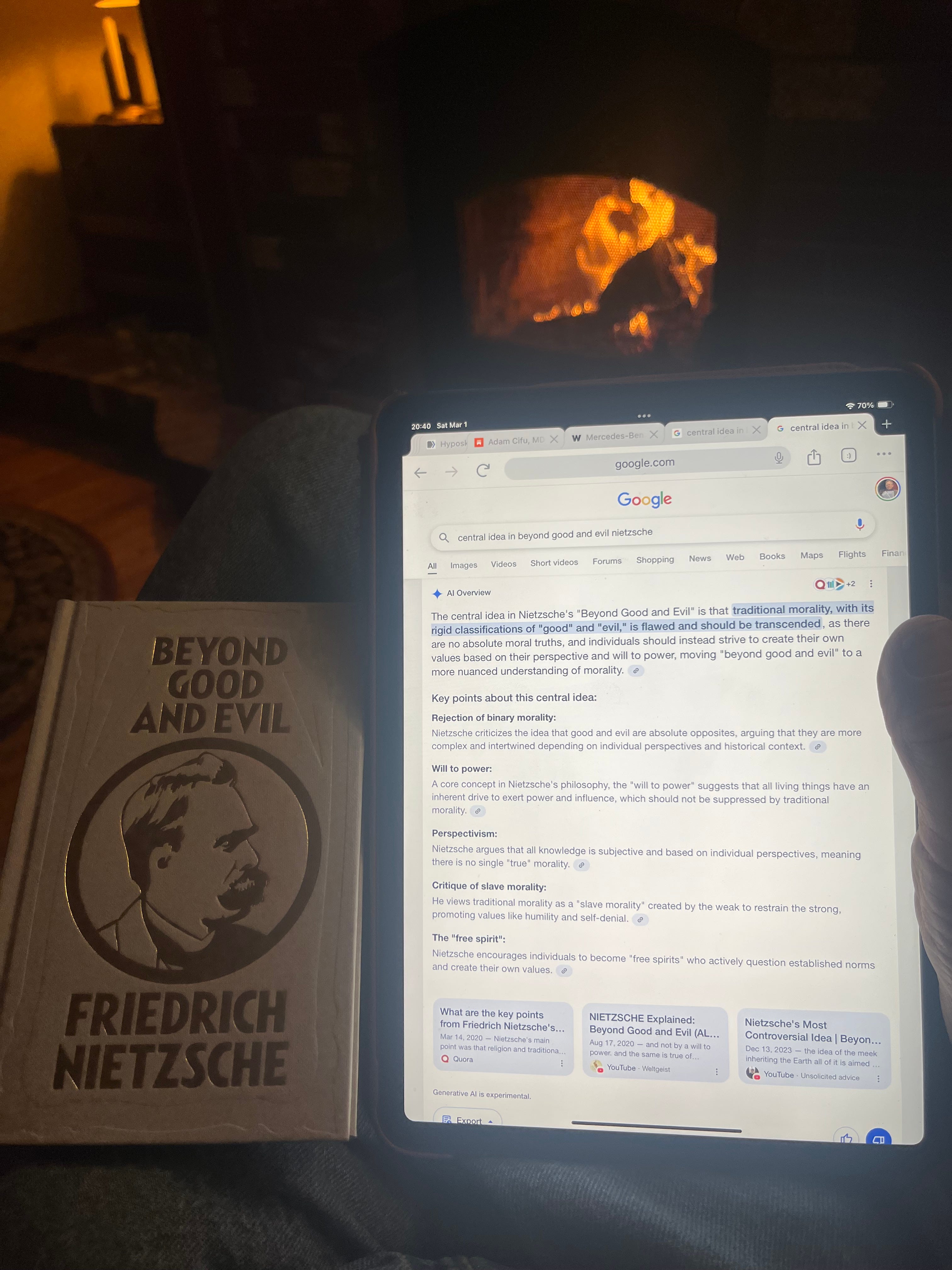
I have been with Blinkist for many months now and really enjoy listening to their book summaries when I’m resting or driving. Sometimes, after listening to a summary there, I will buy the book on audible or in print. This is what happened after I listened to Nietzsche’s Beyond Good and Evil. I just opened the package that came last week. It’s a small, hard cover volume that looks old, even though it is brand new.
Here’s Google’s AI summary (I just realized it is more than a little different every time I come back to it…) of the central ideas in Nietzsche’s Beyond Good and Evil. I have to say it sounds a lot like some of what is going on today with the widening gaps in resources and influence between the elite and the masses, whose opposite moralities he calls “master morality” and “slave morality”.
I really do think our culture has moved exactly where Nietzsche predicted and wanted it to go.
“The central idea in Nietzsche’s “Beyond Good and Evil” is that traditional morality, with its rigid classifications of “good” and “evil,” is flawed and should be rejected, as there are no universal truths and individuals should instead strive to create their own values based on their unique perspective and will to power, essentially going “beyond good and evil.”.
Key points about this central idea:
Critique of established morality:
Nietzsche criticizes philosophers for blindly accepting traditional moral systems, arguing that they are often based on the perspective of the weak and resentful, rather than the strong and creative.
Will to Power:
A core concept where individuals are driven by an inherent desire to dominate and express their own power, which can be seen as a force beyond conventional morality.
Perspectivism:
Nietzsche argues that all truths are subjective and depend on the individual’s perspective, meaning there is no single “correct” morality.
The “Noble Soul”:
Nietzsche envisions a higher type of person who embraces their own will to power and creates their own values, rising above the herd mentality.”











 A Country Doctor Writes:

Jesus inverted morality from how it was understood before him. What makes a great leader is how he serves. Every person should be treated with respect because everyone is of great worth in God’s eyes. Other gods required people to sacrifice to them, but Jesus is the God that sacrificed himself for his people.
Nietzsche’s morality is essentially just the old pre-Christian morality. I agree that we are living in a profoundly Nietzschean moment of world history, which is why I don’t think this will end well.